

If you think video calls are just “a pandemic thing,” the numbers will embarrass you. Video conferencing did not fade out. It got bigger, smarter, and stitched itself into how work actually happens.
Teams now make decisions on camera, close deals on camera, hire on camera, and sometimes even argue politely on camera. Meanwhile, the industry behind it is growing fast, and people are building their careers around being good on screen.
Here’s an article I compiled with the most surprising video conferencing stats that show where it is headed and what it is quietly changing. Check them out, and you may never look at a meeting invite the same way again.
Video Conferencing Stats: Market Growth
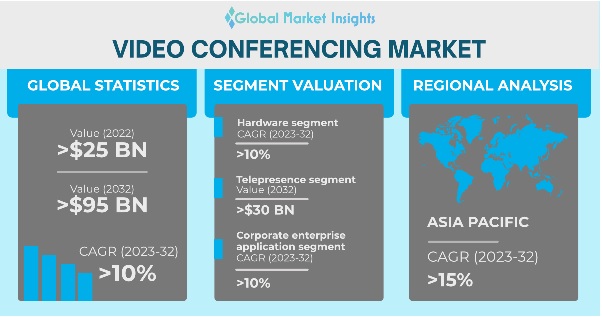
- The global video conferencing market is projected to grow from USD 37.29 billion in 2025 to USD 60.17 billion by 2032 at a 7.1% CAGR (Fortune Business Insights).
- The global Unified Communications as a Service (UCaaS) market is projected to grow from USD 66.42 billion in 2025 to USD 215.53 billion by 2032, at an 18.15% CAGR (Fortune Business Insights).
- Between 2024 and 2029, the industry is anticipated to add about $8.84 billion in value, driven by continued demand for virtual collaboration (ResearchAndMarkets).
- North America accounts for around 38% to 40% of global video conferencing revenue as of 2024, the largest regional share (Grand View Research).
- The Asia-Pacific region is the fastest-growing, with a projected annual growth rate of about 9% through 2028, thanks to increasing adoption in businesses and education (Grand View Research).
- Zoom currently holds approximately 55% of the video conferencing software market share, making it the leading platform globally (Statista).
- Microsoft Teams reached about 145 million daily active users by 2021, reflecting its widespread adoption for workplace meetings (Microsoft).
Why These Stats Matter:
These numbers show video conferencing is no longer a “tool” you add on. It is a major category with real budget weight, steady growth, and intense competition. If your team treats video as an afterthought, you will fall behind on meeting quality, security, integrations, and customer-facing execution.
Video Conferencing Stats: Remote & Hybrid Work
- Nearly 66% of U.S. internet users have participated in online video calls as of late 2023 (Statista).
- As of March 2025, roughly 22.8% of U.S. employees (about 36 million people) worked remotely at least part-time (U.S. Bureau of Labor Statistics).
- An overwhelming 81% of workers globally prefer to work in a hybrid or remote format over being full-time in the office (Owl Labs).
- About 16% of companies worldwide are now operating with a fully remote workforce (no physical office) (Owl Labs).
- Approximately 74% of U.S. employers offer hybrid work arrangements to their staff on a permanent basis (The Conference Board).
- 90% of remote employees report being as productive or more productive working from home as they were in the office (Owl Labs).
- 33% of employees say they would quit their job if they could no longer work remotely, highlighting how crucial video-enabled flexibility is (Owl Labs).
- 57% of workers would prefer to work from home full-time, given the option, rather than be in the office every day (Owl Labs).
- Around 31% of job seekers in 2025 are exclusively seeking remote jobs, showing the lasting appeal of remote work (Cultivated Culture).
- The prevalence of remote job listings has roughly tripled since 2020. By early 2025, fully remote roles made up over 15% of all U.S. job postings (Robert Half).
- In mid-2025, about 24% of new U.S. job postings were for hybrid positions, and 12% were for fully remote roles (Robert Half).
- The share of fully on-site jobs has dropped. In 2023, about 83% of postings were office-only, but by 2025, that fell to around 66% as companies embraced flexibility (Robert Half).
Why These Stats Matter:
Remote and hybrid work are now baked into what employees expect and what employers offer. That means video calls are not occasional. They are the connective tissue holding teams together. If your video workflows are messy, your culture, productivity, hiring, and retention will take the hit first.
Video Conferencing Stats: Adoption and Usage
- As of 2023, 37.82% of U.S. employees used video conferencing once or twice a week, and 12% used it more than five times a week, showing how routine video meetings have become in the workplace. (Zoom)
- 58% of businesses use video conferencing in their day-to-day operations as a routine part of how they communicate (Finances Online).
- IDC reports that in 2023, the top vendors in the worldwide web conferencing applications market were Microsoft (32.2%) and Zoom (32.0%), highlighting how deeply enterprise-grade web conferencing is embedded in workplace operations. (IDC).
- 83% of large enterprises say they are likely to invest in new or upgraded video collaboration software, versus only 27% of small businesses, a sign that big firms are leading the charge (99firms).
- U.S. businesses now host over 11 million video conference meetings each day on average (Verizon).
- The use of video conferencing is 87% higher today than it was just two years ago, reflecting the massive uptick in adoption since 2020 (No Jitter).
- IDC reports that the top 5 vendors account for 81% of the worldwide web conferencing market revenue, showing that video-first meeting platforms have become a dominant part of business communication infrastructure. (IDC)
- Roughly 50% of all employees worldwide are expected to be using video conferencing by the end of this decade as remote and hybrid work become the norm (Market.biz).
- Zoom’s 2025 video conferencing statistics roundup notes that video meetings have become a default collaboration layer as organizations formalize hybrid work and scale distributed operations. (Zoom)
Why These Stats Matter:
Adoption stats matter because they show video is now a default channel, not a special workaround. Teams are making decisions, running projects, and handling customer conversations on camera every day. That raises the bar for reliability, meeting hygiene, and platform choice, especially for fast-growing companies.
Video Conferencing Stats: Benefits of Video Meetings
- 94% of businesses say that using video conferencing has increased productivity for their teams (Yahoo Finance).
- 98% of workers agree that video calls facilitate better communication and collaboration, improving relationships inside and outside the company (Nasstar).
- 90% of companies find it easier to get their point across clearly through video conferencing compared to phone or email (Nasstar).
- 89% report that video meetings reduce the time required to complete projects or tasks by streamlining decision-making (Nasstar).
- 89% of video conferencing users feel more connected with their colleagues and clients, as face-to-face interaction (even virtual) builds rapport (Nasstar).
- 87% of employees who are not in the same room say they feel more engaged with colleagues during video meetings versus audio-only calls (Nasstar).
- 82% of people are less likely to multitask during a video meeting compared to an audio call, since seeing each other on screen keeps participants more focused (Nasstar).
- 76% of individuals use video conferencing as a key tool to work remotely, enabling them to collaborate from home or outside the office (Nasstar).
- Among those working remotely, 75% say that video meetings have improved their productivity and work-life balance by reducing commuting and time wastage (Nasstar).
- Adding a video component to meetings can boost productivity by up to 50% according to research, as visual interaction keeps teams more engaged and on-task (Wainhouse Research (Logitech PDF)).
- McKinsey reports that many travel managers were surprised by how well virtual collaboration works, and that a meaningful portion of internal business travel is expected to be replaced permanently by video meetings. (McKinsey)
- 56% of CFOs plan to invest more in video conferencing to reduce unnecessary business travel, seeing virtual meetings as a cost-saving measure (99firms).
- Utilizing video meetings can save organizations about $11,000 per employee per year in increased productivity and reduced travel and office costs (Global Workplace Analytics).
- 79% of employees say having a clear agenda leads to more productive meetings, which applies to virtual meetings too, where a focused agenda yields better outcomes (MyHours).
- About one in three Americans (33%) uses live video chat to communicate with businesses for customer service or inquiries (99firms).
Why These Stats Matter:
The benefits data explain why the video is stuck. It saves time, improves clarity, and reduces travel without killing momentum. When video meetings are run well, they speed up decisions and reduce back-and-forth. The real takeaway is not “use video more.” It is “use video smarter and with intention.”
Video Conferencing Stats: Meeting Culture & Behavior
- The average virtual meeting lasts between 30 and 60 minutes, similar to the length of typical in-person meetings (Nasstar).
- 73% of virtual meetings involve just 2 to 4 people, indicating that most online meetings are kept small and focused (Cornerstone Dynamics).
- In the U.S., about 42% of all meetings are now conducted via video conferencing (fully online), with the rest being hybrid or in-person meetings (Zoom).
- Nearly 88% of hybrid workers say that every meeting at their company now has at least one remote participant joining via video (Owl Labs).
- 89% of organizations use more than one video conferencing platform (for example, Zoom, Microsoft Teams, Webex), rather than relying on a single solution for all meetings (Nasstar).
- Only 37% of organizations upgraded their video meeting technology (hardware or software) in 2023, despite the huge shift to remote work (Owl Labs).
- Smaller businesses have been slower to upgrade. In 2023, only 28% of companies under 250 employees upgraded their video systems, versus 42% of larger firms (Owl Labs).
- 81% of workers report losing meeting time due to technical difficulties (for example, audio or connectivity issues) during online meetings (Owl Labs).
- 96% of remote team members feel that video conferencing significantly improves connectivity among dispersed colleagues, helping them communicate better (Owl Labs).
- 80% of employees use video calls for one-on-one meetings with colleagues, and 78% use video for team meetings (99firms)
- The majority of people (77%) join video meetings from a desktop or laptop, versus 31% from a smartphone and 13% from a tablet, underscoring the importance of good PC setups (99firms).
- Over half (52%) of fully remote managers spend 3 or more hours per day in virtual meetings, highlighting how many video calls fill a remote leader’s schedule (Zoom).
- Demand for video meeting tools spiked. There was a 500% increase in buyer activity for video conferencing software during 2020’s shift to remote work (TrustRadius).
- In April 2020, Cisco’s Webex platform saw 25 billion meeting minutes logged in that single month, an all-time high for the service (Cisco).
- Zoom’s daily meeting participants exploded from about 10 million in December 2019 to over 300 million in April 2020 amid the pandemic-driven surge in usage (Zoom).
- Poorly organized meetings (virtual or in-person) cost U.S. companies an estimated $399 billion in lost productivity annually (and about £58 billion in the UK) (Inc.).
Why These Stats Matter:
Meeting behavior stats reveal a hard truth: video does not automatically make communication better. Technical issues, multitasking, and poor structure still waste time. These numbers push you to fix the basics, such as agendas, smaller groups, clearer roles, and better equipment, before adding more meetings.
Video Conferencing Stats: Webinars and Virtual Events
- Over half (54%) of B2B professionals attend webinars at least weekly, using them to learn and engage with industry content (Cvent).
- American companies increased the number of webinars they hosted by 36% in just one month at the start of the pandemic (February to March 2020) (RingCentral).
- 67% of marketers said they increased their investment in webinars during early 2020 as webinars became a key lead-generation and engagement tool (RingCentral).
- An estimated 78% of webinar hosts use a dedicated webinar platform (as opposed to general video meeting software) when conducting large webinars (Cvent)
Why These Stats Matter:
Webinar stats show virtual events are not a pandemic leftover. They became a steady, repeatable way to educate buyers, generate leads, and build authority at scale. If your webinars feel improvised, you lose trust fast. Strong webinar performance now depends on structure, automation, and audience engagement.
Before we move forward, here is a quick video playlist on automated webinars and how to get it right:
Video Conferencing Stats: Education and E-Learning
- 87% of educators plan to invest in online collaboration and video tools over the next five years, seeing virtual learning as a long-term strategy (Zoom).
- 88% of educators believe video conferencing allows more students to complete advanced degrees by providing greater access and flexibility (Zoom).
- 73% of educators say that video meetings can help reduce student dropout rates by keeping students engaged, regardless of location (Zoom).
- In spring 2020, 77% of public schools and 73% of private schools in the U.S. moved classes online (at least partially) to enable remote learning during COVID-19 closures (National Center for Education Statistics).
Why These Stats Matter:
Education stats matter because they show that video is not just for work. It is expanding access, improving continuity, and keeping learners engaged. Schools and training teams are investing long-term, which means expectations are rising. Better delivery, interaction, and reliability are now part of learning quality.
Video Conferencing Stats: Healthcare and Telemedicine
- The share of physician practices offering telehealth jumped from 25.1% in 2018 to 79.0% in 2020, and still remained at 71.4% in 2024 (American Medical Association).
- Telehealth utilization surged to roughly 38 times pre-pandemic levels by early 2021 as patients and doctors turned to video visits (McKinsey).
- Even after reopening, telehealth has stayed far more common than before. By late 2023, around 13% of all healthcare visits were being conducted via telemedicine (versus under 1% before 2020) (American Medical Association).
- The global telemedicine market (remote video consultations, etc.) is projected to reach $194.1 billion by 2032, underscoring the huge growth in video-based healthcare (Industry Today).
Why These Stats Matter:
Telemedicine numbers prove that video conferencing is shaping real-world outcomes, not just workplace convenience. Patients and providers kept using video visits even after in-person care returned. That tells you video is now a serious service channel. Quality, security, and trust are non-negotiable in this space.
Video Conferencing Stats: Future Outlook
- 90% of employers say they will keep hybrid-work policies permanently, allowing employees to continue splitting time between home and office beyond 2025 (Norwest).
- The total video conferencing market (including hardware like cameras) can approach $7 billion by 2028 as upgrades and replacements drive new investments (Futuresource Consulting)
- Major providers are integrating AI capabilities into video platforms. For example, Zoom’s AI Companion can automatically summarize meetings and highlight action items for participants (Zoom).
- 43% of business travelers now prefer to travel less for work, given that video conferencing effectively replaced many trips (Global Business Travel Association).
- An estimated 93% of communication impact is nonverbal (tone of voice, body language). Video meetings preserve these cues far better than phone calls, which helps reduce misunderstandings in remote work (Psychology Today).
- Ongoing rollout of 5G networks and high-speed fiber is making high-quality video calls more reliable, since ultra-fast connections reduce lag and improve video clarity for remote users (McKinsey).
- In 2025, 52% of companies plan to expand desktop HD video conferencing, 42% plan to upgrade in-room video systems, and 23% are exploring immersive telepresence solutions for more life-like virtual meetings (LinkedIn).
- Leading platforms now support virtual events with tens of thousands of attendees, blurring the line between a meeting and a large conference (WebinarNinja).
- Security has become paramount: features like end-to-end encryption and real-time fraud detection are now standard on major video conferencing services to protect meetings (Ring Central).
- Grand View Research reports that the video conferencing market is expanding largely due to the rapid shift toward cloud-based solutions, driven by scalability, lower costs, and easier integration with enterprise tools. (Grand View Research).
- IDC reports that the worldwide web conferencing applications market is concentrated among major enterprise vendors, with Microsoft and Zoom alone accounting for roughly 64% of revenue, which reflects the scale of enterprise investment in web conferencing software. (IDC).
- Zoom’s 2025 stats roundup reports that video conferencing adoption continues across organizations of all sizes as hybrid work becomes normalized and workflows increasingly depend on video-based collaboration. (Zoom).
- Fortune Business Insights includes government, healthcare, and education among the major industries driving demand for video conferencing solutions, reflecting sustained public-sector adoption. (Fortune Business Insights).
- In 2024, 71.4% of physicians reported using telehealth weekly, up from 25.1% in 2018 and slightly below 79% in 2020, showing telemedicine’s lasting reliance on video-based care. (American Medical Association).
- Gallup reports that hybrid work remains widespread and stable, which continues to increase dependence on digital communication to coordinate across distributed schedules and work locations. (Gallup)
- Zoom’s 2025 video conferencing roundup notes tell that people widely use video meetings for customer communication, sales conversations, and virtual events, reflecting video’s role in revenue-facing work. (Zoom).
- 73% of hybrid employees enjoy the flexibility of their schedules and would not trade their ability to work remotely for a fully fixed office schedule (Owl Labs).
- 98% of workers want to work remotely for the rest of their careers, indicating that a significant portion of the workforce never wants to return to full-time office work (Forbes).
- 76% of American workers say they’d look for a new job if forced to work fully in person, highlighting how rare the preference for everyday office attendance has become (CNBC).
- 39% of hybrid workers admit to coffee badging, going into the office briefly just to be seen, then leaving to finish work remotely (Owl Labs).
- Zoom reported that total revenue grew 78% year over year in Q4 of fiscal year 2020, reflecting the demand surge that accelerated global reliance on video meetings. (Zoom).
- About 55% of meetings in the U.S. last between 30 minutes to 1 hour, whereas 67% of meetings in Europe last over an hour, suggesting Europeans endure longer meetings on average (My Hours).
- Around 73% of meeting participants admit to multitasking (sending emails or messages) during meetings, highlighting the challenge of keeping everyone’s attention in both virtual and in-person meetings (Archie).
Why These Stats Matter:
Future-facing stats show where the next leap is happening: AI assistance, cloud-first stacks, and meeting tools that integrate with real workflows. Video platforms are becoming operating systems for collaboration, not just virtual rooms. If you choose tools without thinking ahead, you will be forced to switch later.
What These Video Conferencing Statistics Tell Us
Video conferencing has moved from a convenience to a core infrastructure. The numbers point to stable growth, deep adoption across industries, and a lasting shift in how people communicate and make decisions. But the biggest change is this: video is no longer just about “seeing faces.”
It is a productivity engine that can either sharpen execution or quietly waste time, depending on how it is managed. That is why purpose-built webinar tools matter in this landscape. If you want webinars that run like a system, not a scramble, a platform like WebinarNinja stands out. It brings together registration pages, automated reminders, replays, integrations, and audience engagement features so your webinars feel organized, professional, and easy to scale.
Want to host a webinar for free?
Use WebinarNinja to teach, improve marketing, and grow your sales.