

If you’re searching for WebinarGeek alternatives, you’re probably in one of these situations: you need more marketing automation, a smoother attendee experience at scale, better production controls, or a pricing model that fits how you actually run webinars.
I’ve been there. After a few “why is this workflow so fiddly?” weeks and one memorable live session where I learned the hard way that the platform’s defaults were not my defaults, I started keeping a shortlist of tools that are genuinely better for specific jobs.
Here’s a list of the best WebinarGeek competitors and, more importantly, the exact scenarios where each tool tends to shine, so you can pick fast and move on to planning your next webinar instead of debating software.
Check out a sneak peek of these tools in the table below:
| Tool name | Best use case | Pricing |
|---|---|---|
| WebinarNinja | Best Webinar Software to Generate Leads, Grow Sales, and Teach Better | A FREE 14-day trial is available. Paid starts at $0.30/attendee/month. |
| GoTo Webinar | Best for Enterprise Internal Webinars | Starts at $228/user/year. Billed annually. |
| WebinarJam | Best for Sales Event Webinars | Starts at $39/user/month. Billed annually. |
| Webex Webinars | Best for Large-Scale Corporate Webcasts | Starts at $675/user/year. |
| BigMarker | Best for Full-Funnel Webinar Program Operations | Custom price. |
| ON24 | Best for Enterprise Demand Gen Analytics | Custom price. |
| Zoom Webinars | Best for Fast Setup for Familiar Audiences | Starts at $66.67/user/month for up to 300 attendees. Billed annually. |
| Crowdcast | Best for Community-Driven Interactive Live Shows | Starts at $34/user/month. Billed annually. |
| Zoho Webinar | Best for Budget-Friendly Training for Teams | Starts at 8/organizer/month, billed annually. |
| ClickMeeting | Best for Automated Webinars Plus Lead Generation | Custom price. |
10 Best WebinarGeek Alternatives & Competitors
To build this list, I focused on tools with a real track record in live webinars, automated or simulive delivery, audience engagement, integrations, analytics, and scalability. I checked each platform’s official product and pricing pages and used official help docs where needed, especially for features that often get misrepresented (like simulive, capacity rules, or monetization).
I also used WebinarGeek’s official feature set as the baseline, including its support for automated, hybrid, on-demand, and paid webinars, plus its plan-based constraints like maximum session duration and add-ons.
1. WebinarNinja
Best Webinar Software to Generate Leads, Grow Sales, and Teach Better
When I used WebinarNinja, I kept noticing how much “pre-work” it removed. Instead of duct-taping landing pages, reminder emails, and post-webinar follow-ups across three tools, I could keep the whole flow in one place and focus on the strategic parts of hosting a webinar instead. The first time I ran a training-style webinar with a timed offer at the end, the built-in email notifications and analytics let me focus on content, not logistics.
Where it outperforms WebinarGeek specifically is in giving you unlimited registrants and co-presenters on all paid plans with no capacity-based add-ons, and a complete lead generation workflow out of the box.
Automated and evergreen sessions run 24/7, CRM sync with HubSpot, Mailchimp, ConvertKit, and Zapier is native, and analytics track the full journey from registration to post-webinar conversion.
I remember finishing a session, closing my laptop, and thinking, “Wait, that’s it?” because the usual scramble to patch webinar follow-ups and export lists simply did not happen. If you’re the kind of host who wants fewer tabs open while you’re live, this is the vibe. It stays formal enough for business webinars, but it still feels approachable and fast to operate when you’re juggling slides, questions, and timing.
Why WebinarNinja Is One of the Best Alternatives to WebinarGeek
- More built-in marketing flow, fewer add-ons. WebinarNinja emphasizes an all-in-one setup with webinar delivery plus automated emails and analytics in the same platform. WebinarGeek also supports webinar emails and marketing workflows, but its pricing model includes add-ons for certain capabilities, which can make “simple” setups more modular than some teams want.
- A clearer “run webinars repeatedly” operating model. WebinarNinja’s feature packaging is designed around running webinars continuously, including automated and hybrid formats. WebinarGeek is strong in multiple webinar types too (automated, hybrid, on-demand, paid), but operational complexity can rise when you start layering plan limits and add-ons.
- Support positioning that’s very hands-on. WebinarNinja highlights onboarding and support access with success-oriented language. WebinarGeek offers support and help resources, but WebinarNinja leans harder into “guided success” positioning for ongoing webinar programs.
- Good fit for coaching, training, and “teach then convert” webinars. WebinarNinja’s product positioning is strongly aligned to teaching, marketing, and selling with webinars. WebinarGeek can handle these formats, but many teams pick WebinarNinja specifically to unify teaching and selling workflows under one roof.
- Simple mental model when scaling from live to hybrid. WebinarNinja places live, automated, and hybrid webinars together in its core packaging. WebinarGeek supports these, too, but its plan matrix includes hard limits such as maximum duration by tier, which can add friction when you are scaling formats.
Pricing: A FREE 14-day trial is available. Paid starts at $0.30/attendee/month (includes CourseNinja worth $1200).
2. GoTo Webinar
Best for Enterprise Internal Webinars
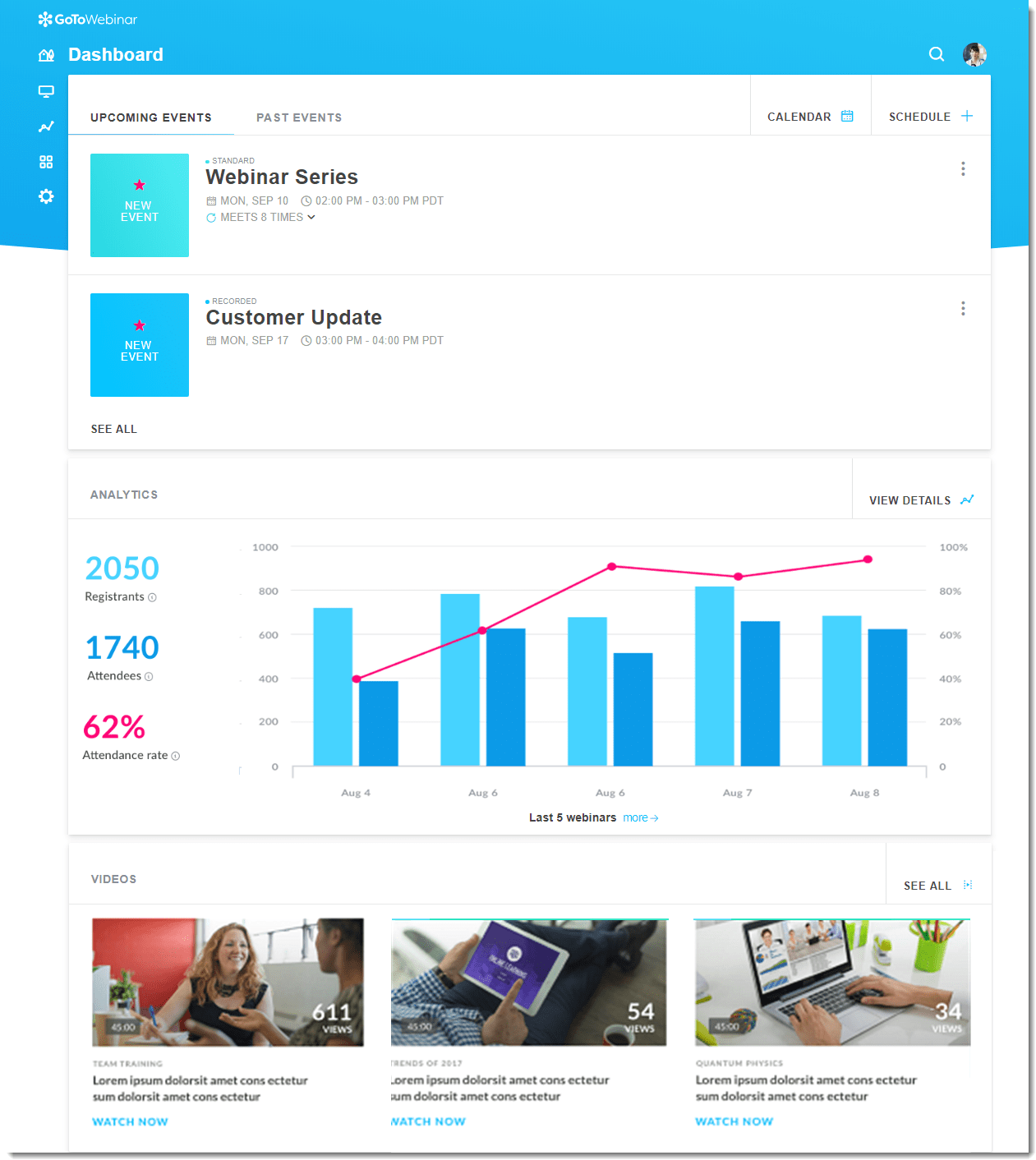
GoTo Webinar is the tool I associate with “we cannot afford surprises.” If you’ve ever hosted a big internal webinar where leadership is present, or a customer-facing update that has to run like a train schedule, you know what I mean. In teams I’ve worked with, GoTo Webinar often gets picked because it’s operationally steady and has a deep ecosystem of webinar operations features like registration tooling, reporting, and payment collection support.
What I like about it in practice is the feeling that it was designed for consistency. When the organizer changes, or a colleague needs to jump in as a co-host at the last minute, you’re not reinventing the process.
I’ve watched operations teams use it to standardize the same “webinar template” across departments, which sounds boring until you’ve lived through the alternative: ten teams doing ten different things and nobody remembering which settings reduce chaos.
It is not trying to be flashy, and that is precisely why it shows up in serious internal communications stacks.
Why GoTo Webinar Is One of the Best Alternatives to WebinarGeek
- Strong operational features for registration and tracking. GoTo Webinar provides source tracking for registration URLs, which helps measure which invite channels drive signups. WebinarGeek has robust registration and reporting, but GoTo’s operational tooling around source tracking is particularly direct for multi-channel promotion workflows.
- Payment collection is designed into webinar workflows. GoTo Webinar supports accepting payments and references Stripe integration in its documentation. WebinarGeek supports paid webinars too, but GoTo’s payment capability is commonly used in more standardized ticketing scenarios.
- Clear capacity packaging for mid-to-large webinars. GoTo’s pricing page presents plans built around webinar capacity, which maps cleanly to internal approval processes. WebinarGeek’s plan matrix also uses viewer tiers, but GoTo’s packaging tends to be easier to justify in IT-led or procurement-heavy environments.
- Mobile app emphasis for hosts and teams. GoTo Webinar highlights mobile app availability in its plan grid. WebinarGeek supports mobile hosting too, but GoTo’s broader conferencing ecosystem can make mobile workflows more familiar to corporate users already using GoTo tools.
- Webinar program governance. GoTo Webinar plans reference multiple organizers at higher tiers. WebinarGeek supports collaboration too, but governance needs can involve add-ons depending on plan setup.
Pricing: Starts at $228/user/year. Billed annually.
3. WebinarJam
Best for Sales Event Webinars
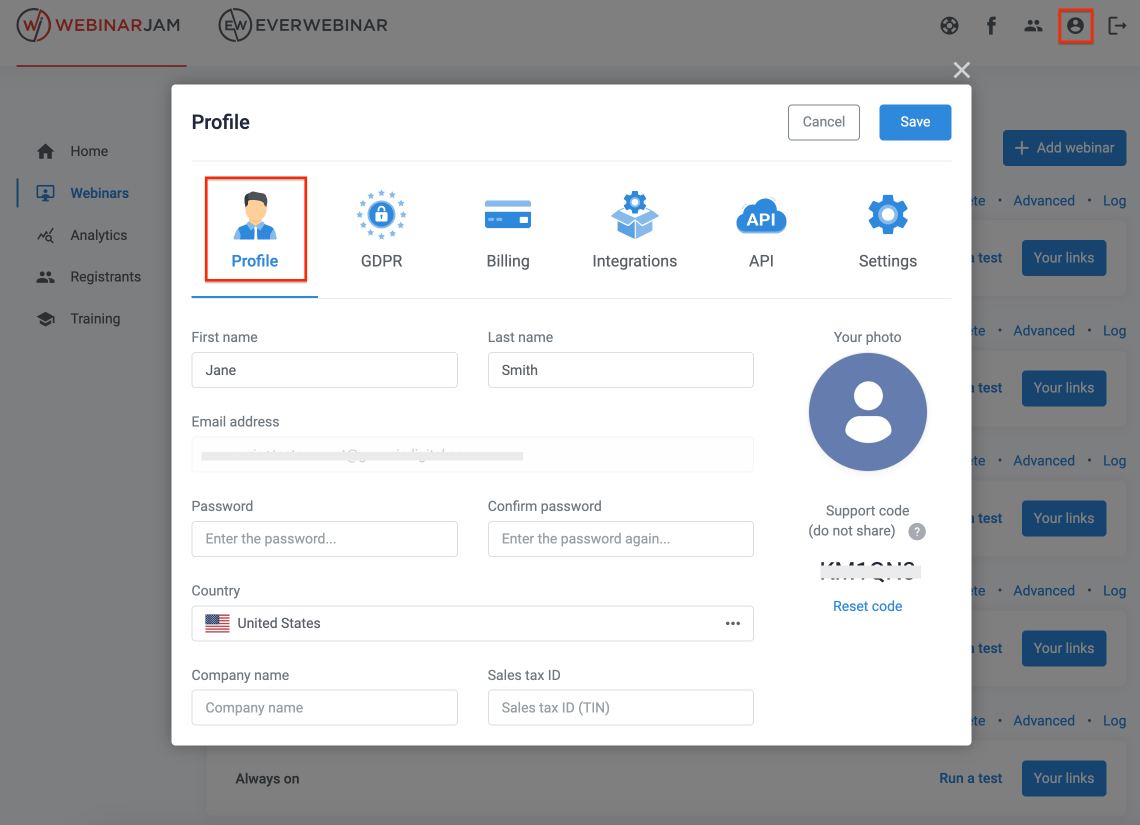
A close friend of mine has used WebinarJam for years for launch-style webinars, and the way they describe it is hilarious and accurate: “It’s built for the part where you ask people to do something.” Their most specific story was a high-stakes demo webinar where they needed Q&A flowing, a strong live chat experience, and a smooth handoff to follow-up sequences.
What stood out in their experience was how the platform supports the “momentum” of a sales event. When you’re moving from education to pitch to objections, the hosting experience has to keep up. They told me about one incident where the first five minutes were bumpy because the team was late joining as presenters, and it still recovered quickly because the live flow was designed to handle real-world timing issues.
One important nuance: WebinarJam is primarily the live webinar product, and for evergreen automation, they point users to EverWebinar. If you want “live first” with sales mechanics, it’s a contender. If you want evergreen webinars fully inside one product, factor that into your decision.
Why WebinarJam Is One of the Best Alternatives to WebinarGeek
- Clear live webinar sales positioning. WebinarJam strongly positions itself for live sales webinars and conversion-focused use cases. WebinarGeek supports paid webinars and marketing workflows, but WebinarJam’s framing is especially sales-webinar-forward.
- The integrations list is very explicit. WebinarJam’s pricing page includes a detailed integrations list and mentions Zapier coverage. WebinarGeek supports native integrations and Zapier too, but WebinarJam’s “here are the tools” disclosure is unusually direct for teams that want certainty fast.
- Presenter and role mechanics for sales events. WebinarJam describes granting presenter rights and managing live participation roles, which is useful for sales demos, co-hosted launches, and moderated Q&A. WebinarGeek supports multiple presenters and interactive sessions, but WebinarJam’s live role handling is often used in launch-style events.
- Hybrid and simulive expectations are clearer. WebinarJam explains hybrid webinars as playing prerecorded video during live sessions, and it clearly separates evergreen automation as a separate product. WebinarGeek supports hybrid and automated webinars inside one platform, which can be simpler if you prefer one product for both.
- Trial and refund policies are spelled out. WebinarJam’s pricing page details trial and refund policies clearly. WebinarGeek offers a free trial as well, but WebinarJam tends to make policy expectations more prominent for new buyers.
Pricing: Starts at $39/user/month. Billed annually.
4. Webex Webinars
Best for Large-Scale Corporate Webcasts
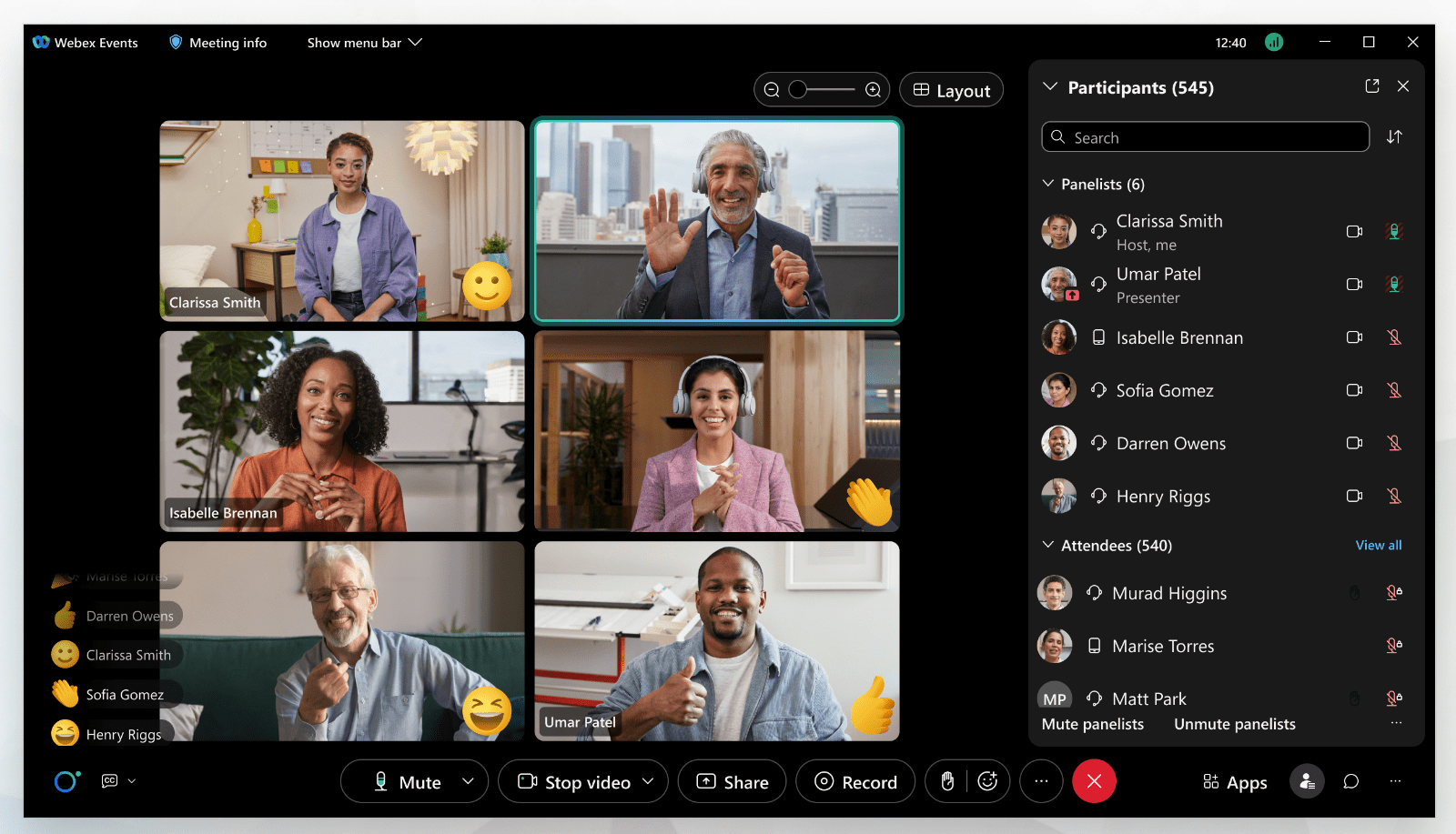
Webex Webinars is what I reach for when the room is large, the audience needs structure, and the organization cares deeply about security and enterprise polish. The Webex ecosystem is designed to stretch from interactive webinars into broader event formats, and it is explicit about the difference between single-session webinars and multi-session events.
In practice, I’ve seen Webex shine in environments where the webinar is not just a marketing moment, but a corporate-grade broadcast. Think all-hands meetings, regulated training sessions, global partner updates, and product announcements that must run cleanly. It is the kind of platform where the words “accessibility,” “controls,” and “administration” show up early in conversations, not as afterthoughts.
The experience tends to feel structured, like it expects you to plan, rehearse, and execute, and that is a good thing when the stakes are high. If your team values predictable governance and enterprise-ready delivery more than playful simplicity, Webex is worth a serious look.
Why Webex Webinars Is One of the Best Alternatives to WebinarGeek
- Higher scale ceiling for very large audiences. Webex markets webinar capacity at very high attendee levels. WebinarGeek’s standard plan matrix tops out at lower published viewer tiers, which can matter if you are truly broadcasting at enterprise scale.
- Clear separation between webinar and event products. Webex draws a line between webinars (single-session) and events (multi-session, hybrid, in-person), which helps when you are scaling from webinars into conferences. WebinarGeek handles multiple webinar types well, but Webex’s product separation can reduce internal confusion about which format to buy.
- Translation and caption positioning are stronger. Webex highlights translation and caption support as first-class capabilities. WebinarGeek supports localization and related options, but Webex tends to win when accessibility and global language support are core requirements.
- CRM integration emphasis in the enterprise context. Webex explicitly positions CRM integrations in its webinar ecosystem. WebinarGeek supports CRM integrations too, but it lists some CRM connectors as add-ons depending on plan, which can change your true cost of ownership.
- Enterprise ecosystem advantage for IT-led organizations. Webex is commonly adopted as part of a broader collaboration suite, simplifying procurement and governance. WebinarGeek is lighter and often faster for marketing-led teams, but Webex can win in IT-led environments.
Pricing: Starts at $675/user/year.
5. BigMarker
Best for Full-Funnel Webinar Program Operations
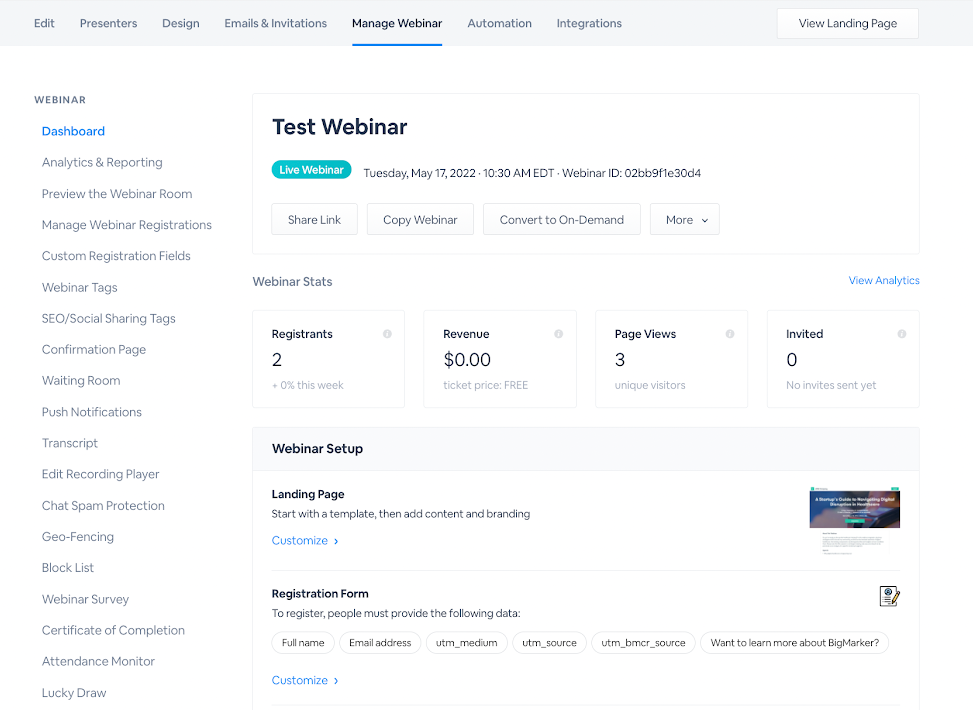
A marketer friend of mine runs a webinar program that feels like a small media company: monthly thought leadership, quarterly virtual events, lead scoring, and post-event content repurposing. BigMarker became their webinar operating system because it leans hard into audience experience, data capture, and program-level controls.
What they loved most was the sense of scale without chaos. They could run recurring series, spin up event hubs, and keep registration and reporting standardized across multiple teams, without turning every event into a custom project. There was one week where they had back-to-back sessions for different audiences and still managed clean handoffs between presenters because the workflow felt more studio-like than “one-off meeting link.”
The platform’s orientation makes it feel like it expects you to have a content calendar, a pipeline goal, and a team behind the scenes, even if the team is just two people wearing five hats each.
Why BigMarker Is One of the Best Alternatives to WebinarGeek
- Higher ceiling for large audiences and program growth. BigMarker positions itself for large-scale webinars and virtual events. WebinarGeek supports scaling too, but its standard plan tiers and add-ons can be less aligned to multi-team, program-level growth.
- Production tooling feels more studio-like. BigMarker emphasizes production and studio capabilities. WebinarGeek supports RTMP streaming as an add-on, which may be enough for many teams, but BigMarker is designed more like a broadcast workflow for organizations running frequent, high-production webinars.
- Integration and automation positioning is stronger at the program level. BigMarker puts CRM and marketing automation integration messaging front and center. WebinarGeek supports integrations and Zapier too, but certain CRM connections can be treated as add-ons, which can complicate budgeting for growth teams.
- Depth for series and multi-format webinar calendars. BigMarker highlights simulive, evergreen, and webinar series support in its platform language. WebinarGeek supports automated, hybrid, on-demand, and paid webinars, but BigMarker tends to feel more purpose-built for managing a full calendar of formats.
- Enterprise service structure is more explicit. BigMarker’s enterprise language is designed for procurement, service expectations, and complex implementations. WebinarGeek has enterprise options, but BigMarker’s enterprise orientation can be clearer when legal, security, and scale requirements are strict.
Pricing: Custom price.
6. ON24
Best for Enterprise Demand Gen Analytics
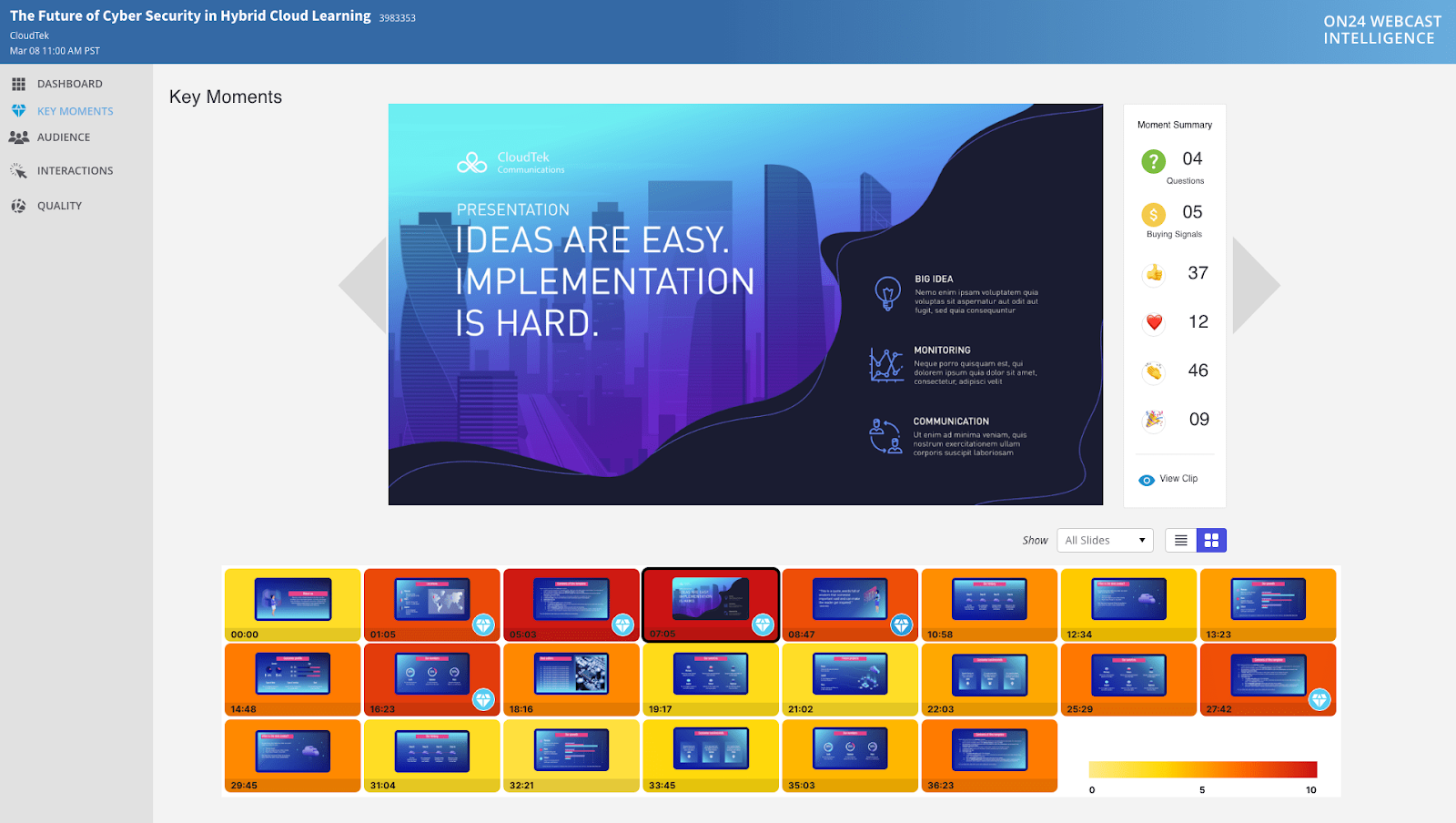
ON24 is the platform you pick when webinars are not just events, but a measurable pipeline engine. It is known for treating engagement as first-party data, and the product language emphasizes analytics, insights, personalization, and content repurposing at scale.
Where it tends to shine is in the questions your team asks after the webinar ends. Not “How many attended?” but “Who engaged, where did they engage, and what does that imply?” If you’re running webinars as a serious demand generation channel, those questions stop being nice-to-haves and start being your weekly dashboard. I’ve seen teams use ON24 as a central part of their content-to-pipeline process, especially when they are trying to connect engagement behavior to follow-up routes.
It is also the kind of tool that rewards thoughtful planning. If you build strong CTAs, segment experiences, and align your follow-up, the analytics story gets sharper. WebinarGeek offers solid reporting and webinar types, but ON24 tends to be selected when the analytics depth itself is the point.
Why ON24 Is One of the Best Alternatives to WebinarGeek
- Analytics and engagement data is a core differentiator. ON24 positions its platform around deep engagement insights and analytics. WebinarGeek provides robust reporting, but ON24 is built for teams that treat webinars as a measurable revenue channel.
- AI-driven content and workflow positioning. ON24 emphasizes AI-related content and workflow benefits as part of its platform messaging. WebinarGeek includes AI analysis in its feature set too, but ON24’s broader content engine approach is often stronger for enterprise teams.
- Platform packaging for scaled programs. ON24 packages its offering at a platform level, which aligns to larger teams and enterprise planning. WebinarGeek’s tiering is clear, but ON24’s packaging is frequently more aligned to cross-team demand gen operations.
- Benchmark-driven optimization mindset. ON24 publishes benchmark reporting that helps teams compare engagement patterns and optimize experiences. WebinarGeek supports strong reporting, but ON24’s ecosystem often puts optimization and benchmarking closer to the center of the workflow.
- Better fit for ABM and lifecycle marketing workflows. ON24’s messaging aligns with segmentation and conversion acceleration. WebinarGeek supports CRM integrations and lead workflows, but ON24 tends to be purpose-built for ABM-style engagement programs at scale.
Pricing: Custom price.
7. Zoom Webinars
Best for Fast Setup for Familiar Audiences
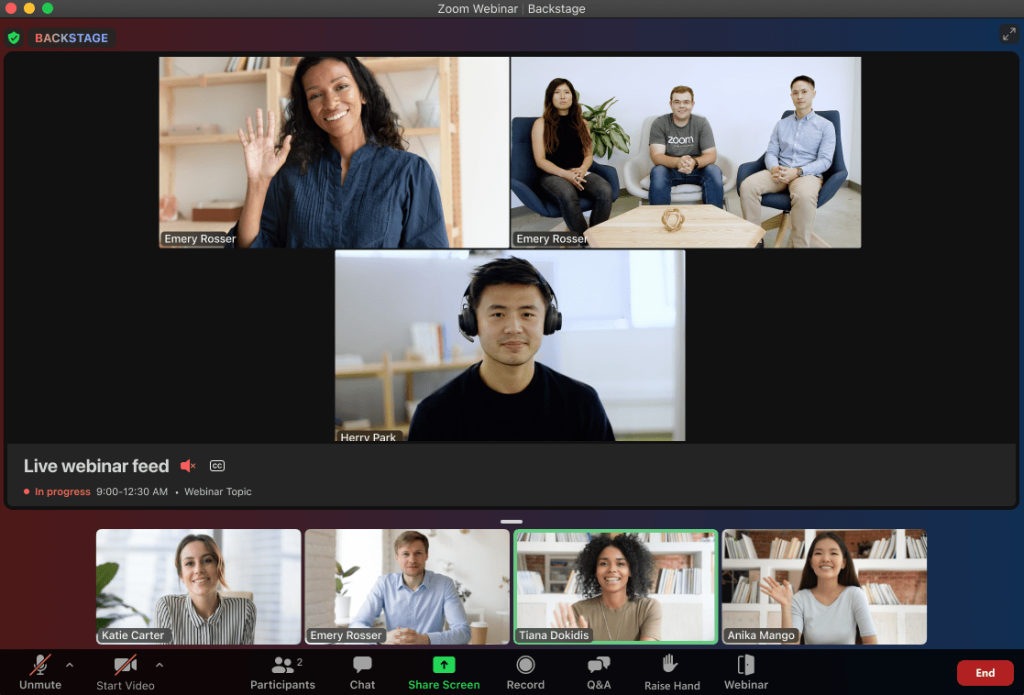
Zoom Webinars is the “everyone already knows how to join” choice, which is not a small advantage. When attendance friction is your enemy, familiarity is a feature. I’ve watched teams obsess over conversion rates and then lose people at the join step because the experience feels unfamiliar. Zoom avoids that problem for a huge portion of audiences.
From a capability standpoint, Zoom Webinars supports large audiences depending on license capacity and has a robust ecosystem of webinar roles, Q&A, chat, reporting, and more. Zoom’s documentation also clarifies capacity models and feature differences, including distinctions between standard webinar licensing and more premium event production capabilities in higher-tier offerings.
If your organization already uses Zoom internally, that familiarity can become a hidden productivity boost for your team as well. The setup tends to feel intuitive, and the expectation-setting is easier because many people already “speak Zoom.” WebinarGeek is strong for webinar-specific marketing formats and automation, but Zoom is often chosen when speed, familiarity, and organizational standardization matter most.
Why Zoom Webinars Is One of the Best Alternatives to WebinarGeek
- Mass adoption lowers attendee friction. Zoom’s market familiarity often reduces drop-off because many audiences already trust the join experience. WebinarGeek is browser-based and smooth, but Zoom’s familiarity can be the deciding factor for certain demographics and internal IT audiences.
- Scales high depending on capacity. Zoom supports large webinar capacities depending on the plan and license configuration. WebinarGeek’s published plan tiers can be lower at the top end, which matters if you need to broadcast on a very large scale.
- Role-based webinar structure is very standardized. Zoom’s host, co-host, panelist, and attendee role model is widely understood and well-documented. WebinarGeek supports moderators and interactive sessions, too, but Zoom’s role model is a common standard in IT-managed organizations.
- Premium production features exist when you need them. Zoom offers higher-tier options that include more advanced production and event tooling. WebinarGeek supports RTMP streaming as an add-on, which works well for many marketing teams, but Zoom’s production stack can be broader depending on licensing.
- Reporting expectations are clearly documented. Zoom’s webinar reporting and registration data handling are well-documented, which helps teams plan data workflows. WebinarGeek has strong reporting as well, but Zoom reporting is often a deciding factor for teams already invested in Zoom.
Pricing: Starts at $66.67/user/month for up to 300 attendees. Billed annually.
8. Crowdcast
Best for Community-Driven Interactive Live Shows
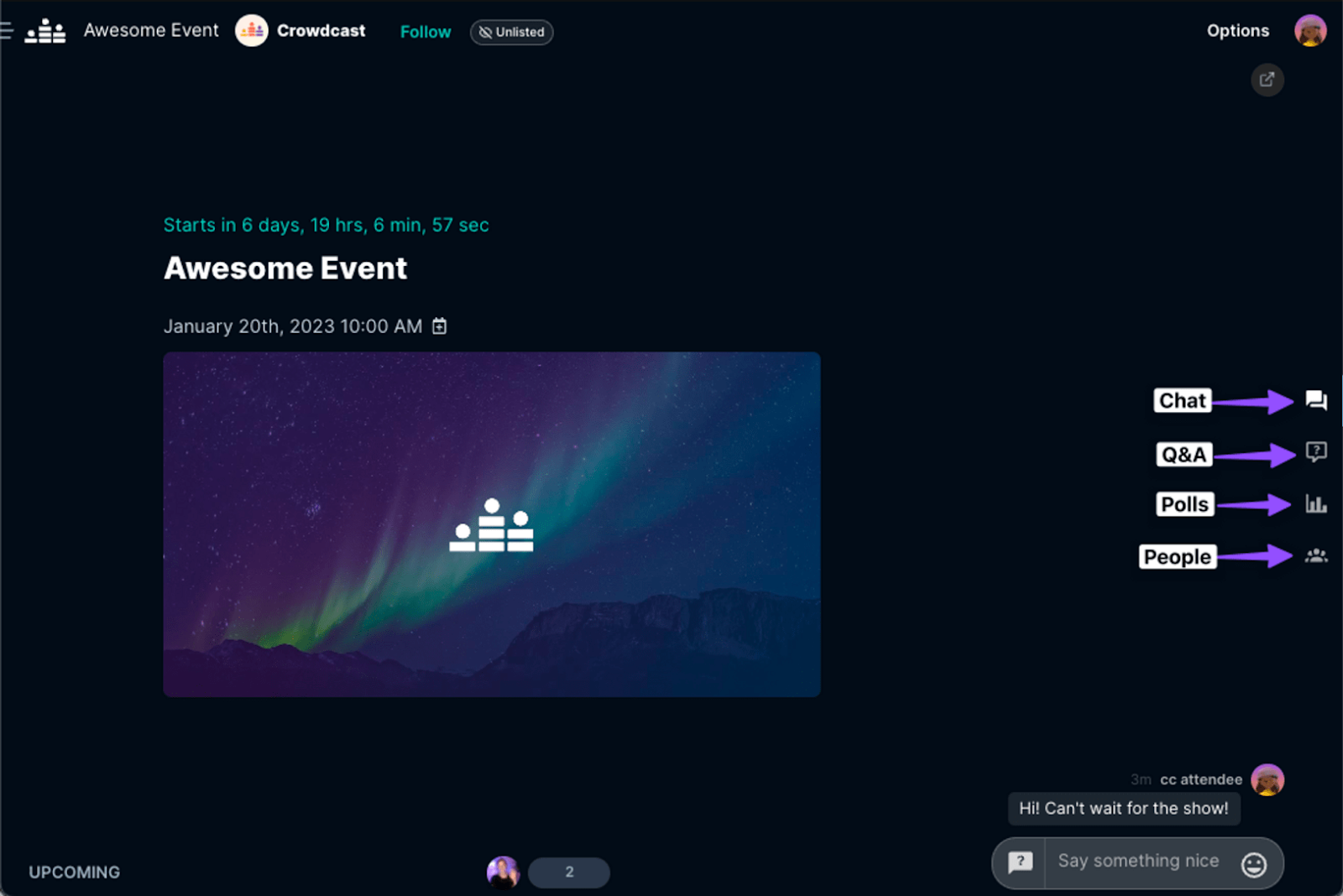
One of my colleagues runs a creator-led community with weekly live sessions, and Crowdcast is the first tool they used where the chat felt like part of the show, not a side panel. Their favorite moment was a Q&A-heavy session where audience questions came in fast, and the host could keep the pace without the experience feeling chaotic.
What makes Crowdcast feel different is the energy. It encourages interaction in a way that feels more like a live show than a corporate broadcast. My friend described it like this: “When it’s good, it feels like the audience is co-hosting.” That is exactly the right mental model for workshops, AMAs, book launches, and creator-style sessions where community engagement is the product, not just the side effect.
Crowdcast is not trying to be the most enterprise compliance platform. It is trying to make live events feel alive. If your webinars are closer to workshops, AMAs, or community sessions, Crowdcast can be a smart alternative to WebinarGeek’s more marketing-program-oriented structure.
Why Crowdcast Is One of the Best Alternatives to WebinarGeek
- Community-first monetization mechanics. Crowdcast includes ticketing and paid event mechanics as a visible part of its platform approach. WebinarGeek supports paid webinars too, but Crowdcast’s packaging is overtly built for creator monetization and community-driven programming.
- Multistreaming is part of the platform story. Crowdcast supports multistream workflows at higher tiers, which is useful for creators and communities growing across social channels. WebinarGeek supports RTMP streaming as an add-on, but Crowdcast’s multistream framing is more native to creator workflows.
- Capacity logic centers on live attendees. Crowdcast often frames capacity around live attendees, which can fit community events where registration is high but attendance is predictable. WebinarGeek’s plan tiers focus on viewer caps within its matrix, which can be less flexible for certain community models.
- Fast setup for repeat live programming. Crowdcast is structured for frequent, recurring sessions with replay availability and a creator-friendly operating model. WebinarGeek is strong for marketing webinars and automation, but Crowdcast can feel lighter for weekly community programming.
- Pricing transparency is straightforward. Crowdcast lists plan pricing clearly. WebinarGeek’s pricing is detailed and plan-based, but the final configuration can involve add-ons depending on needs.
Pricing: Starts at $34/user/month. Billed annually.
9. Zoho Webinar
Best for Budget-Friendly Training for Teams
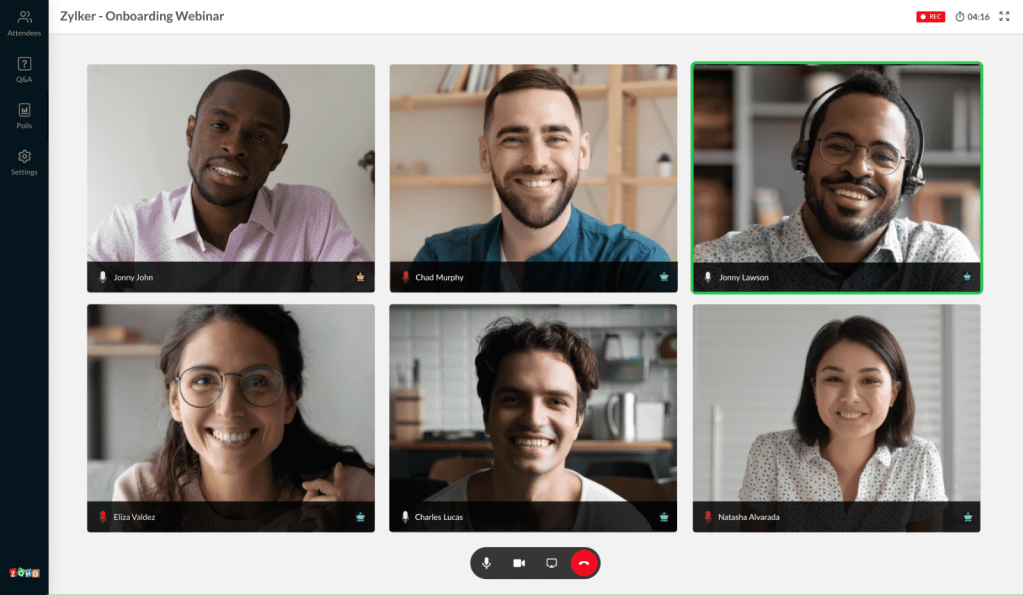
Zoho Webinar is the sensible choice, and I mean that as a compliment. If you’re already in Zoho’s ecosystem or you need a webinar tool that covers the fundamentals without feeling like you’re paying for a broadcast studio you will never use, it fits nicely.
What I like most is that Zoho publishes a clear plan structure including a Free tier and a straightforward feature ladder, plus practical additions like registration moderation and branding features as you move up the tiers. It also highlights common webinar engagement features like polls, Q&A, raise hand, and allowing attendees to talk, which are especially useful for training and internal enablement sessions.
I’ve also seen Zoho Webinar work well when a team wants to “graduate” from meetings to webinars without a steep learning curve. You can run training sessions, internal onboarding, and customer education without over-engineering the production. WebinarGeek offers broader webinar program depth, especially across paid and automated formats, but Zoho Webinar often wins when the brief is simple: “Make it easy, keep it affordable, and cover the essentials.”
Why Zoho Webinar Is One of the Best Alternatives to WebinarGeek
- A real Free plan for basic webinars. Zoho Webinar offers a Free plan for low-stakes or early-stage webinar needs. WebinarGeek offers a free trial, but it is primarily subscription-driven rather than offering a permanent free tier.
- Simple upgrade path through clear tiers. Zoho’s tier ladder is straightforward, which helps cost-sensitive teams forecast growth. WebinarGeek also uses tiers, but Zoho’s structure can be easier for smaller teams to justify internally.
- Training-friendly engagement features are emphasized. Zoho highlights interactive elements that matter for trainings, like polls, Q&A, raise hand, and allowing attendees to talk. WebinarGeek supports interactive sessions too, but Zoho’s packaging leans into training realities.
- Long-session training support at higher tiers. Zoho highlights longer webinar duration allowances as you move up tiers. WebinarGeek’s plan matrix includes duration limits by tier, which can be a constraint for long trainings unless you upgrade.
- Ecosystem simplicity for Zoho-first teams. If your CRM and email already live in Zoho, Zoho Webinar can reduce integration complexity compared with stitching together tools. WebinarGeek has integrations too, but a single-vendor workflow can be simpler for some teams.
Pricing: Starts at $8/organizer/ month, billed annually.
10. ClickMeeting
Best for Automated Webinars Plus Lead Generation
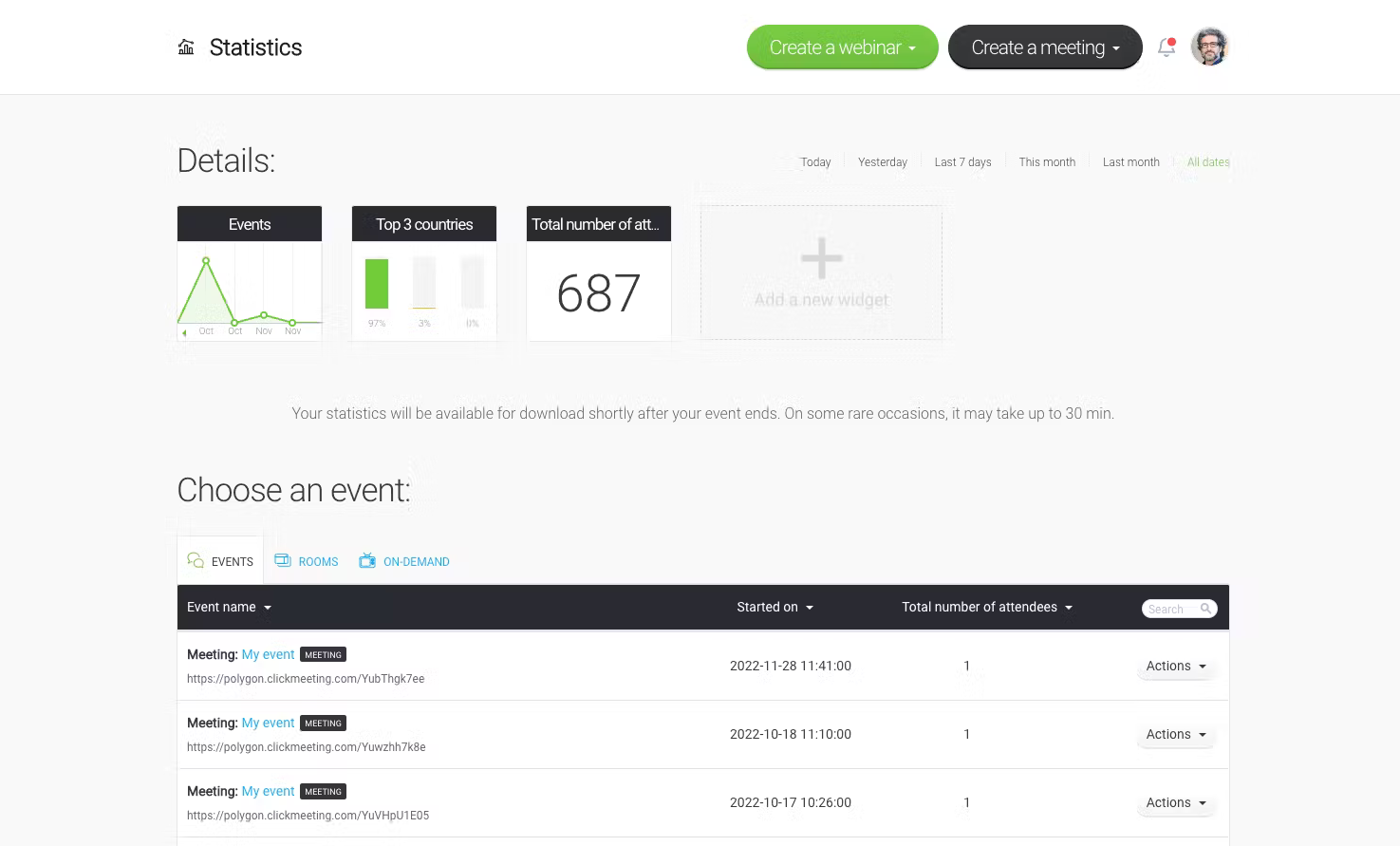
I have a friend group in the SaaS business that runs monthly lead-gen webinars and quarterly automated evergreen sessions, and ClickMeeting has become their quiet workhorse. Their experience was very specific: they wanted to record one strong webinar, then run it repeatedly as an automated session with minimal manual work. ClickMeeting explicitly positions automated webinars and on-demand webinars as part of its platform toolkit.
The story they still tell is about a week they were traveling and still “hosted” two automated sessions that generated leads, simply because the timeline and follow-ups were already configured. That’s the value of automation done right. It turns your best webinar into an asset, not a one-time performance.
If WebinarGeek’s automation works for you, ClickMeeting is still worth comparing because its automation positioning is very direct, and it supports paid and on-demand concepts as well. It is the kind of tool you pick when you want to reduce live hosting pressure, keep consistency, and still produce measurable results.
Why ClickMeeting Is One of the Best Alternatives to WebinarGeek
- Automation-first positioning is explicit. ClickMeeting clearly describes automated webinars and on-demand webinars as lead and revenue generators. WebinarGeek supports automated and on-demand webinars, too, but ClickMeeting’s messaging is more squarely centered on automation as the main use case.
- Parallel events support can matter for busy teams. ClickMeeting offers an option for running parallel events, which is valuable if you host multiple webinars at the same time. WebinarGeek supports multiple broadcasts, but concurrency typically becomes a plan-and-configuration conversation.
- Marketing tracking hooks are part of the feature story. ClickMeeting highlights integrations that matter for tracking and performance measurement. WebinarGeek supports integrations and tracking too, but ClickMeeting’s marketing hooks are often surfaced more directly in its feature messaging.
- Automation definitions are easy for teams to understand. ClickMeeting explains automated webinar behavior clearly, which reduces confusion when teams are implementing evergreen sessions for the first time. WebinarGeek supports automation as well, but clarity of setup expectations can differ by tool.
- Billing options are explained plainly. ClickMeeting highlights monthly and annual plans and frames annual billing as discounted. WebinarGeek supports monthly and annual billing, too, but ClickMeeting’s billing explanation is especially plain-language for small teams.
Pricing: Custom price.
How I Chose These Alternatives to WebinarGeek
Before I call any platform a strong alternative, I try to strip away the homepage polish and look at what actually affects your work once a webinar is on the calendar. A tool can sound impressive in a feature list, but the real test comes when you are building registration flows, managing presenters, keeping attendees engaged, and proving results after the event.
So, I used a consistent set of criteria across every platform in this list. I focused on the things that shape the day-to-day hosting experience and long-term webinar success: setup, usability, attendee experience, analytics, integrations, pricing, and the platform’s ability to support growth.
User Reviews and Ratings
I looked for tools that have a real track record with live webinar programs, automated webinars, virtual events, and recurring audience engagement. I prioritized review platforms that are actively used by marketers, trainers, creators, internal communications teams, and enterprise webinar teams, rather than tools that only look good in promotional copy.
This helped me build a more reliable webinar platform comparison based on actual use, not just feature claims.
Essential Features and Functionality
I mapped each platform against the core features most teams expect from a modern webinar solution. That included support for live, on-demand, and automated webinars, along with engagement tools such as polls, Q&A, and live chat. I also looked at attendee management features like registration controls, presenter roles, access settings, reminders, and follow-up workflows.
Since many buyers switch platforms to simplify execution, I paid close attention to whether these tools handle the essentials inside one system or rely heavily on outside apps and workarounds.
Webinar Analytics
A webinar is not just a live session. It is also a data source. That is why webinar analytics was one of my main evaluation points. I reviewed how clearly each platform reports registrations, attendance, engagement, drop-off behavior, replay activity, and post-event performance.
For some teams, basic reporting is enough. For others, especially demand generation teams, webinar analytics needs to go deeper so they can understand what drove engagement and what should happen next.
Lead Generation Integration
I also examined how well each platform supports lead generation integration. For many businesses, webinars are not run in isolation. They sit inside a larger marketing and sales workflow. So I checked whether platforms connect smoothly with CRMs, email marketing tools, automation systems, and other lead routing setups.
The key question here was simple: does the platform help you move leads where they need to go without adding manual work after every event?
Ease of Use
I favored tools that reduce operational friction. That means fewer confusing settings, cleaner workflows, and less time spent hunting for controls when you are close to going live. Ease of use matters even more when you run recurring webinars or need another team member to step in without a long handoff.
A platform should not make simple tasks feel technical. It should help you launch faster and stay focused on the webinar itself.
Customer Support
When the stakes are high, customer support becomes part of the product. I gave extra weight to vendors that clearly explain their onboarding, support access, and troubleshooting resources. This matters even more for larger webinar programs, virtual events, and multi-team operations where small issues can quickly affect a lot of attendees.
Value for Money
I compared not just starting prices, but what each platform actually includes in its pricing tiers. This is where webinar software can get tricky. One tool may look affordable until you realize automation, branding, integrations, or higher capacity sit behind upgrades or add-ons.
So instead of judging price alone, I looked at the relationship between pricing tiers, included features, and real-world usability. That gave me a more honest view of value.
Scalability and Virtual Events
Some platforms work well for a small webinar series but start to feel limiting as your program grows. That is why I also assessed scalability and virtual events support. I looked at attendee capacity, production controls, recurring webinar support, multi-session capabilities, and how well each tool handles growth from simple webinars to more complex event formats.
This matters if you plan to expand from occasional sessions into a broader webinar program or larger virtual events over time.
Personal Experience and Expert Opinion
Where I had direct experience, I included it. Where I did not, I relied on detailed, long-term experiences from people I trust who use these tools in real webinar environments. I focused on practical stories, recurring workflows, and the kinds of problems that show up during actual use.
That helped me keep this comparison grounded in reality, not hype.
My Top 3 WebinarGeek Alternative Picks
If you want the short list, these are the three I’d look at first based on the most common “why people switch” reasons: ease, program scalability, and pipeline-grade analytics.
1. WebinarNinja
I put WebinarNinja in the top spot because it consistently reduces complexity without making you feel underpowered. In my own use, I liked how it brings webinar hosting, automated email reminders, and analytics into a single workflow, which helped me run repeatable programs with fewer moving parts. It made it easier to stay consistent across sessions and avoid the “forgot to send the follow-up” moments that quietly hurt performance.
2. BigMarker
BigMarker made my top three because it behaves like a system for running a webinar program, not just a platform for hosting a webinar. If you manage a multi-format calendar with recurring series, evergreen sessions, and higher production expectations, BigMarker’s program-level orientation becomes a real advantage.
3. ON24
ON24 earned its place because analytics depth is not an add-on in the way you think about; it is the product. If your webinars are tied to demand gen, ABM, or enterprise pipeline goals, ON24’s focus on engagement insights and reporting is exactly what helps you justify investment and improve results over time.
Ready to Pick the Best WebinarGeek Alternatives?
The best WebinarGeek alternative ultimately depends on what you are optimizing for. Some teams prioritize conversion-focused webinar funnels, while others need enterprise-grade security and governance.
You might be looking for a platform that can support a full webinar program with repeatable workflows, or you may care most about deep analytics and measurable engagement insights. In other cases, minimizing attendee friction, enabling highly interactive community sessions, or keeping costs predictable for training and enablement is the deciding factor.
That said, I lean slightly toward WebinarNinja when someone asks me for the most practical upgrade path from WebinarGeek.
I like that it’s an all-in-one webinar system with automated email reminders, analytics, and interactive features like polls and Q&A, which helps you ship webinars faster with fewer moving parts.
Frequently Asked Questions

How do I avoid losing registrants or attendees during a platform switch?
Run one webinar on the new tool while keeping your old setup available as a backup for a short period. Use clear join instructions, include a primary join link plus a backup, and send a reminder that explains exactly what attendees should expect. WebinarNinja-style all-in-one workflows can help reduce missed steps.
Do I need a new webinar platform if I already use a meeting tool?
Not always. If you only run small internal sessions, a meeting tool can be enough. But if you need structured registration, stronger attendee controls, higher capacity, or automation workflows, a dedicated webinar platform usually saves time and reduces risk as you scale.
How can I compare platforms fairly without doing multiple full trials?
Create a short checklist and test the same scenario across tools: set up registration, send reminders, run a 10-minute test webinar, check analytics, and export leads. Keep the test identical each time. You will notice differences quickly, especially in setup time and reporting clarity.
What are the most common hidden limits to look for in webinar software?
Watch for caps on webinar duration, attendee limits per plan, storage or recording limits, branding restrictions, and which features require add-ons. Also check whether automated or simulive webinars are included or treated as separate products, since that can change the total cost. This is where platforms like WebinarNinja can feel simpler because fewer pieces are scattered.
How do I choose the right attendee capacity for my plan?
Use your last 3 to 5 webinars as the baseline and look at peak live attendance, not registrants. Then add a buffer based on growth goals, promotions, or partnerships. If you regularly exceed capacity, you risk joint failures, so it is safer to size up slightly.
What integrations matter most when evaluating WebinarGeek alternatives?
Start with what you already rely on: CRM, email marketing, calendar tools, and analytics tracking. The best integration is the one that reduces manual exporting and follow-up work. If you need lead routing, check whether your CRM sync is native or dependent on Zapier.
Can I reuse my existing webinar recordings and assets on a new tool?
In most cases, yes. You can upload recordings, reuse slides, and rebuild registration pages and email sequences. The main work is formatting: different tools handle video hosting, email templates, and branding controls differently. If you move to a more unified platform such as WebinarNinja, rebuilding the workflow can feel more straightforward.
Want to host a webinar for free?
Use WebinarNinja to teach, improve marketing, and grow your sales.

![10 Free Webinar Software in 2026 [A Detailed Comparison]](https://webinarninja.com/blog/wp-content/uploads/2024/06/Feature_WN_10-Free-Webinar-Software-in-2024-a-Detailed-Comparison.png)