

If you want to know where virtual events are headed, don’t listen to opinions. Follow the data.
Behind every webinar, virtual conference, and hybrid event is a growing body of research that reveals how businesses are changing the way they educate, market, sell, and collaborate. When you look across those reports together, a much clearer picture begins to emerge.
In this guide, you’ll find more than 100 recent virtual event statistics covering market trends, webinar adoption, AI, hybrid events, corporate training, sustainability, and much more, to help you make informed decisions.
Let’s get started.
1. Virtual Event Market Size & Growth Projections
The virtual events industry has grown from a niche category into a market valued by multiple research firms at hundreds of billions of dollars, with double-digit growth forecast well into the next decade.
What started as a workaround for in-person restrictions has become a distinct line item in corporate budgets, spanning webinars, conferences, trade shows, and training delivered entirely online. Because several independent research firms track this market using different methodologies and scope definitions, their headline numbers don’t always match exactly, and that’s expected rather than a red flag.
- The global virtual events market was valued at USD 243.0 billion in 2025 and is forecast to reach USD 1,057.9 billion by 2034, representing a compound annual growth rate of 17.80% between 2026 and 2034. (IMARC Group)
- North America currently dominates the virtual events market, a position researchers attribute to the rising number of smartphone users, the emergence of advanced digital technologies, and companies’ growing focus on building brand image through online engagement. (IMARC Group)
- The global virtual events market size was estimated at USD 98.07 billion in 2024 and is projected to reach USD 297.16 billion by 2030, growing at a compound annual growth rate of 20.0% from 2025 to 2030. (Grand View Research)
- The external event segment, used to engage customers, partners, and other outside stakeholders, recorded the largest revenue share of the virtual events market at over 40% in 2024. (Grand View Research)
- The exhibition and trade shows segment accounted for the largest revenue share of the virtual events market by application in 2024, driven by businesses’ growing need to showcase products, assess competitors, and reach audiences digitally without physical venue costs. (Grand View Research)
- The educational institution segment of the virtual events market is expected to post a significant compound annual growth rate through 2030, fueled by the accelerating adoption of digital learning tools and rising demand for flexible, remote-friendly education formats. (Grand View Research)
- The BFSI (banking, financial services, and insurance) industry vertical is estimated to record a growth rate of nearly 22.1% within the virtual events market from 2025 to 2030, driven by high adoption of virtual platforms for secure transactions and remote banking services. (Grand View Research)
- The global virtual event platform market is estimated at USD 15.99 billion in 2025 and is predicted to climb to USD 17.60 billion in 2026 before reaching approximately USD 41.12 billion by 2035, a compound annual growth rate of 9.91%. (Precedence Research)
- By component, the software segment accounted for the largest share of the virtual event platform market at 89% in 2025, while the services segment, covering planning, production, and optimization support, is expected to grow at the fastest rate going forward. (Precedence Research)
- The U.S. virtual event platform market was valued at USD 4.56 billion in 2025 and is projected to reach approximately USD 12.01 billion by 2035, expanding at a compound annual growth rate of 10.17% over that ten-year forecast window. (Precedence Research)
- The virtual events market reached USD 16.61 billion in 2026 and is on track to surpass USD 27.65 billion by 2031, with web-based platforms leading the category in 2025 at a 48.43% share, thanks to widespread browser-based accessibility. (Mordor Intelligence)
- Asia-Pacific is forecast to expand its virtual events market at a 12.45% compound annual growth rate through 2031, a pace researchers attribute directly to continued 5G network rollouts and government-led digitalization mandates across the region. (Mordor Intelligence)
- Conferences and summits delivered 42.64% of aggregate virtual events spending in 2025, a share researchers credit to their familiar agenda structure, multi-track programming depth, and consistently strong appetite from event sponsors compared with other formats. (Mordor Intelligence)
- Product launches held virtually are projected to climb at a 12.01% compound annual growth rate across 2026–2031, as automakers, smartphone brands, and software vendors increasingly premiere offerings to global audiences without coordinating simultaneous events across cities. (Mordor Intelligence)
Why this matters:
No matter which forecast you use, the direction is the same: organizations are shifting real budget toward virtual formats, not treating them as a stopgap. That growth is being driven less by necessity now and more by cost efficiency, global reach, and measurable ROI, which is exactly the case WebinarNinja customers make internally when they ask for budget to run more live, automated, or series webinars.
2. Webinars & B2B Content Marketing Adoption
Webinars remain one of the highest-trust, most-used content formats in B2B marketing, holding their position even as newer formats like short-form video and podcasts compete for budget and attention.
The picture that emerges is consistent year over year: webinars aren’t a fading tactic, they’re a core, budgeted part of how B2B teams generate leads and build authority.
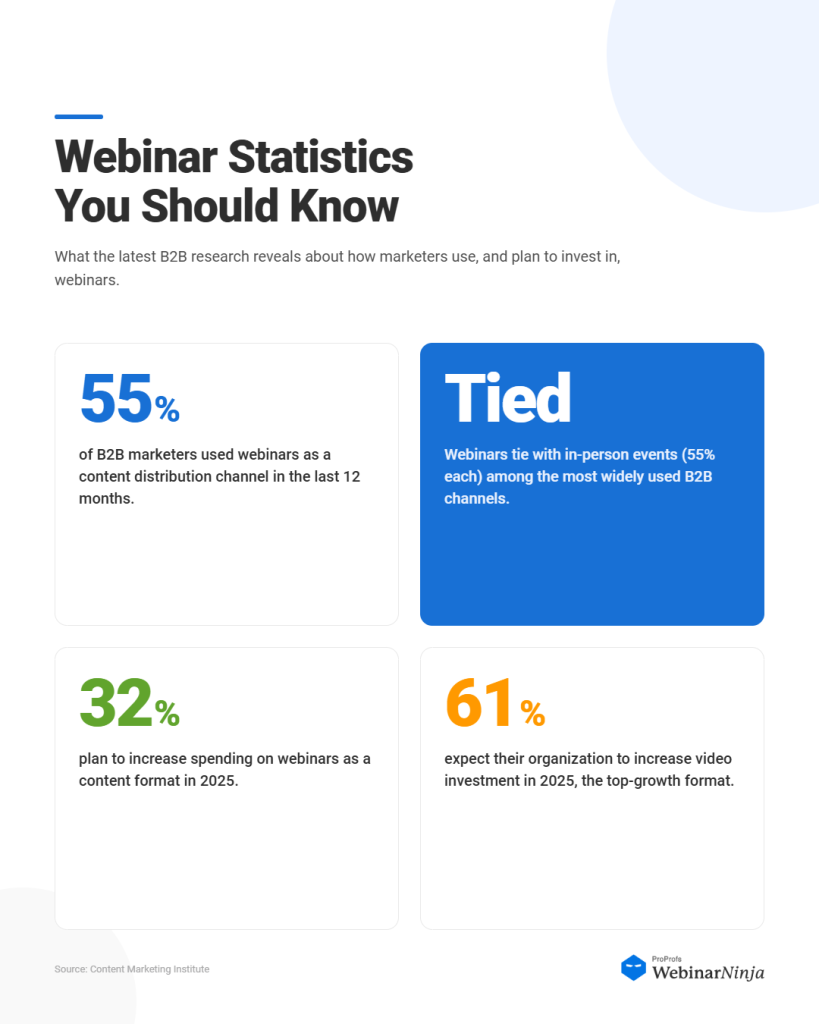
- Fifty-five percent of B2B marketers used webinars as a content distribution channel in the last 12 months, tying webinars with in-person events (also 55%) among the most widely used channels in B2B marketing. (Content Marketing Institute)
- Among B2B marketers surveyed, 61% expect their organization to increase video investment in 2025, followed by thought leadership content at 52%, while 32% specifically plan to increase spending on webinars as a format. (Content Marketing Institute)
- A striking 58% of B2B marketers rate their overall content strategy as only “moderately effective,” with nearly half of that group attributing the shortfall specifically to a lack of clear, measurable goals for their programs. (Content Marketing Institute)
- B2B marketers distribute content through organic social platforms (89%), corporate blogs (84%), email newsletters (71%), and other email communication (63%). (Content Marketing Institute)
- B2B marketers identify in-person events and webinars as the two distribution channels that produce the best results for their content marketing efforts, ahead of every other channel measured in the annual benchmark survey. (Content Marketing Institute)
- Ninety-two percent of B2B marketers use short articles or posts as part of their content mix, while 76% use video and 75% use case studies or customer stories, with video cited as the format producing the best overall results. (Content Marketing Institute)
- Ninety-six percent of B2B marketers say they measure content performance in some way, yet attributing ROI, tracking the customer journey, and connecting performance to business goals remain the top three measurement challenges heading into 2025. (Content Marketing Institute via ContentByCass)
- More than two-thirds of B2B marketers, 78%, report allocating budget to experiential marketing activities, yet fewer than a third rate their own program maturity as established, advanced, or leading rather than still exploratory or developing. (Content Marketing Institute)
- Enterprise marketing teams invest in experiential marketing at notably higher rates than the broader B2B cohort, with 88% of enterprise teams allocating budget to experiential activities in 2025 compared with 78% of B2B marketers overall. (Content Marketing Institute)
- When asked how much of their marketing spend goes toward experiential activities, 31% of enterprise marketers say they invest only a small portion, between 1% and 10% of the total marketing budget, into these programs. (Content Marketing Institute)
- More than half of B2B marketers, 52%, describe their organization’s data governance strategy as established, advanced, or leading, while the remaining 48% say governance work is still in the exploratory or developing stage. (Content Marketing Institute)
- The Content Marketing Institute’s 16th annual content marketing survey, conducted with MarketingProfs between June and August 2025, drew 1,229 global responses, with 1,015 of those respondents identifying specifically as B2B marketers based mostly in North America. (Content Marketing Institute)
Why this matters:
These numbers come directly from a fifteen-plus-year-running, independently conducted survey, not from a webinar vendor’s platform data, making them a fair benchmark regardless of which tool you use. The consistent tie between webinars and in-person events as top-performing channels is the strongest evidence that webinars have graduated from “nice to have” to core infrastructure in B2B marketing.
3. Hybrid Events & Format Preferences
Hybrid isn’t replacing virtual or in-person, it’s becoming its own permanent third category that borrows the best parts of both. Attendees increasingly expect the choice to show up in a room or watch from home, and organizers who force a single format risk losing a meaningful share of their audience.
Here’s what independent research shows about how attendees and marketers are actually choosing between formats, including how those preferences differ by region, seniority, and event type. The split below is closer to even than most marketers assume, which is itself useful data when you’re deciding how to allocate production budget between the two.
- In a global survey of B2B marketers, 57% said they would prefer to attend the in-person version of a hybrid event, while 33% preferred the virtual version and 10% expressed no preference either way. (Statista)
- Survey respondents on hybrid event format preference were drawn primarily from North America (56%), followed by Europe (25%), Asia (10%), and South America (9%), giving the data a broad but North America-weighted geographic base. (Statista)
- As of a June 2021 survey, 99% of polled companies agreed that webinars represented a critical element of their overall marketing plan, underscoring how central the format had already become to digital event strategy. (Statista)
- Livestream video was used by almost three-quarters of global marketers as a digital engagement tactic, while an additional one in five marketers who hadn’t yet adopted livestreaming said they planned to add it to their strategy. (Statista)
- One in two employees say the ability to work remotely is an important factor in deciding whether to accept future employment, a signal that the preference for flexible, hybrid-friendly work and event formats extends well beyond marketing teams. (Statista)
- Live meetings software was favored by 43% of marketers surveyed for running virtual events, while more than one in three respondents said they specifically preferred a fully immersive virtual event experience over a standard webinar format. (Statista)
- Nearly one-third of trade shows worldwide were staged in a hybrid format in 2021, combining an in-person component with virtual attendance options, reflecting an early and lasting shift in how large-scale industry events are structured. (Statista)
Why this matters:
The data shows a real split in preference, not a landslide toward one format, which is exactly why series and hybrid-friendly tools matter. Rather than picking one format and hoping it fits everyone, the more durable strategy is giving your audience the choice, then using engagement data to see which sessions perform better live versus on-demand.
4. Corporate Training & eLearning Delivered Through Virtual Formats
A huge share of “virtual events” volume isn’t marketing webinars at all, it’s corporate training, onboarding, and compliance education delivered live or on-demand.
This category is arguably growing even faster than event marketing, partly because it touches nearly every department in a company rather than just the marketing team. HR, L&D, customer success, and compliance teams have all adopted live and recorded virtual sessions as their default delivery method, meaning the total addressable market for webinar-style tools is much larger than the “marketing webinar” label suggests.
The numbers below reflect that broader footprint, spanning everything from onboarding a new hire to certifying a workforce on a new regulation.
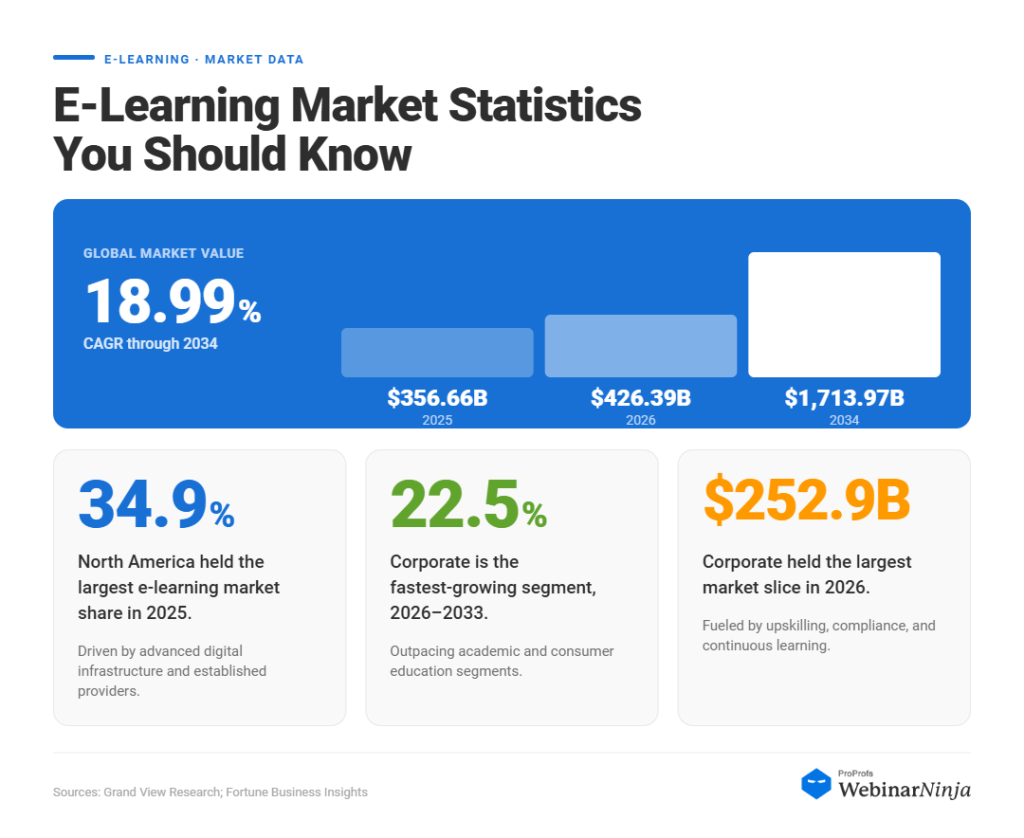
Note that “corporate e-learning” is measured differently across firms below; some report it as a segment within the broader e-learning services market, others as its own standalone market, and some break it out by single countries. So figures like $252.9B, $129.5B, and $44.03B aren’t competing claims about the same number; they’re different slices of the same trend.
- The global e-learning services market was estimated at USD 352.98 billion in 2025 and is projected to reach USD 1,485.00 billion by 2033, growing at a compound annual growth rate of 19.9% as digital training adoption accelerates worldwide. (Grand View Research)
- The blended learning segment, which pairs instructor-led sessions with digital course content, accounted for the largest revenue share of the e-learning services market in 2025, reflecting organizations’ preference for combining live and self-paced formats. (Grand View Research)
- North America held the largest e-learning services market share at 34.9% in 2025, a position researchers link to the region’s advanced digital infrastructure and the strong presence of established online education and training providers. (Grand View Research)
- The corporate end-use segment of the e-learning services market is expected to grow at the fastest compound annual growth rate of 22.5% between 2026 and 2033, outpacing academic and consumer education segments over the same period. (Grand View Research)
- The global e-learning services market was valued at USD 356.66 billion in 2025 and is projected to climb to USD 426.39 billion in 2026 before reaching USD 1,713.97 billion by 2034, a compound annual growth rate of 18.99%. (Fortune Business Insights)
- The corporate segment accounted for the largest slice of the global e-learning services market at USD 252.9 billion in 2026, a share researchers attribute to rising investment in digital training for workforce upskilling, compliance, and continuous learning. (Fortune Business Insights)
- North America’s e-learning services market stood at USD 125.26 billion in 2025, representing 35.12% of global demand, and is projected to grow to USD 146.87 billion in 2026 on the strength of continued corporate training investment. (Fortune Business Insights)
- The Asia-Pacific e-learning services market reached USD 101.64 billion in 2025, accounting for 28.50% of global share, and is expected to reach USD 125.81 billion in 2026 as digital transformation and internet accessibility keep expanding regionally. (Fortune Business Insights)
- The global corporate e-learning market was valued at USD 129.5 billion in 2025 and is expected to reach USD 956.4 billion by 2035, growing at a compound annual growth rate of 22.29% as companies digitize employee training. (SNS Insider)
- Blended learning dominated the corporate e-learning market in 2025 with roughly 42% share, a preference researchers attribute to the format’s ability to combine online digital courses with traditional, higher-engagement instructor-led training sessions. (SNS Insider)
- Large enterprises accounted for roughly 58% of the corporate e-learning market in 2025, though small and mid-sized organizations represent the fastest-growing segment as cost-effective virtual training tools become more accessible to smaller teams. (SNS Insider)
- The IT industry vertical accounted for roughly 31% share of the corporate e-learning market in 2025, the largest of any sector, while healthcare organizations are expected to post the fastest growth rate as clinical training moves online. (SNS Insider)
Why this matters:
Training and onboarding delivered as live or automated virtual sessions is one of the fastest-growing, least-discussed corners of the virtual events market.
If your team is running customer onboarding, employee training, or compliance education through recorded or scheduled sessions, you’re already part of this multi-hundred-billion-dollar category, and there’s a strong case for treating those sessions with the same production and engagement rigor as a marketing webinar.
5. Video, Live-Streaming & Content Format Performance
Virtual events don’t exist in isolation, they’re part of a broader shift toward video as the dominant content format in B2B marketing. As buyers increasingly expect to watch rather than read, marketing teams have shifted budget away from static formats and toward anything with a camera and a script.
Here’s what the leading independent video-marketing research shows, including how consistently video outperforms other formats on trust, comprehension, and lead generation. Webinars sit inside this broader video trend, which is part of why the two categories of data below tell such a complementary story.
- Ninety-one percent of businesses now use video as a marketing tool, a figure tied for an all-time high, with video marketers most commonly favoring YouTube, Instagram, Facebook, LinkedIn, and webinars as their top-performing distribution channels. (Wyzowl)
- Eighty-two percent of video marketers say video marketing has given them a good return on investment, a meaningful drop from the prior year’s all-time high of 93%, though still a strongly positive result overall. (Wyzowl)
- Ninety-three percent of video marketers say video has helped increase their audience’s understanding of their product or service, while 85% say video has directly helped them generate new leads for their business. (Wyzowl)
- Eighty-three percent of video marketers report that video content has directly increased sales, and 82% say it has helped increase web traffic, making video one of the most consistently effective formats measured in the annual survey. (Wyzowl)
- When asked how they would most like to learn about a new product or service, 63% of consumers said they would prefer to watch a short video, far outpacing text-based articles, ebooks, infographics, and webinars combined. (Wyzowl)
- Eighty-four percent of consumers say they want to see more video content from brands in 2026, a figure that has held remarkably steady, within eight percentage points, for eight consecutive years of the same annual survey. (Wyzowl)
- Eighty-nine percent of consumers say a video’s production quality directly impacts how much they trust the brand behind it, reinforcing why polished, well-produced webinars and live sessions matter more than volume alone. (Wyzowl)
- Sixty-seven percent of businesses that did not use video marketing in the previous year say they plan to start using it in 2026, suggesting the small remaining pool of video holdouts is continuing to shrink. (Wyzowl)
Why this matters:
Webinars sit at the intersection of two massive trends: the shift to video and the shift to live, interactive content, which is part of why they consistently outperform static content on trust and lead quality.
If your organization already treats video as a priority, webinars are the natural next step: the same medium, live interaction, and a built-in audience who opted in specifically to hear from you.
6. Remote & Hybrid Work Context Shaping Virtual Events
Where and how people work directly shapes how they show up to virtual events, from what time of day they can attend to how much patience they have left for another screen after a full day of back-to-back meetings.
As more of the workforce splits time between home and office, the line between “attending a meeting” and “attending a webinar” has effectively disappeared for a large share of employees. That context matters for anyone planning session times, formats, or follow-up cadence.
- More than one in four workers, 28%, now work a hybrid schedule, while 9% remain fully remote and 63% work fully in-office, based on a 2025 survey of 2,000 full-time U.S. knowledge workers. (Owl Labs)
- Among hybrid employees, in-office attendance continues to climb, with 34% now going into the office four days a week, up from 32% in 2024 and just 23% in 2023, suggesting a gradual return-to-office trend. (Owl Labs)
- Eighty percent of workers say they have experimented with AI tools at work, a 45% increase from March 2025 alone, as employees look for ways to reclaim time lost to commuting and meeting logistics. (Owl Labs)
- Sixty-four percent of workers say their companies are actively encouraging employees to use AI at work, up from 56% just a few months earlier in the same year, reflecting rapidly accelerating enterprise AI adoption. (Owl Labs)
- Eighty-five percent of U.S. workers say good workplace technology is a top factor in their overall work life, ranking just behind compensation and having a supportive manager among the things employees value most. (Owl Labs)
- Eighty-nine percent of UK employees say access to good technology is important to their work, up from 83% in 2024, and companies have responded by increasing IT support and upgrading meeting room equipment. (Owl Labs)
- Forty-six percent of full-time office workers report feeling disengaged at work, compared with just 30% of remote employees, a gap researchers link to longer commutes, rising stress, and reduced schedule flexibility for in-office staff. (Owl Labs)
- Only 48% of companies upgraded their video conferencing technology in the past year, even as 87% of respondents emphasized how important good technology is to their overall work experience and productivity. (Owl Labs)
Why this matters:
With a meaningful share of the workforce now permanently hybrid or remote, live virtual sessions aren’t a substitute for “real” meetings anymore; for a large chunk of the workforce, they are the real meeting. That’s part of why reliable, easy-to-join virtual event technology (no downloads, no friction) has become a baseline expectation rather than a nice-to-have.
7. Sustainability & Environmental Impact of Virtual Events
Beyond cost and reach, virtual events carry a measurable environmental advantage over in-person gatherings, one that’s increasingly relevant for organizations reporting on ESG goals.
As sustainability commitments become a standard line item in corporate reporting, event teams are being asked to quantify the footprint of their programs in ways that were rarely tracked a few years ago. Independent research from academic institutions and professional associations has begun to put real numbers behind what most people intuitively assume: skipping the travel, venue, and catering that come with in-person events results in a substantial emissions reduction.
The figures below come from peer-reviewed and industry-association sources rather than vendor marketing, which makes them useful evidence for anyone building an internal sustainability case.
- A one-day virtual event with 200 attendees produces carbon emissions roughly equivalent to driving 3,300 miles or burning 1,500 pounds of coal, yet that same event held in person would generate nearly 66 times more carbon emissions. (IEEE)
- Holding a five-thousand-attendee international conference virtually instead of in person can reduce the event’s carbon emissions by an amount roughly equivalent to the total annual emissions produced by 158 American households. (IEEE)
- More than 60% of the carbon emissions generated by large virtual conferences come from network data transfers alone, meaning uploading and downloading video calls, live streams, and shared presentation files rather than device manufacturing. (IEEE)
- An analysis of a two-day academic virtual conference attended by more than 100 speakers and delegates from around the world found the event produced only about 15 to 20 kilograms of CO2-equivalent emissions from IT equipment and electricity use. (Cambridge University Press & Assessment)
- A researcher from the University of Bristol’s computer science department found that emissions from electricity consumption during an online conference are several orders of magnitude smaller than the emissions generated by travel to the equivalent in-person event. (Cambridge University Press & Assessment)
- A peer-reviewed study describing the shift from in-person to virtual events as an effective climate mitigation strategy found the change can reduce an event’s overall carbon footprint by roughly 94% and cut total energy use by about 90%. (TRACE)
- Simply turning off your camera during a video conference can reduce that meeting’s individual environmental footprint by as much as 96%, since video streaming is the single largest driver of a virtual event’s carbon output. (Plan A)
- Decarbonizing the electrical grid that powers data centers and streaming infrastructure could cut the carbon footprint of virtual conferences by as much as three-quarters, according to sustainability researchers modeling renewable-energy scenarios for digital events. (Plan A)
Why this matters:
For organizations under pressure to reduce travel-related emissions or report progress against sustainability targets, shifting recurring meetings, training, and even portions of a conference agenda to virtual formats is one of the more measurable, low-friction wins available, without requiring attendees to change much about how they participate.
8. Video Marketing & Content Distribution Benchmarks
A closer look at where marketing teams are putting their video and content budget, and which formats are earning the strongest returns heading into 2026. Budgets are finite, and as more channels compete for the same dollars, marketing leaders are increasingly forced to justify spend with hard performance data rather than instinct.
The numbers below come from HubSpot’s own marketing research, which surveys practitioners directly about what’s actually working rather than relying on a single platform’s usage logs. Taken together, they show a market that’s still reallocating budget toward formats, like video and webinars, that combine measurable engagement with first-party audience data.
- In HubSpot’s 2026 State of Marketing research, blog posts ranked among the top five highest-ROI content formats, while roughly 94% of marketers said they planned to use AI in their content creation process in the year ahead. (HubSpot)
- Forty-two percent of marketers reported using LinkedIn as part of their overall marketing strategy in 2025, an 11-percentage-point increase from 2024, as the platform’s user base continues to grow past 1.2 billion members worldwide. (HubSpot)
- Small businesses are 23% more likely than the marketer average to report seeing measurable ROI from blog posts, according to HubSpot’s 2026 benchmark data on content format performance across company sizes. (HubSpot)
Why this matters:
Content and video budgets are shifting toward formats marketers can prove are working, and webinars occupy a unique position: they’re video, they’re live or on-demand, and, unlike a blog post, every attendee has to actively register, which gives you a built-in, first-party data point that a passive content view simply doesn’t provide.
9. Regional & Industry-Vertical Trends in Virtual Events
Adoption isn’t uniform. Different regions and industries are scaling virtual event technology at very different paces, driven by infrastructure, regulation, and workforce composition.
A finance team in North America and an education ministry in Southeast Asia are working from very different starting points, even though both are technically part of the same global “virtual events market.” Internet penetration, 5G rollout, government digitalization programs, and even cultural comfort with remote interaction all shape how quickly a given region or sector moves online.
The data below breaks that unevenness down by geography and vertical, which is useful context before assuming a single strategy will work everywhere at once.
- North America accounted for more than 39% of virtual events market revenue in 2024, the largest of any region, a position Grand View Research links to advanced networking infrastructure and early adoption of new event technologies. (Grand View Research)
- Asia-Pacific is forecast to be the fastest-growing regional virtual events market through 2029, with China and Japan capturing considerable revenue share as both countries continue investing heavily in digitally simulated meeting and communication systems. (Market Data Forecast)
- India and Australia are expected to see significant growth in the virtual events market share, a trend researchers attribute to the rising number of small and mid-sized businesses and widespread technology acceptance across both countries. (Market Data Forecast)
- Latin America, the Middle East, and Africa are all projected to grow significantly in virtual events adoption between 2025 and 2029, driven by rising disposable income, expanding cloud communication services, and a growing number of regional startups. (Market Data Forecast)
- The Asia-Pacific virtual events market generated USD 26.71 billion in revenue in 2024 and is projected to reach USD 87.25 billion by 2030, growing at a compound annual growth rate of 21.5% from 2025 to 2030. (Grand View Research)
- The large-scale events use-case segment is estimated to grow at a compound annual growth rate of over 19.6% from 2025 to 2030, driven by rising demand for online platforms capable of hosting massive marketing events and new product introductions. (Grand View Research)
- The global webinar and webcast market exceeded USD 1.14 billion in 2025 and is set to expand at a compound annual growth rate of over 7.6% between 2026 and 2035, driven partly by AI-powered event planning tools. (Research Nester)
- The number of U.S. workers primarily working from home grew from 5.7% in 2019 to 17.9% in 2021, stabilizing around 22.7% by early 2024, a structural shift that continues to fuel demand for webinar and remote-meeting technology. (Research Nester)
Why this matters:
If you’re building a global or multi-region event strategy, treating “virtual events” as one homogeneous market is a mistake: adoption curves, infrastructure, and even preferred formats vary meaningfully by geography and industry, which should inform everything from your scheduling time zones to your platform’s language and accessibility support.
10. The Bigger Picture: Virtual Events as Permanent Infrastructure
A handful of additional data points round out the picture of just how embedded virtual events have become in how organizations operate, train, and go to market. These figures cover the parts of the market that don’t neatly fit into “marketing webinar” or “corporate training,” including recruitment, day-to-day team communication, and the underlying technology stack that makes it all possible.
Looking at the market through this wider lens makes it clear that virtual events have become general-purpose infrastructure, similar to email or video conferencing, rather than a single-use tool tied to any one department or campaign type. The stats below reflect that breadth, drawn from segment-level breakdowns published by leading market research firms.
- The global virtual event platform market’s software segment accounted for 89% share in 2025, underscoring how much of the market’s value now comes from platform capability itself rather than one-off production services. (Precedence Research)
- The medium enterprise segment dominated the virtual event platform market by organization size in 2025, while the small enterprise segment is expected to grow fastest, reflecting how affordable virtual tools are unlocking new segments of buyers. (Precedence Research)
- Small businesses are increasingly turning to virtual event platforms because the format lowers the overall cost of hosting meetings and events, helping smaller teams compete for attention and reach without matching the marketing budgets of larger enterprises. (Precedence Research)
- Video conferencing and unified communications solutions stand as the largest component of the virtual events market in 2025, reflecting their central role in supporting seamless, real-time collaboration across geographically distributed teams and audiences. (IMARC Group)
- A key driver identified across virtual events market research is the accelerating pace of digital transformation across industries, as businesses increasingly leverage virtual platforms to host conferences, trade shows, and meetings that reach global audiences cost-effectively. (IMARC Group)
- The extended events segment of the virtual events market, events designed to let remote audiences participate in gatherings happening at a different physical location in real time, is projected to be one of the fastest-growing categories through 2033. (Grand View Research)
- The communication services segment accounted for the largest market share within virtual events by service type, reflecting how central real-time business conversations, announcements, and meetings remain to overall virtual events market value. (Market Data Forecast)
- Growing use of virtual event solutions in remote candidate recruitment is cited as a meaningful driver of the recruitment services segment within the broader virtual events market, as employers seek convenient ways to interview and screen distributed candidates. (Market Data Forecast)
Why this matters:
The throughline across nearly a decade of market research is consistent: virtual events aren’t a category that peaked during the pandemic and is now fading; they’re an infrastructure that keeps finding new use cases, from recruiting to compliance training to global product launches, each with its own growth trajectory.
11. Additional Market, Technology & Training Data Points
A final round-up of standalone figures that didn’t fit neatly into the categories above but are too useful to leave out, covering alternate market forecasts, AI-driven engagement tools, and a few more corporate training benchmarks. Some of these come from research firms whose numbers differ meaningfully from the figures cited in Section 1, which is worth flagging rather than smoothing over.
Market sizing for a fast-moving, loosely defined category like “virtual events” varies a lot depending on which segments a given firm chooses to include, so treat the spread itself as useful information about how uncertain even professional forecasts can be.
- The global virtual events market was valued at USD 202.35 billion in 2025 and is predicted to reach USD 246.64 billion in 2026, growing at a compound annual growth rate of 21.89% to reach USD 1,202 billion by 2034. (Market Data Forecast)
- The communication services category accounted for the largest share of the virtual events market at nearly 35% in 2020, a position researchers attribute to massive growth in digitally simulated meetings that continue reshaping internal and external business communication. (Market Data Forecast)
- Using an internal database and industry analysis, one research firm valued the global virtual events market at USD 15 billion in 2025, projecting growth to USD 24 billion by 2032 at a more conservative compound annual growth rate of 5.50%. (6Wresearch)
- The global virtual event platforms market was valued at USD 1.65 billion in 2025 and is projected to reach USD 1.83 billion in 2026 and USD 4.73 billion by 2035, growing at a compound annual growth rate of 11.12%. (Global Growth Insights)
- More than 70% of organizations now use virtual engagement tools in their day-to-day operations, while over 60% of event planners say prioritizing digital participation capabilities has become central to how they plan every event. (Global Growth Insights)
- More than 75% of large enterprises in the United States regularly use virtual event technologies for employee engagement, customer communication, and ongoing training activities, reflecting how deeply embedded these tools have become in day-to-day enterprise operations. (Global Growth Insights)
- Roughly 68% of event organizers say they prefer hybrid event formats specifically because the approach improves overall audience reach and participation compared with running an event as purely in-person or purely virtual. (Global Growth Insights)
- Mobile attendance at virtual and hybrid events now exceeds 55% of total participation, while more than 60% of organizations say they actively invest in engagement analytics and networking tools to better understand attendee behavior. (Global Growth Insights)
- AI and VR adoption within virtual event platforms is estimated to have increased attendee engagement by 25% to 30% across education, healthcare, and corporate sectors, according to market analysis tracking the rise of immersive event technology. (Business Research Insights)
- Cybersecurity and data privacy concerns affect an estimated 20% to 25% of virtual event participants, a factor researchers identify as a meaningful restraint that continues to limit broader platform adoption among privacy-conscious organizations and individual attendees. (Business Research Insights)
- AI-managed engagement tools, including chatbots and matchmaking algorithms designed to improve networking outcomes, are now being implemented in over 40% of virtual events as organizers look to automate parts of the attendee experience at scale. (Business Research Insights)
- According to World Bank data cited in recent market analysis, roughly 37% of the global population, about 2.9 billion people, remained offline in 2021, a gap researchers say continues to limit fully equitable global access to virtual events. (Business Research Insights)
- The custom e-learning segment led the global e-learning services market with the largest revenue share, 29.5%, in 2025, as organizations increasingly commission tailored training content built around their own specific workflows and compliance requirements. (Grand View Research)
- The simulation-based learning segment is predicted to grow at the fastest compound annual growth rate within the broader e-learning services market, driven by rising demand for practical, hands-on training across healthcare, aviation, and manufacturing industries. (Grand View Research)
- Live-action video remains the most commonly produced video format among marketers, with 51% saying they mostly create live-action content, followed by animated video at 23% and screen-recorded video, such as product demos, at 19%. (Wyzowl)
- Fifty-nine percent of video marketers say they create their video content entirely in-house rather than relying on external production vendors, while the remainder either outsource completely or use a mix of internal and external resources. (Wyzowl)
- More than half of employees, 58%, now use calendar blocking to protect focus time against meetings, with full-time office workers roughly twice as likely to use this tactic compared with their hybrid and fully remote counterparts. (Owl Labs)
- The U.S. corporate e-learning market was valued at USD 44.03 billion in 2025 and is expected to reach USD 325.18 billion by 2035, growing at a compound annual growth rate of 22.29%, fueled by remote and hybrid work adoption. (SNS Insider)
- The UK and Germany e-learning services markets are each projected to surpass USD 19 billion in 2026, at USD 19.71 billion and USD 19.30 billion respectively, supported by growing national investment in digital education infrastructure. (Fortune Business Insights)
- The Latin America e-learning services market represented USD 24.58 billion in 2025 and is projected to grow to USD 29.24 billion in 2026, while the Middle East and Africa region is expected to reach USD 20.51 billion over the same period. (Fortune Business Insights)
Virtual Event Statistics: Quick-Reference Table
| Category | Standout Stat | Source |
| Market size (2025) | $243.0B global virtual events market (estimates from other firms range roughly $15B–$246B depending on scope) | IMARC Group |
| B2B channel usage | 55% of B2B marketers used webinars in the last 12 months | Content Marketing Institute |
| Hybrid preference | 57% prefer the in-person side of a hybrid event; 33% prefer virtual | Statista |
| eLearning market (2025) | $352.98B global e-learning services market | Grand View Research |
| Video adoption | 91% of businesses use video as a marketing tool | Wyzowl |
| Hybrid workforce | 28% of U.S. workers are now hybrid | Owl Labs |
| Sustainability | An equivalent in-person event can generate nearly 66 times as much carbon as a virtual event. | IEEE |
The Bigger Picture Behind These Virtual Event Statistics
The numbers make one thing clear: virtual events aren’t a phase, they’re infrastructure. Companies are shifting real budget from flights and venues into live, recorded, and hybrid sessions, and the growth curves show no sign of flattening. What separates the organizations winning this shift isn’t bigger budgets, it’s better execution: fast setup, reliable attendance, and content that keeps working long after the live session ends.
That’s exactly where a tool like WebinarNinja earns its place. Its live, automated, series, and hybrid formats, paired with built-in registration pages, email automation, and analytics, remove the technical friction between deciding to run a webinar and actually watching it convert.
No downloads for attendees, replays ready within seconds, and a setup simple enough for a first-time host all matter more than they sound. When the tool gets out of the way, the focus goes back where it belongs: the audience, the content, and the results.
Frequently Asked Questions
What counts as a "virtual event"?
A virtual event is any conference, webinar, trade show, training session, or meeting that takes place entirely online, with attendees joining from their own devices instead of a shared physical venue. This spans everything from a single 45-minute lead-generation webinar to a multi-day virtual conference with dozens of concurrent sessions.
What is the difference between a webinar and a virtual event?
A webinar is a specific type of virtual event, usually focused on a presentation, training session, workshop, or product demonstration led by one or more speakers. A virtual event is a broader term that includes webinars, online conferences, virtual trade shows, networking events, career fairs, and other digital gatherings. In short, every webinar is a virtual event, but not every virtual event is a webinar.
How big is the virtual events market right now?
Estimates vary widely by research firm and scope, from roughly $15 billion to $246 billion for 2025–2026 alone, with most firms clustering in the $98 billion to $243 billion range and projecting double-digit annual growth through at least 2030 as adoption continues to expand across regions and industries.
Are virtual events still growing, or has the trend peaked?
Most major research firms tracking this market project strong growth through the early 2030s, with forecasts ranging from high single-digit to double-digit compound annual growth.
Do webinars still generate real leads for B2B companies?
Yes. Content Marketing Institute's ongoing benchmark research consistently shows B2B marketers ranking webinars alongside in-person events as the two distribution channels that produce their best marketing results, well ahead of channels like podcasts, digital events, or microsites.
Are hybrid events replacing purely virtual events?
Not exactly: the data points to coexistence rather than replacement. Although in-person attendance was preferred, a substantial 33% of respondents chose the virtual option, showing continued demand for both formats.
How much smaller is the carbon footprint of a virtual event compared to an in-person one?
Independent research from IEEE found that a one-day virtual event with 200 attendees can generate roughly 66 times less carbon than holding the identical event in person, primarily because it eliminates travel, venue energy use, and on-site catering and waste.
Is corporate training moving to virtual formats too?
Very much so: the corporate segment of the global e-learning services market was valued in the hundreds of billions of dollars in recent research and is projected to keep growing faster than the broader e-learning market, as more companies shift onboarding, compliance, and skills training online.
What's driving continued investment in video and webinars for marketing teams?
Independent research from Wyzowl shows the vast majority of businesses now use video as a core marketing tool, with strong majorities reporting that video has directly increased their leads, sales, and web traffic, and webinars sit right at the intersection of video content and live, first-party audience engagement.
Does remote and hybrid work affect how people show up to virtual events?
Yes. With more than a quarter of the U.S. workforce now working a hybrid schedule, according to Owl Labs' annual research, live virtual sessions have become a default way many employees experience meetings, training, and events, not a fallback option used only when travel isn't possible.
What tools do most B2B companies use to run their webinars and virtual events?
Approaches vary widely depending on company size, budget, and use case: some run live sessions through video conferencing software, others use dedicated webinar platforms with built-in registration pages, email automation, and analytics, like WebinarNinja's live, automated, series, and hybrid webinar formats, chosen specifically to reduce the technical setup required to launch a program.
Want to host a webinar for free?
Use WebinarNinja to teach, improve marketing, and grow your sales.