
Most real estate agents chase leads. The agents at the top of every market board do the opposite. They position themselves before the chase begins, putting their expertise in front of prospects before those prospects know they need an agent. Real estate webinars are the mechanism behind that positioning.
According to the 2024 NAR Profile of Home Buyers and Sellers, 43% of buyers started their search online, and every single buyer used the internet at some stage. The average buyer spent 10 weeks searching. That is a ten-week window where an agent either builds trust digitally or hands the relationship to a competitor who does.
This guide covers which webinar formats work for which audiences, which topics attract qualified buyers, sellers, and investors, how to use webinars to engage real estate clients at every stage, and how to turn a one-time session into a self-running lead-generation system.
What Is a Real Estate Webinar?
That combination makes it a lead-generation tool rather than just a content format. Every registrant is a named, contactable prospect who raised their hand for a specific topic. Every attendee is a warm lead who spent 45 minutes learning from you before your first conversation. And every replay viewer, if the recording is gated, adds themselves to your database without any additional effort on your part.
Why Real Estate Webinars Outperform Every Other Digital Lead Channel
Real estate is a trust industry. No buyer hands $500,000 to a stranger. No seller lists their most valuable asset with someone they met for thirty seconds in a cold call.
Every marketing channel in real estate is fighting to build trust at scale, and webinars do it faster and more convincingly than any other digital format. Here is why.
You Prove Expertise Rather Than Claim It.
A blog post tells prospects you know the market. A 45-minute webinar where you walk through current absorption rates, break down list-to-sale ratios, and take live questions in front of a room of prospects proves it.
There is no credibility gap left between you and the other twelve agents competing for the same phone call.
Attendees Self-Qualify Before You Spend a Minute of Your Time.
Someone who registers for a “First-Time Buyer Bootcamp” has told you exactly where they are in their decision journey. That intent signal is worth more than a hundred cold contacts.
According to data published by Teleprompter.com’s 2024-2025 webinar analysis, 73% of B2B marketers report webinars as their top source of high-quality leads. In real estate terms, the person who shows up to your market conditions session is not browsing. They are planning a transaction.
You Build a Relationship Before the First Conversation.
Prospects who attend a webinar before their initial consultation already know your communication style, your depth of knowledge, and whether they trust your judgment.
That shifts your first call from an introduction to a strategy session. Fewer objections. Faster decisions. Better clients.
| Marketing Channel | Trust Built | Lead Quality | Scalability | Cost Per Lead |
| Cold calling | Low | Low | Medium | High |
| Social media posts | Low-Medium | Low | High | Medium |
| Open house | Medium-High | Medium | Low | Medium |
| Real estate webinar | High | High | High | Low |
| Paid ads | Low | Low-Medium | High | High |
How to Use Webinars to Engage Real Estate Clients: The Four-Format Framework
The single biggest mistake real estate professionals make with webinars is treating them all the same. There are four distinct formats, and each one maps to a different stage of the prospect journey.
Pick the wrong format, and you get registrations but no conversions. Pick the right one, and the format does half the selling for you.
| Format | Best For | Trust Level Built | Effort to Run |
| Live | Market updates, buyer/seller workshops | Very High | High |
| Automated | Evergreen education, 24/7 lead capture | Medium-High | Low (after setup) |
| Series | Bootcamps, investor programs, courses | Highest | Medium |
| Hybrid | Virtual open houses, property showcases | High | Medium |
Live Webinars: Real-Time Trust for High-Stakes Moments
Built for market update sessions, buyer workshops, seller strategy briefings, and investor roundtables where prospects have burning questions and want them answered by a person, not a recording. The live format eliminates the credibility gap; prospects see you think on your feet, handle hard questions, and know your market cold.
5 live webinar titles that consistently fill rooms:
- “What Is Actually Happening in the [City] Market Right Now?”
- “How to Buy in a Competitive Market Without Getting Outbid”
- “Should You Sell Now or Wait? A Data-Driven Answer for [Year]”
- “The Truth About Interest Rates and What They Mean for Buyers Today”
- “How to Price Your Home to Sell in Under 30 Days Without Leaving Money on the Table”
The one thing to do before you end every live session: Offer a single, low-friction next step: a home valuation request, a consultation booking link, or an invitation to your buyer or seller email list. One clear action. Not three.
Automated Webinars: The Lead Engine That Runs While You Sleep
An automated webinar is a pre-recorded session that runs on a set schedule or on demand, 24/7, without your involvement. You record it once. It captures leads while you are at a listing appointment, at dinner, or asleep.
How to set one up in a week:
- Pick one evergreen topic your prospects ask about repeatedly
- Record a tight 25 to 35-minute session; no filler, no padding
- Build a registration page with a specific, fear-addressing title
- Set up three automated emails: confirmation, 1-hour reminder, and 24-hour follow-up
- Add one CTA inside the webinar at the 20-minute mark, before attention drops
- Gate the replay on a landing page so every viewer becomes a lead
6 evergreen topics that work on autopilot:
- “First-Time Buyer Basics: Everything You Need to Know Before You Start”
- “How to Know If Your Home Is Priced Right”
- “5 Mistakes Sellers Make That Cost Them Thousands”
- “Renting vs. Buying in [City]: The Real Numbers”
- “How to Evaluate a Rental Property’s ROI Before You Buy”
- “What Happens at Closing and How to Prepare”
Series Webinars: The Highest-Trust Format in Your Toolkit
A webinar series uses a single registration to enroll an attendee across multiple sessions. By the time someone completes your four-part buyer bootcamp or three-part investor program, the agent choice has already been made in their head. You are not competing anymore.
What a high-converting real estate series looks like:
| Session | Topic | CTA at the End |
| Session 1 | The market right now: what buyers/sellers need to know | Join the full series |
| Session 2 | The process step by step: what most agents never tell you | Download the checklist |
| Session 3 | Common mistakes and how to avoid them | Book a strategy call |
| Session 4 | How to move forward: your personalized next step | Schedule a consultation |
3 series formats that work specifically for real estate:
- The Buyer Bootcamp — 4 sessions covering pre-approval, offer strategy, inspection, and closing. Ideal for first-time buyers who feel overwhelmed and need hand-holding across the process.
- The Investor Accelerator — 3 sessions on market selection, deal analysis, and financing. Attracts serious investors and filters out the merely curious before you spend time on a call.
- The Seller Masterclass — 3 sessions on timing, pricing, and preparation. Converts homeowners who are on the fence into listings, because you answered every objection before they even raised it. Real estate educators can take this further through CourseNinja and monetize the program as a paid course.
Hybrid Webinars: Polish and Presence, Simultaneously
A hybrid webinar format pairs pre-recorded video with a live host in the chat. Your property tour runs in broadcast quality. Your market data slides are clean and animated. And you are live to answer the question a buyer types the moment they see the floor plan.
When to use hybrid over live:
- Showcasing a property that needs broadcast-quality footage
- Presenting market data with charts and animations that are hard to deliver cleanly on a live screen share
- Running multiple showings of the same property without re-presenting from scratch each time
- A guest speaker or co-host segment was pre-recorded, but you want to stay live for Q&A
5 hybrid webinar formats that work well in real estate:
- Virtual open house with live Q&A after the property walkthrough
- New development showcase with the developer pre-recorded and the agent live for buyer questions
- Neighborhood spotlight with pre-recorded resident interviews and live market commentary
- Before-and-after renovation reveal with live discussion on staging strategy and pricing impact
- Off-market property preview for your VIP buyer list with live offer guidance
Your Real Estate Webinar Topic Bank: Titles That Filter for Intent, Not Just Interest
Your registrant list is your lead list. What you put in the title determines who shows up and whether they are browsing or planning a transaction. Use this as a reference you return to every time you plan a session.
Topics That Pull Motivated Buyers Into Your Pipeline
According to the 2024 NAR Profile of Home Buyers and Sellers, first-time buyers fell to just 24% of the market; their lowest share since NAR began tracking the data in 1981. This group is more anxious, more confused, and more starved for guidance than at any point in recent memory. That anxiety is your opening.
| Audience | Title That Converts | Qualification Signal |
| First-time buyers | “First-Time Buyer Bootcamp: From Pre-Approval to Keys” | Early-to-mid funnel, high education need |
| First-time buyers | “How to Buy in [City] Without Getting Outbid” | Active buyer, fear-driven |
| First-time buyers | “5 Mortgage Types for 2025 Buyers and When Each Makes Sense” | Research-stage, rate-sensitive |
| Neighborhood-committed buyers | “Living in [Neighborhood]: Schools, Commutes, and What Homes Actually Sell For” | Geographic intent has already decided |
| Relocating buyers | “Moving to [City]: What No One Tells You Before You Buy” | Out-of-area, high reliance on agent |
Best follow-up offer: A free buyer guide download or neighborhood alert list sign-up, low friction, high qualification.
Topics That Convert Sellers Before They Call Anyone Else
Research from WinningRealtors found that sellers who attend pricing-focused webinars typically list within 60 to 90 days of attending. That is not a warm lead; that is a ticking clock your follow-up system should be built around.
| Audience | Title That Converts | Qualification Signal |
| On-the-fence sellers | “Is Now the Right Time to Sell? A Data-Driven Answer for [City]” | Mentally in the process, uncommitted |
| Pricing-anxious sellers | “How to Price Your Home to Sell Fast Without Leaving Money on the Table” | Ready to list, afraid of mispricing |
| Preparation-focused sellers | “What Buyers Are Actually Looking For in [Year]: A Seller’s Checklist” | Pre-listing, wants to maximise value |
| Downsizing homeowners | “How to Sell, Downsize, and Come Out Ahead in Today’s Market” | Life-stage transition, high equity |
| FSBO prospects | “Why 73% of FSBO Homes Sell for Less — and What to Do Instead” | DIY mindset, needs convincing on agent value |
Best follow-up offer: A complimentary home valuation: it puts you in front of the seller at exactly the moment they are most open to a conversation.
Topics That Attract High-Value Investors
BiggerPockets, one of the most active real estate investing communities online, consistently sees its highest webinar attendance for content on market selection, deal analysis, and tax strategy.
Investors come with explicit financial intent; they want numbers, case studies, and evidence that you understand how they evaluate deals. A single well-run investor session generates more referral business than a month of cold outreach.
| Audience | Title That Converts | Qualification Signal |
| First-time investors | “Rental Property ROI in [City]: What the Numbers Actually Show” | Evaluating first purchase, data-driven |
| Active investors | “Fix and Flip vs. Buy and Hold: Which Strategy Wins in This Market” | Comparing approaches, ready to move |
| Tax-motivated investors | “Real Estate Tax Strategy Before Year-End: What Investors Need to Know” | High intent, seasonal urgency |
| Portfolio builders | “How to Analyze a Deal in 10 Minutes: A Live Walkthrough” | Experienced, wants proof of your analytical edge |
| Passive investors | “Syndications vs. Rental Properties: How to Build Wealth Without the Landlord Headaches” | Capital to deploy, wants options |
Best follow-up offer: A market-specific investment brief or a live deal analysis call; both filter for seriousness before you invest an hour of your time.
How to Use Webinars to Engage Real Estate Clients After the Session Ends
The webinar itself is not the conversion event. It is a trust-building event. The conversion happens in the follow-up, and most agents get this completely wrong; they either move too slowly, send the same email to everyone, or let a recording sit idle when it could be generating leads around the clock.
Here is the system that fixes all three.
The 24-Hour Follow-Up Sequence
Attendees who receive a webinar follow-up within 24 hours convert at dramatically higher rates than those who receive a follow-up two or three days later. Every hour you wait, the session fades. Send three things, in this order:
| Step | What to Send | Why It Works |
| Immediate (within 1 hour) | Thank-you email with replay link | Captures peak engagement while the session is still fresh |
| 24 hours later | Content extension (checklist, market report, buyer/seller guide) | Answers the natural next question without asking for anything |
| 48 to 72 hours later | Low-friction next step (valuation request, consultation booking) | Invitation, not a pitch — the relationship earns it |
The rule: Do not pitch in step one or two. A prospect who just spent 45 minutes being educated by you needs a reason to stay in your orbit, not a reason to feel sold to. Give them a resource. The call comes later.
Segment by What Attendees Actually Did
Not every attendee is in the same place. Sending the same follow-up to everyone wastes your highest-intent leads and pressures the ones who are not ready. Split your list into two groups based on session behavior:
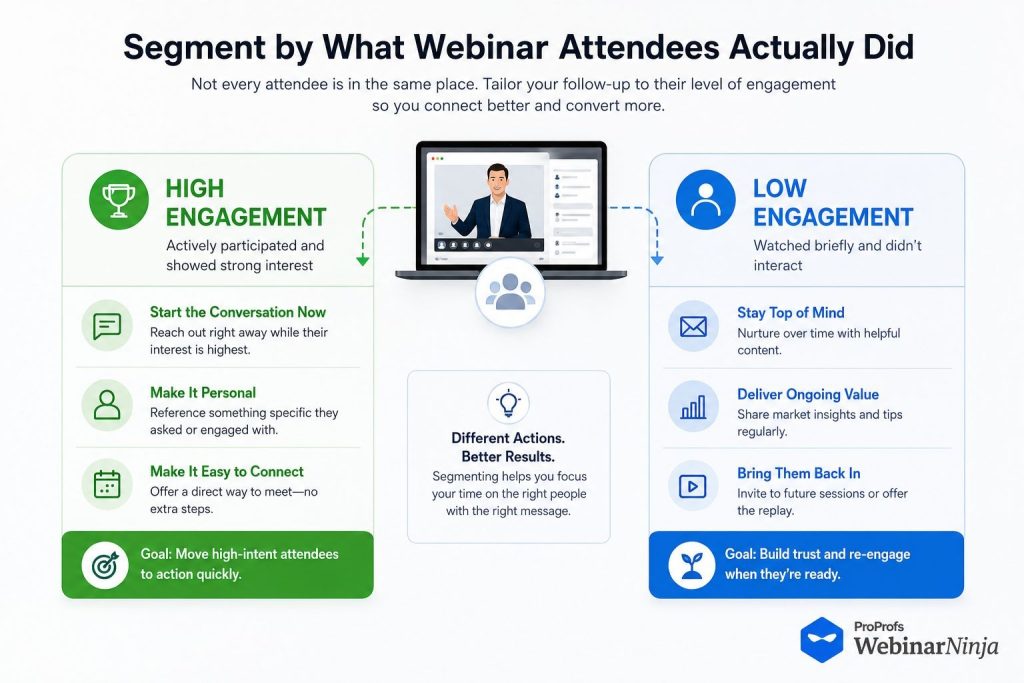
High-engagement attendees (stayed 40+ minutes, submitted Q&A, downloaded handout):
- Send an immediate, personalized consultation invitation
- Reference a specific question they asked during the session
- Offer a direct calendar link, not a contact form
Low-engagement attendees (watched under 15 minutes, no interaction):
- Enter a 30-to-60-day nurture sequence
- Send market updates and additional value content every 10 to 14 days
- Re-invite them to the next live session or offer the replay as a re-entry point
Turn Every Live Session Into an Evergreen Lead Machine
According to data from Kaltura, cited by Content Marketing Institute, 65% of marketers already repurpose webinar content. The real estate professionals who do it systematically build a compounding lead database that grows every month without additional effort.
The WebinarNinja blog covers exactly how to grow your business with automated webinars if you want a step-by-step walkthrough of the setup process.
Here is what one live session can become:
| Asset | How to Create It | Where It Lives |
| Gated replay | Upload a recording behind a registration form | Your website or webinar platform |
| Short-form clips | Pull 60 to 90-second highlight moments | Social media (Instagram, LinkedIn, Facebook) |
| Blog post | Expand the core argument from the session | Your website, SEO value |
| Email sequence | Break key takeaways into a 3-part drip | Your CRM or email platform |
| Lead magnet | Convert the slide deck into a downloadable guide | Registration page incentive |
A one-hour live session produces a lead-generation asset that lasts for 12 months. Gate the replay, distribute the clips, and let every piece drive registrants back to your next session.
That is the compounding return model that separates agents who host occasional webinars from those who build a system.
Setting Up Real Estate Webinars That Run Professionally
Production quality is a credibility signal before a single word is spoken. A real estate professional asking prospects to trust them with the largest financial transaction of their life cannot afford a webinar that looks improvised.
Here is what non-negotiable actually looks like across every element of your setup.
Audio: The One Thing Prospects Will Not Forgive
Video quality is forgivable. Poor audio is not. A prospect who cannot hear you clearly will not sit through 45 minutes straining to catch every word. They will leave within the first five minutes and never come back.
What to get right:
- A dedicated USB or XLR microphone, not your laptop’s built-in mic
- A room with soft furnishings to kill echo: a bedroom or carpeted office beats a bare kitchen
- Headphones to eliminate feedback if you have co-presenters
- A 30-second audio test before every session, not after you go live
Background and Lighting: Your Silent Brand Statement
Every second you are on camera, your background is communicating something about your professionalism. A cluttered shelf, a bright window behind you, or a generic blurred background all send the same message: this person did not prepare.
What to get right:
- Position your key light source in front of your face, not behind it
- Use a branded virtual background or a clean, neutral physical space
- Keep the camera at eye level. Looking down at a laptop reads as unprepared
- Dress as you would for a listing appointment, because this is one
Before we move forward with the other elements, here is a quick video on the best tools & equipment for the webinars:
Slides: Less Is Always More
The agent who shows up with 40 text-heavy slides loses the room by slide 15. Slides are a visual aid, not a script. If your audience is reading your slides, they are not listening to you.
What to get right:
- One concept per slide, no exceptions
- Market data visualized as charts, not listed as numbers in bullet points
- Every chart is sourced and dated, so prospects trust what they are seeing
- A maximum of 20 slides for a 45-minute session
- No slide that takes more than 10 seconds to understand at a glance
Your Registration Page: The First Conversion Happens Here
Before a single prospect attends your webinar, they have to decide it is worth their email address. The title and three bullets on your registration page do all of that work. Get them wrong, and your attendance rate suffers no matter how good the session itself is.
Weak title: “Join our monthly real estate webinar”
Strong title: “5 Reasons Buyers Are Still Winning in This Market and How to Be One of Them”
The difference is in specificity and stakes. A strong title names a fear, promises a resolution, and signals that the session is for a specific person with a specific problem, not everyone with a vague interest in real estate.
Platform: Where Most Agents Make a Silent Mistake
A dropped connection mid-session, an unreliable reminder email, or an attendee who cannot join without downloading an app; each of these costs you registrants before you ever earn them. Your platform is part of your production quality.
What to look for:
- Browser-based access, so a prospect on their phone at 7 PM can join without a single installation step
- Q&A with upvoting so the most important questions surface first
- Per-attendee analytics so you can segment your follow-up by engagement, not just attendance
- Automated email sequences are built in, not bolted on through a separate tool
Real estate teams also increasingly use webinars to train and communicate with new agents, keeping dispersed teams aligned on scripts, market positioning, and compliance without scheduling room-based sessions.
Promoting Real Estate Webinars to the Right Audiences
A compelling webinar with weak promotion is a wasted session. Your distribution strategy determines the quality of your registrants, and the channels you select signal exactly the kind of audience you expect.
Here is how to use each channel correctly.
Your Email List: The Highest-Converting Channel You Already Own
Most agents send one generic announcement to their entire list. That is the mistake. A seller who receives an email about a buyer bootcamp does not register. A seller who receives an email about a pricing strategy session absolutely does.
How to segment before you send:
- Buyers: anyone who has inquired, attended an open house, or downloaded a buyer resource in the last 12 months
- Sellers: past clients with equity, contacts who have asked about market conditions, or anyone who has requested a valuation
- Investors: contacts who have attended a previous investment-focused session or asked about rental properties
Send each segment a version of the email that speaks directly to the problem their webinar solves. Same session, three different subject lines, three different opening sentences.
For a deeper breakdown of how to build email sequences that move registrants toward a consultation, the WebinarNinja blog covers webinar lead generation strategies worth bookmarking.
Social Media: Lead With the Fear, Not the Event
Promotion that describes an event gets ignored. Promotions that describe a feeling get clicks. The difference is in the opening line.
Weak: “Join me this Thursday for a free real estate webinar.”
Strong: “Thinking about selling but paralyzed by this market? I am running a free 45-minute session on the exact data I use to advise my seller clients right now.”
The second version pulls in homeowners who are genuinely in that emotional state. Apply the same logic across every platform: name the fear first, then offer the session as the resolution.
Paid Social: The Most Precise Targeting in Real Estate Marketing
Facebook and Instagram allow geographic targeting by zip code, age range, and renter or homeowner status.
A “First-Time Buyer Workshop” served to renters aged 28 to 42 within three specific zip codes is a remarkably precise audience match that would cost significantly more through traditional advertising channels to reach with equivalent qualification.
What makes a paid promotion work:
- Use the fear-first framing from your organic posts, not a polished ad headline
- Target a tight geographic radius: three to five zip codes maximum
- Set a registration-page objective, not a traffic objective, so the platform optimizes for sign-ups
- Run the ad for five to seven days before the session, not weeks in advance
Co-Hosting: Double Your Reach Without Spending a Dollar
A webinar co-hosted with a mortgage broker, estate attorney, or financial planner doubles your promotional reach instantly.
Both hosts promote to their lists, both audiences receive more comprehensive value, and the session builds two referral relationships simultaneously. It is the most underutilized promotional lever in real estate.
If you are new to structuring a co-hosted session, the WebinarNinja blog on best webinar platforms walks through how to set up a session that works for multiple presenters without technical friction.
Co-hosting combinations that work:
- Agent and mortgage broker: ideal for first-time buyers and high-rate market topics
- Agent and estate attorney: ideal for seller, downsizing, and estate planning audiences
- Agent and financial planner: ideal for investor and wealth-building topics
- Agent and property manager: ideal for landlord and buy-to-let audiences
Choosing Your Channel Mix
| Promotion Channel | Best For | Cost | Lead Quality |
| Email to segmented list | All audiences | Free | Very High |
| Social media organic | Buyer and seller topics | Free | Medium |
| Facebook/Instagram paid | Geographic targeting | Low-Medium | Medium-High |
| Co-hosting partnership | All audiences | Free | High |
| LinkedIn organic | Investor and commercial topics | Free | High |
| Local community groups | First-time buyers | Free | Medium-High |
Before we move forward, watch this quick session on how to promote your webinar effectively:
Measuring Real Estate Webinar Performance
Hosting webinars without tracking the right metrics is how agents convince themselves the channel does not work, when the actual problem is that they are reading the wrong numbers.
Four metrics tell you everything, and each one points to a different part of your system when something is broken.
Registrant-to-Attendee Rate: Is Your Promotion Working?
According to Univid’s 2026 Webinar Benchmarks Report, the median live attendance rate across webinars is 49%. If your rate is significantly below this, the problem is not your content. It is your promotional emails, reminder sequence, or session timing.
What to check when this number is low:
- Your reminder email sequence: send at registration, 24 hours before, and 1 hour before
- Your session time: Tuesday to Thursday between 11 AM and 2 PM consistently outperforms Friday evenings
- Your subject lines: a fear-based or curiosity-driven subject line outperforms a generic event announcement every time
Session Engagement Rate: Is Your Content Holding the Room?
Q&A submissions, poll participation, chat activity, and handout downloads tell you whether your audience is present or has you open in a background tab while scrolling elsewhere. This matters because engagement during the session directly predicts conversion after it.
The same Univid report found that webinars with polls, live reactions, and Q&A enabled a 33% CTA conversion rate. Sessions with minimal interaction average below 20%.
What to check when this number is low:
- Your presentation-to-interaction ratio: aim for an engagement moment every 8 to 10 minutes
- Your poll questions: ask something your audience has a genuine opinion on, not a quiz
- Your Q&A structure: invite questions early, not only at the end, so the conversation builds throughout
Follow-Up Conversion Rate: Is the Trust Translating Into Business?
Within 30 days of attending, what percentage of your attendees book a consultation, request a valuation, or enter an active sales conversation? This is the metric that tells you whether the trust built during the session is doing its job or evaporating in the follow-up.
What to check when this number is low:
- Your first follow-up email: does it pitch too early or give a genuine reason to stay in contact?
- Your segmentation: are high-engagement and low-engagement attendees receiving the same message?
- Your next step: is the CTA specific and low-friction, or vague and commitment-heavy?
Cost Per Qualified Lead: Is the Channel Earning Its Place?
Include your time, platform costs, and any promotional spend. What does a consultation booking from the webinar channel actually cost you?
For most agents running consistent webinars, this number improves substantially within the first three to six months as content is refined, repurposed, and promoted more efficiently.
Compare it against what you spend per consultation through paid ads, direct mail, or referral networks. The moment agents stop treating webinars as optional is usually the comparison.
Your Benchmark Dashboard
| KPI | What It Measures | Benchmark to Target |
| Registrant-to-attendee rate | Promotion and reminder quality | 49%+ |
| Session engagement rate | Content and interaction quality | 33%+ with polls and Q&A |
| Follow-up consultation rate | Follow-up sequence effectiveness | 10 to 15% of attendees |
| Replay-to-lead conversion | On-demand landing page performance | 15 to 25% of viewers |
| Cost per qualified lead | Overall channel efficiency | Track vs. other channels |
Build Your Real Estate Webinar Strategy on a Foundation That Scales
Real estate webinars are not a campaign. They are a system.
One live session produces one result. A monthly cadence, supported by automated versions of your best content and a segmented follow-up sequence, produces compounding returns that grow every quarter. The agents who dominate their markets are not listing more properties. They are the recognized experts before a prospect ever enters the transaction window.
Start with one session this month. Keep the topic specific, the follow-up immediate, and the recording gated so every replay viewer becomes a lead. Improve on what the analytics tell you in month two.
If you are looking for a webinar platform that handles all four formats, automates your follow-up, and requires zero technical setup, WebinarNinja was built for exactly this workflow. Over 30,000 businesses use it to run their webinar programs, with more than 3 million webinars delivered and 10 million leads captured. Registration pages, email sequences, per-attendee analytics, and all four webinar formats are included.
Frequently Asked Questions
What are real estate webinars?
Real estate webinars are live or pre-recorded online sessions where agents, brokers, investors, or educators present property market information, buying and selling strategies, or investment guidance to a registered online audience. They typically include screen-sharing, live Q&A, polls, and automated follow-up email sequences, serving simultaneously as an educational resource and a lead capture mechanism.
How often should real estate agents host webinars?
Most agents who see consistent pipeline results from webinars run at least one live session per month. Monthly cadence creates enough touchpoints to maintain audience familiarity while giving you time to prepare substantive content between sessions. Supplementing monthly live events with automated versions of your strongest recorded content keeps lead capture running continuously between sessions.
What is the ideal length for a real estate webinar?
Between 45 and 60 minutes performs best for real estate audiences. Sessions under 30 minutes tend to sacrifice depth and leave attendees with unanswered questions. Sessions beyond 75 minutes see significant drop-off. Structure your content so that roughly 35 to 40 minutes covers the core material, with the remaining time reserved for live Q&A, which is the section most attendees stay for.
How do you promote a real estate webinar effectively?
Combine three channels: a segmented email send to your existing contacts two weeks and again three days before the session, social media posts that open with a specific prospect fear or pain point, and a targeted paid social campaign using geographic and demographic filters that match your audience. Co-hosting with a mortgage broker or financial planner adds a second audience and increases registrations at zero additional cost.
What webinar platform should real estate agents use?
Look for a platform that includes built-in registration pages, automated email reminders and follow-up sequences, live Q&A with upvoting tools, fast replay availability, and per-attendee analytics. Paying separately for landing page tools, email automation, and analytics significantly inflates your operational cost and complexity. The right platform like WebinarNinja consolidates all of this with no download required for attendees, removing the single biggest friction point for clients joining from their phones.
How do real estate webinars generate leads?
Registration is the lead capture event. Every person who signs up provides their contact information and gives you explicit permission to continue the conversation. The webinar qualifies that lead by revealing intent, someone who attended your seller pricing strategy session is far more specific in their need than a generic website visitor. Your post-webinar follow-up sequence then moves qualified attendees toward a consultation, home valuation request, or other conversion action.
Can real estate agents run automated webinars successfully?
Automated webinars work exceptionally well for evergreen topics that do not depend on current market data, first-time buyer overviews, financing education, neighborhood investment guides, and buying or selling process explanations. Content recorded once can generate leads for months. The key is keeping the substance strong enough to stand without live interaction, and updating the recording when market conditions shift enough to make it inaccurate.
What should a real estate webinar registration page include?
A specific, benefit-led title that names the exact problem being solved; three to four bullet points stating what attendees will learn; the date and time in the attendee's local time zone; speaker credentials that establish authority; and a single, prominent registration button. Removing unnecessary form fields beyond name and email increases registration rates. If you have run previous sessions, including an attendee count or testimonial from a past participant adds meaningful social proof.
How do you follow up after a real estate webinar?
Send a replay link with a brief content summary within 24 hours. Include one content extension, a checklist, guide, or market report, that continues the value of the session. Offer a low-friction next step, such as booking a consultation or requesting a home valuation, framed as a natural continuation rather than a sales prompt. For high-engagement attendees, a personal note referencing a specific question they asked during the Q&A outperforms a mass follow-up email significantly.
How do first-time buyer webinars differ from investor webinars?
First-time buyer webinars should reduce fear and confusion, walking through the process methodically, demystifying financing options, and setting realistic expectations. The tone is supportive and educational. Investor webinars should lead with data: market analysis, cash flow projections, cap rate calculations, and risk assessment frameworks. Investors come to evaluate your analytical credibility. Mixing these tones and objectives in a single session produces content that serves neither audience well.
What is the difference between live and hybrid real estate webinars?
A live webinar is delivered entirely in real time, with you presenting on camera or slides while attendees interact through chat and Q&A. A hybrid webinar uses pre-recorded video segments, such as a property tour or market analysis presentation, while you are live in the chat facilitating discussion. Hybrid formats enable high production quality for visual content, such as property tours and neighborhood walkthroughs, without sacrificing the real-time engagement that makes attendees feel a personal connection.
How do real estate webinars compare to open houses as a lead generation tool?
Open houses capture local, in-person traffic with strong geographic specificity but severe scalability limits. A successful open house produces 20 to 30 meaningful conversations. A well-promoted webinar reaches 100 or more qualified prospects simultaneously across a wider geographic area while building trust over a much longer session. Webinars also create a recorded asset that continues to generate leads for months after the event. The two formats are complementary rather than competitive; webinars often generate prospects who eventually attend your open houses.
Want to host a webinar for free?
Use WebinarNinja to teach, improve marketing, and grow your sales.