
Your last workshop had twelve people in the room, cost you a full day to prep and run, and left you hoarse by 4 p.m.
Your last webinar had 400 registrants, lasted 90 minutes, and continued to generate sign-ups from the replay a week later. So which one actually made you more money?
That’s the real webinar vs. workshop question nobody answers directly, because it depends on what you’re trying to get out of the room, and most businesses have never sat down to work that out.
Here’s why the question matters right now. A study by HubSpot found that 42% of marketers use webinars specifically for lead generation, which tells you the format has shifted from “nice to have” to a primary revenue channel for a huge share of businesses. At the same time, workshops haven’t gone anywhere.
By the end of this guide, you’ll know exactly what separates a webinar from a workshop beyond the marketing copy, which one fits your specific goal (leads, sales, training, or teaching), how to tell when you actually need both, and what to look for in a platform before you commit to running either one regularly.
Webinar vs. Workshop: What’s the Difference?
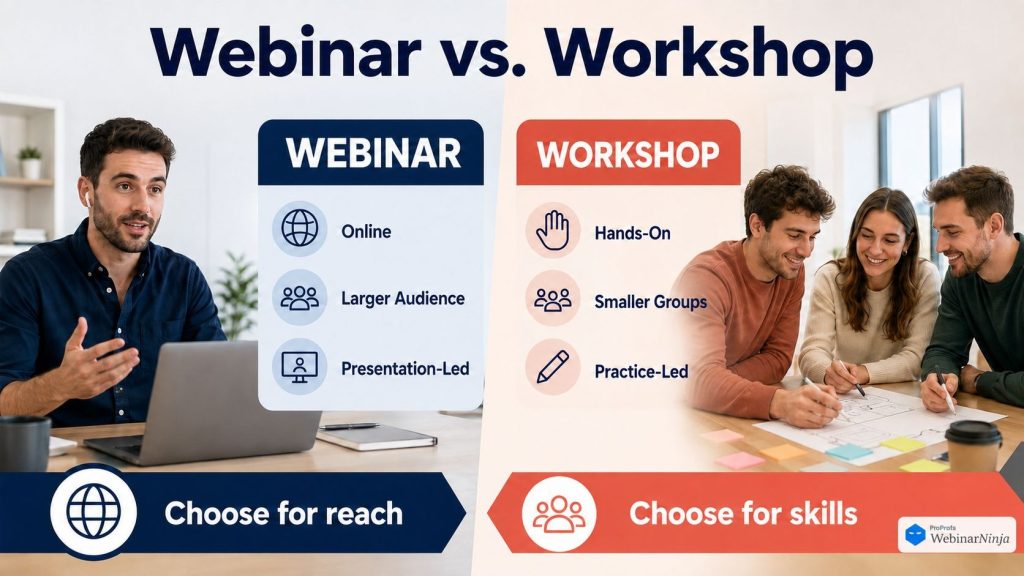
The real difference is group size and participation depth, not the platform used to run it.
That distinction shows up in how each format is structured:
- Webinars run with one (or a few) presenters to many attendees, with the audience mostly listening, watching, and occasionally engaging through chat, polls, or Q&A.
- Workshops run with one facilitator to a small group, with attendees completing exercises, submitting work, or practicing a technique alongside the instructor.
- Webinars are built to be repeated at scale, often recorded once and replayed indefinitely.
- Workshops are built around real-time interaction, so a recording captures the session but rarely replaces the experience.
Neither format is inherently better. A webinar that tries to teach a hands-on skill to 400 people usually fails at the “hands-on” part, and a workshop capped at 15 seats will never generate the reach a lead-generation campaign needs. Matching the format to the goal is the actual decision, not comparing the words themselves.
How Do Webinars and Workshops Compare Side-by-Side?
The table below breaks down the operational differences that actually affect your planning, staffing, and results.
| Factor | Webinar | Workshop |
| Typical group size | 50 to 1,000+ attendees | 5 to 25 participants |
| Interaction level | Chat, Q&A, polls, light engagement | Hands-on exercises, direct feedback |
| Facilitator effort per session | Low to moderate; can run on autopilot | High; requires active guidance throughout |
| Best repeat model | Automated or evergreen replay | Live only, rarely repeatable as-is |
| Primary business goal | Lead generation, sales, and product demos | Skill building, certification, and onboarding |
| Typical length | 30 to 90 minutes | 2 hours to multi-day |
| Cost to scale | Low; same session reaches unlimited viewers | High; more facilitators needed as groups grow |
| Follow-up method | Automated email sequences, replay access | Personalized feedback, assignments, check-ins |
Reading across this table, the pattern is clear: webinars trade depth for reach, and workshops trade reach for depth. Neither trade-off is a flaw. It’s the whole point of choosing one over the other.
Want to host a webinar for free?
Use WebinarNinja to generate leads, improve marketing, and grow your sales.
Why Do People Choose Webinars Over Workshops?
Most businesses reach for a webinar when the goal is generating leads, filling a sales pipeline, or educating a large audience without multiplying their own time. The math is simple: one hour of live presenting can reach hundreds of people at once, and a recorded version continues to work long after the live event ends.
This is where the lead generation webinar model earns its reputation. A well-run webinar captures registrant emails through a landing page, delivers value live, and then routes every attendee (and every no-show) into an automated follow-up sequence. That single session does the work a workshop simply can’t at scale, because a workshop facilitator can only give real attention to a small room.
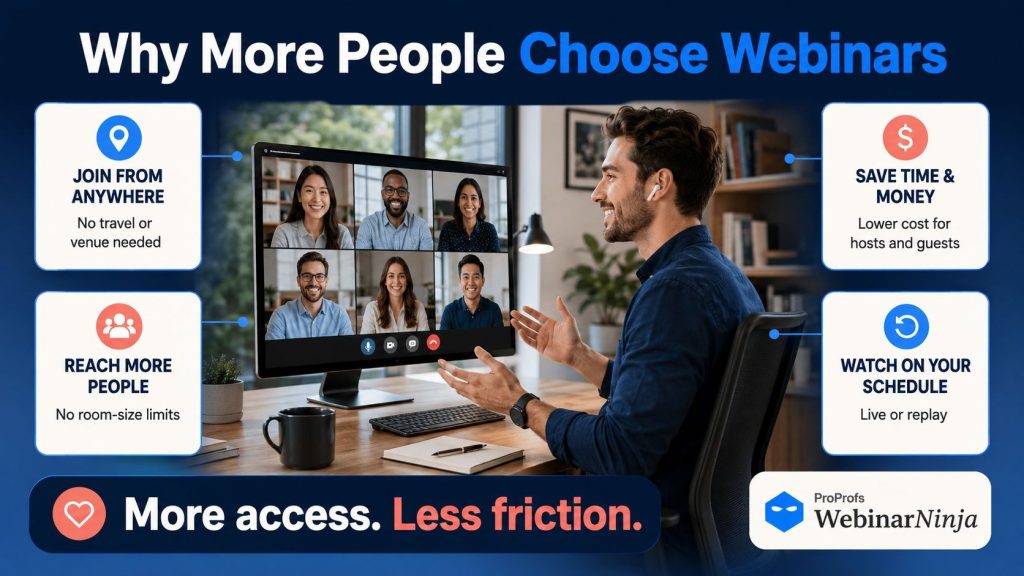
Webinars also solve a problem that workshops create by nature: inconsistent scheduling. Running a live session once and turning it into an evergreen replay means new leads can watch, register, and convert at 2 a.m., without anyone having to host a second live event.
Businesses researching automated webinar platforms are usually trying to solve exactly this problem: how to keep generating leads without repeating the same hour-long pitch every single week.
Check out this quick video on the best benefits of webinars:
When Does a Workshop Make More Sense Than a Webinar?
A workshop wins when the goal is skill transfer, not reach. If attendees need to practice something, submit work for feedback, or walk away able to actually do a task rather than just understand it conceptually, a large passive webinar audience won’t get there. Small groups and direct facilitator attention are mechanisms, not limitations.
This is why workshops dominate in a few specific use cases:
- Employee onboarding, where new hires need to practice a process with a trainer watching and correcting in real time.
- Certification programs in which participants must demonstrate competency before completing.
- Coaching intensives, where the value comes from personalized feedback on each person’s specific situation.
- Technical training, where hands-on troubleshooting can’t be replicated by watching a slide deck.
Businesses running these programs often look for a way to train and communicate with employees or customers without losing the interactive feel of an in-person session. The trade-off is real: workshops rarely scale past a handful of concurrent participants without adding facilitators, and that cost grows linearly with your audience.
A workshop that works beautifully for 15 people usually breaks down at 150, not because the content is wrong, but because one person can only give real attention to so many people at once.
Check out this quick video on how to make your workshops last long:
Want to host a webinar for free?
Use WebinarNinja to generate leads, improve marketing, and grow your sales.
Can You Combine Webinars and Workshops for Better Results?
Yes, and most mature businesses eventually land here. The combination usually looks like a webinar for reach and top-of-funnel education, followed by a smaller, paid workshop or course for those who want to go deeper.
The webinar does the heavy lifting of reaching a wide audience; the workshop monetizes the smaller group that’s ready to commit.
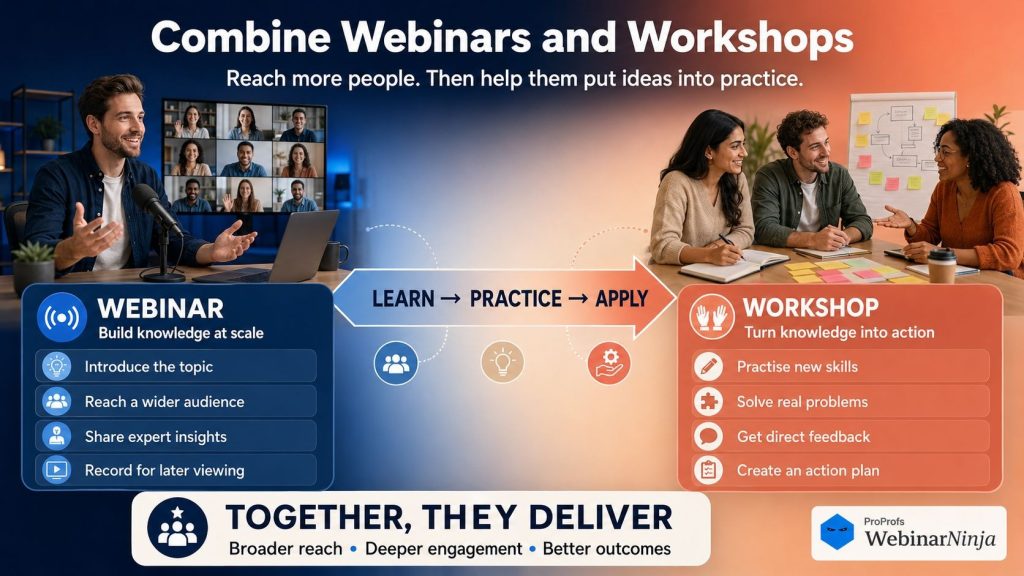
This is the model behind CourseNinja, which comes with WebinarNinja at no extra cost and lets you run live cohort-based courses or on-demand video courses once someone is ready to go beyond a single webinar.
A business can run a free lead-generation webinar to a broad audience, then invite the most engaged registrants into a paid, smaller-group course experience where the actual hands-on teaching happens. That’s the webinar-to-workshop pipeline in practice, and it’s how a single topic turns into both a lead magnet and a revenue stream.
Series and hybrid formats blur this line even further. A webinar series structures multiple sessions under one registration, which works well for a multi-part training that still needs the reach of a webinar format.
Businesses building out a full webinar funnel often start exactly here: one broad session that qualifies interest, followed by a tighter, paid experience for people who raised their hand. If you want to see how the automated side of that funnel works before committing to the workshop layer, Get Started Free with a webinar and test the model with a real audience first.
Webinar vs. Workshop: What Should You Look For in an Ideal Platform?
The right platform needs to support registration, live delivery, and follow-up without forcing you to stitch together three or four separate tools. Look for built-in landing pages, automated email sequences, and analytics that show you exactly who attended, who dropped off, and who’s ready for the next step.
Specific capabilities worth checking before you commit:
- No download required for attendees. Every extra step between “click the link” and “join the session” costs you attendance.
- Support for a large number of live attendees and unlimited automated viewers, so growth doesn’t force a platform switch later.
- Auto-recording with rapid replay, available within seconds of the session ending, not hours later.
- CRM and email integrations, so registrants flow directly into your existing follow-up workflows instead of a spreadsheet.
- The ability to hide attendee counts, which matters more than most people expect when a session has a smaller audience than hoped.
A study by HubSpot in 2024 found that 42% of marketers use webinars specifically for lead generation, which is exactly the group most likely to feel the platform’s limitations once they outgrow simple video calls. Many teams start this search after outgrowing Zoom Meetings, since it lacks native automated webinar functionality and pushes teams toward an expensive add-on.
If that sounds familiar, reviewing Zoom webinar alternatives is usually the fastest way to see what an all-in-one option actually includes by default.
Also, here’s a quick video that will help you check if WebinarNinja is the right webinar platform for your requirements:
How Do You Choose Between a Webinar and a Workshop for Your Goal?
Start with the outcome you actually need, not the format you’re used to running. If the goal is filling a pipeline, educating a broad audience, or demonstrating a product to hundreds of people at once, a webinar is the right tool.
If the goal is teaching a skill that requires practice, feedback, or certification, a workshop’s smaller group size is doing real work, not just limiting your reach.
Use this quick framework:
- Define the primary goal: lead generation, sales, training, or teaching.
- Estimate your realistic audience size: dozens suggest a workshop; hundreds suggest a webinar.
- Decide how much personal feedback participants need: heavy feedback needs favor workshops.
- Check how often you’ll repeat the session: frequent repetition favors an automated webinar format.
- Map out the follow-up: a webinar needs an email sequence; a workshop needs ongoing check-ins.
- Budget your own time realistically: workshops cost more facilitator hours per attendee than webinars ever will.
Most businesses that want to grow sales with a scalable, repeatable format start with a webinar and add a workshop layer once they have an audience worth going deeper with.
Running the numbers before you commit to either format saves you from building a workshop that can’t scale or a webinar that can’t teach what your audience actually needs.
Want to host a webinar for free?
Use WebinarNinja to generate leads, improve marketing, and grow your sales.
Webinar vs. Workshop: Build the Format That Actually Fits Your Goal
The single most useful thing to take from this comparison: a webinar and a workshop aren’t competing tools; they’re solving two different problems, reach versus depth, and most businesses eventually need both. Trying to force one format to do the other’s job is usually where the frustration comes from, not the format itself.
The next step is simple. Write down your primary goal for the next 90 days, whether that’s leads, sales, training, or teaching, and pick the format built for that specific outcome instead of defaulting to whatever you ran last time.
When it’s time to actually run either one, the setup matters as much as the decision. A colleague who just went through this same choice would probably tell you they ended up on a platform that let them test a live webinar first, then add automated replays and a smaller course layer once they saw which registrants wanted to go deeper. WebinarNinja was built for exactly that path: delightfully easy to set up, with live, automated, and series formats available from the same dashboard, so the format you choose today doesn’t lock you out of the one you’ll need next quarter.
Frequently Asked Questions
What is a webinar?
A webinar is an online seminar delivered to a group of attendees, usually one presenter speaking to many viewers through chat, polls, and light interaction. It's commonly used for product demos, lead generation, and audience education at scale.
What is a workshop?
A workshop is a structured, interactive session where a smaller group practices a specific skill under a facilitator's direct guidance. Participants typically complete exercises or receive personalized feedback, which distinguishes it from a passive presentation format.
How long should a webinar or workshop last?
Webinars typically run 30 to 90 minutes to hold audience attention. Workshops often run longer, from two hours to multiple days, because hands-on practice and feedback naturally take more time than a straight presentation.
Can a workshop be run online?
Yes, online workshops are common and use the same video infrastructure as webinars, but with smaller participant caps and more interactive tools like breakout exercises. The format depends more on group size and facilitation style than on the delivery medium.
How many people can attend a webinar versus a workshop?
Webinars can scale to hundreds or thousands of attendees, with WebinarNinja supporting up to 1,000 live attendees and unlimited viewers on automated sessions. Workshops typically cap between 5 and 25 participants to preserve meaningful facilitator interaction.
Is a webinar better than a workshop for lead generation?
Yes, for pure lead generation, webinars generally outperform workshops because they reach a larger audience per hour of effort. Workshops can still generate leads, but their smaller group size makes them less efficient for top-of-funnel volume.
Is a workshop better than a webinar for training?
Yes, workshops are generally better for training that requires practice, feedback, or certification, since facilitators can correct mistakes in real time. Webinars can introduce a topic well, but they rarely replace hands-on skill development.
Can you charge for a webinar the same way you charge for a workshop?
Yes, both formats support paid registration, though workshops more commonly charge premium prices due to their smaller, higher-touch nature. WebinarNinja supports built-in payment processing at registration for both paid webinars and paid course-style workshops.
Which one takes less time to plan, a webinar or a workshop?
Webinars generally take less ongoing time to plan once built, especially in an automated format that runs without a live host. Workshops require more planning per session because facilitators must prepare for live interaction and individualized feedback.
What platform is best for running both webinars and workshops?
An all-in-one platform that supports live, automated, and course-style formats without requiring separate tools tends to work best for both. WebinarNinja covers this range, including CourseNinja for the smaller, workshop-style course experience.
Should a small business start with a webinar or a workshop?
Most small businesses should start with a webinar, since it builds an audience faster and requires less facilitator time per attendee. Once that audience is established, adding a smaller workshop or course layer becomes a natural next step rather than a first move.
Want to host a webinar for free?
Use WebinarNinja to teach, improve marketing, and grow your sales.