

Nobody tells you that a brilliant webinar can die in the inbox.
You can have the perfect topic, a credible speaker, a polished registration page, and still watch half your registrants disappear before the session starts. Not because they lost interest. Because your webinar email marketing strategy gave them every opportunity to forget you existed.
According to Zippia, email drives 57% of all webinar registrations, more than social media, paid ads, and organic search put together. The hosts who fill their live rooms are not spending more on ads or going viral on LinkedIn. They are just sending better, more strategically timed emails to better-segmented lists.
This guide gives you exactly that: the complete webinar email marketing strategy from first invite to post-event follow-up, with the sequence, templates, subject line formulas, and deliverability rules that make the difference between a full room and an empty one.
What Makes a Webinar Email Marketing Strategy Work
A strategy that actually works does three things. First, it runs a deliberate pre-event sequence timed to when people actually register, with the heaviest sending in the final 7 days when 59% of sign-ups occur (Zippia). Second, it segments by engagement level: no-shows receive a different message than attendees, and cold prospects receive a different message than warm leads. Third, it treats the 48 hours after the webinar as the start of the conversion window, not the end of the content.
Every section of this guide is built around those three principles: sequence, segmentation, and follow-up. If you take nothing else away from this page, apply that framework to your next webinar.
Build Webinar Email Sequence That Covers Invite, Reminder & Follow-Up
What Are the Best Pre-Webinar Email Marketing Strategies?
Before tactics, here is the data that should govern every decision in your pre-webinar email marketing strategy:
| Metric | What the data says | Source |
| Best days to send promo emails | Tuesday, Wednesday, Thursday | Customer.io |
| Best time of day | 11 AM in the recipient’s local time zone | OptinMonster |
| When most registrations happen | 59% of sign-ups occur in the final 7 days before the event | Zippia |
| Personalized subject lines | Increase open rates by up to 26% | Campaign Monitor |
| Email marketing ROI | $36 returned for every $1 spent | Litmus, 2024 |
As email strategist Jay Schwedelson, founder of Outcome Media, puts it: “The biggest mistake webinar marketers make is treating their invite email like a one-time announcement rather than the opening move in a sequence. The registration window is a conversation, not a broadcast.”
The key insight from the 59% stat: do not front-load all your promotion in week one and go quiet. Your biggest registration window is the final 7 days. That is where your webinar reminder emails do the real work.
Here are some of the best pre-webinar email marketing strategies to boost attendance and engagement:
1. Create a Compelling Subject Line
The subject line is your first chance to grab attention. Make it clear, intriguing, and action-driven. Highlight the webinar’s value or urgency, such as “Unlock Expert Tips on [Topic]” or “Limited Spots for [Webinar Name] – Save Your Seat Now!”
Personalized subject lines increase open rates by up to 26% (Campaign Monitor) and emails with a strong CTA generate 371% more clicks than those without one (Campaign Monitor). Your subject line is the CTA for the email itself.
Here are 25 subject line formulas by stage: copy, fill in the blanks, send:
Pre-webinar: Invitation:
- “You are invited: [Topic] — [Day], [Date] at [Time]”
- “Free live training: How to [Outcome] in [Timeframe]”
- “[First Name], join us [Day] for [Topic]”
- “Only [X] spots left for [Webinar Name]”
- “Register free: [Topic] with [Speaker Name], [Title]”
Pre-webinar: Reminders:
- “[First Name], [Webinar Name] is in 7 days — are you in?”
- “Tomorrow: [Topic] — here is your join link”
- “Starts today at [Time] — [Webinar Name]”
- “Last chance: [Webinar Name] begins in 2 hours”
- “This is your final reminder: [Webinar Name] today at [Time]”
Post-webinar: Attendees:
- “Thank you for attending — here is the replay”
- “[First Name], here is the [resource] I mentioned on the call”
- “The recording of [Webinar Name] is ready”
- “One thing I forgot to cover during [Webinar Name]…”
Post-webinar: No-shows:
- “You missed it — but you can still watch: [Webinar Name]”
- “[First Name], we saved your spot on the replay”
- “Here is what happened at [Webinar Name] (full recording inside)”
- “Did life get in the way? The replay is waiting for you”
Urgency: use a maximum of once per sequence:
- “48 hours left to register for [Webinar Name]”
- “Registration closes [Day] — [Topic] webinar”
- “[X] people have already registered — will you be there?”
- “This is the last reminder before [Webinar Name] closes”
- “Doors close at midnight: [Webinar Name]”
- “[First Name], your spot expires in 24 hours”
- “Final call: [Webinar Name] starts [Day]”
Three rules for every subject line:
- Keep it under 50 characters: 55% of all emails are opened on mobile devices (Campaign Monitor) and longer lines get cut off on most screens.
- Never use ALL CAPS, multiple exclamation marks, or words like “FREE!!!” or “GUARANTEED”: these trigger spam filters before anyone sees your email.
- Always A/B test before your largest sends; testing subject lines improves conversion rates by up to 37% (Campaign Monitor).
Registration copy, without the guesswork
If writing subject lines and headlines isn’t your strength, WebinarNinja’s AI can generate scroll-stopping options for your topic in seconds, so you’re choosing between proven formulas instead of staring at a blank subject line field.
2. Personalize Your Emails
Personalization goes beyond adding the recipient’s name. Segment your audience based on their interests or past interactions and tailor the content to each group. This helps increase relevance and connection.
3. Send a Series of Reminder Emails
Do not rely on a single invitation email. A one-email approach is the single biggest reason webinar hosts see low attendance rates. 59% of webinar registrations happen in the final 7 days before the event (Zippia), the people who will fill your seats are still deciding in that last week, and a single email sent two weeks out will not reach them when they are ready to commit.
Here is the complete 7-email sequence:
| When to Send | Goal | |
| Save the date | 3–4 weeks before | Plant the date, build anticipation |
| Registration invite | 2 weeks before | Drive initial sign-ups |
| Reminder: non-registrants | 7 days before | Re-engage people who saw the invite but did not sign up |
| Reminder: confirmed registrants | 1–2 days before | Reduce no-shows, set session expectations |
| Day-of alert | 2–3 hours before start | Capture same-day registrations |
| Post-event: Attendees | Within 24 hours | Deliver replay and resources, present next step |
| Post-event: No-shows | Within 24–48 hours | Recover missed attendees via replay |
Emails #3 and #5 are your highest-leverage sends. Most people decide whether to attend in the final 72 hours. Do not skip them. Note that the day-of alert (email #5) should go out 2–3 hours before start, not right at go-live, since that window still gives same-day registrants enough time to actually join.
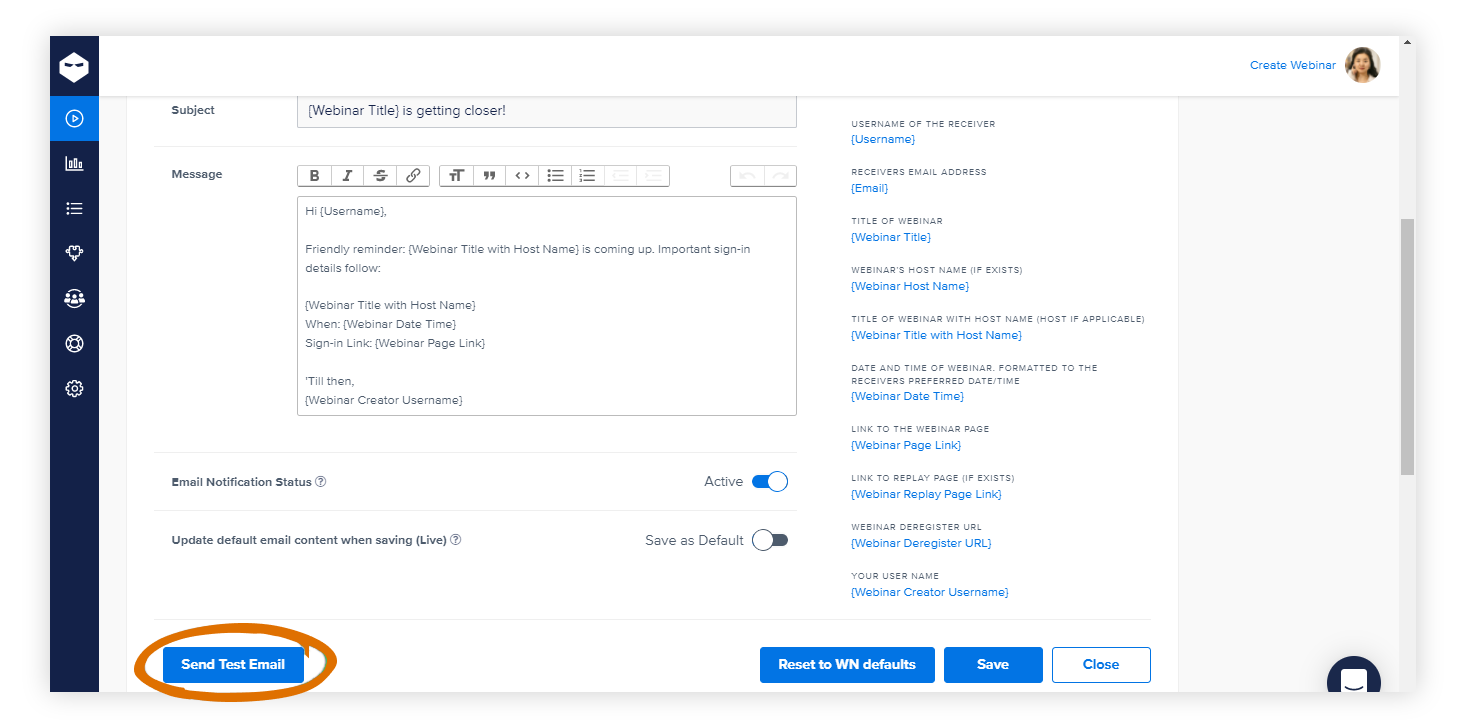
If you use WebinarNinja, emails #4, #5, #6, and #7 are automated the moment someone registers: no manual work, no third-party integrations required.
4. Highlight Key Takeaways and Benefits
Focus on what attendees will gain from the webinar, like actionable insights, exclusive tips, or access to expert knowledge. Use bullet points to list specific learning outcomes and benefits.
5. Include a Clear Call-to-Action (CTA)
Make the CTA visible and enticing. Use action verbs like “Reserve My Spot” or “Join Us Live.” Ensure the CTA button stands out and links directly to the registration page.
6. Leverage Social Proof
Use testimonials, stats, or speaker credentials to build credibility. Mention how many people have already registered, or include a brief bio of your expert speaker to create excitement.
7. Incorporate Visuals
A well-designed email with visuals such as speaker headshots, banners, or sneak peeks of the webinar slides makes it more appealing and engaging. Include images that reflect the tone and content of the webinar. You can also strengthen your brand identity by ensuring every email looks consistent and professional, starting with your signature. Here’s how to add a logo to your email signature for a more polished, branded impression.
8. Optimize for Mobile
Ensure your emails are mobile-responsive so recipients can read and register on their phones. Test different email design layouts to guarantee that the CTA and key points are visible on smaller screens.
9. Offer a Teaser or Exclusive Content
Provide a short preview or free content related to the webinar topic, such as a guide or video snippet, to spark interest. Tease some exclusive insights that will only be available during the live session.
10. Add an Urgency Element
Use time-sensitive language like “Seats are filling fast” or “Join in [number] days” to create a sense of urgency. You can also include a countdown timer to drive immediate action.
| Pro Tip: Test and optimize your campaign. A/B testing different subject lines, CTAs, and content styles helps you understand what resonates best with your audience. Keep refining based on open and click-through rates to maximize registration conversions. |
Automate Your Email Sequence So No Reminder Ever Gets Missed
What Are the Best Post-Webinar Email Marketing Strategies?

If social media is the cocktail party, then email marketing is the ‘meet up for coffee’. The original 1 to 1 channel.
Here are some of the best post-webinar email marketing strategies to engage your audience effectively and maximize the success of your webinar follow-up efforts:
1. Send a Thank-You Email Immediately
Sending a thank-you email to attendees right after the webinar shows appreciation and maintains engagement. Include key highlights from the webinar and provide a link to the recording for those who want to revisit it.
2. Share the Webinar Recording
For attendees and non-attendees alike, sharing the webinar recording via email can extend the reach of your content. Include a compelling subject line to entice recipients to watch it. You can also add timestamps for important sections to improve accessibility.
3. Segment Your Audience for Targeted Follow-Ups
Segment your audience based on their engagement levels, attendees, non-attendees, and active participants. Create personalized emails for each group with content tailored to their interaction with the webinar. For example, send additional resources to engaged attendees and a separate email for those who missed it.
4. Send a Resource Follow-Up Email
In your follow-up email, provide additional resources such as slides, white papers, blog posts, or case studies that complement the webinar content. This not only reinforces your message but also positions you as a resourceful and knowledgeable brand.
5. Include a Strong Call-to-Action (CTA)
Every post-webinar email should have a clear CTA, guiding recipients on the next steps, whether downloading a resource, scheduling a demo, or joining another webinar. Make the CTA actionable and time-sensitive to encourage quicker responses.
6. Offer Exclusive Post-Webinar Content
Reward your attendees with exclusive offers, such as a free consultation, discounts, or access to a premium feature. This adds value and incentivizes future participation. Non-attendees could receive a smaller bonus to encourage them to attend future events.
7. Request Feedback and Conduct Surveys
You can conduct a post-webinar survey, asking participants about their experience, what they liked, and what could be improved. This helps you gather insights for future webinars and keeps the engagement going.
8. Invite Registrants to Your Next Webinar
Capitalize on the momentum by promoting your next webinar or event. Leverage the interest from this session to generate excitement for what’s coming next, using sneak peeks or related content to make the upcoming webinar seem even more attractive.
9. Send Case Studies or Testimonials
Follow up with real-world case studies or testimonials that demonstrate how others benefited from your product or service. This can push hesitant leads down the funnel and build credibility.
10. Create a Drip Email Campaign
For long-term engagement, create a drip campaign that keeps leads warm by providing them with valuable content over time. This could include industry insights, product updates, or additional webinars related to their interests.
| Pro Tip: Automate Your Follow-Up Campaigns using email marketing tools to personalize emails at scale, ensuring timely delivery without manual effort. |
One stat that reframes the post-event window: 25% of all webinar-related sales happen after the event, through follow-up emails (EntrepreneursHQ). The webinar is not the finish line. It is the start of the conversion window. The replay email, the resources email, and the offer email are where a substantial share of the revenue from a webinar actually lives.
Capture the 25% of Sales That Happen After the Webinar Ends
How to Personalize and Segment Your Webinar Emails
When it comes to personalizing and targeting your webinar email marketing strategy, going beyond basic customization can significantly boost engagement and conversions.
Segmented campaigns generate 760% more revenue than non-segmented ones (Campaign Monitor). For email marketing for webinars, split your audience into these four groups at minimum:
| Segment | Who they are | What to send |
| Cold list | Have not heard about this webinar yet | Curiosity-led invite, benefit-first subject line |
| Warm leads | Have engaged with your content before | Personalized invite referencing what they read or watched |
| Registered, not yet attended | Signed up, but the event is upcoming | Reminder sequence plus what to expect email |
| Previous attendees | Attended a past webinar of yours | VIP-angle invite: “You joined us before, here is what is next” |
If you are just starting out, the minimum is this: split registrants from non-registrants and send them different emails from day one. That single change will lift both your open rates and your show-up rate.
Here are some advanced strategies that will set you apart:
1. Use Behavioral Triggers Based on Engagement
Rather than sending generic follow-up emails, tailor your content based on attendee behavior. For instance, if someone stayed for the entire webinar, send them exclusive post-event materials. For those who left early, highlight key points they missed to re-engage their interest.
2. Leverage Dynamic Content Blocks
Embed personalized blocks within your emails that change based on the recipient’s preferences, industry, or role. For example, show different product demos or case studies depending on their sector, making the content more relevant without the need for separate campaigns.
3. Incorporate Time-Sensitive Personalization
Send emails that not only include the recipient’s name but also reflect their time zone. Adjust email delivery times to align with when the recipient is most active online, and reference local times for the webinar to eliminate confusion.
4. Segment Based on Registration Source
Different channels (social media, email lists, ads) bring different types of registrants. Use the registration source to segment your audience and craft targeted emails. For example, social media registrants might prefer shorter, punchier emails, while email list registrants may appreciate detailed insights.
5. Offer Exclusive Bonuses for Early Responders
Create urgency by offering a bonus to those who register within the first few hours of receiving the invitation. This could be anything from early access to the webinar content to a downloadable guide to a discount on a related product or service.
6. Implement AI-Powered Personalization
Most hosts know they should personalize follow-up emails based on what each attendee actually cared about. Almost nobody does it, because matching individual questions and moments to individual recipients by hand takes hours you don’t have.
And modern AI webinar tools like WebinarNinja take a different approach. The moment your webinar ends, AI pulls directly from what was said on the call and writes your follow-up emails, ready to edit and send. If someone asked a specific question live, that context is already built into what gets generated, instead of a generic “thanks for attending” template going out to everyone.
That is the real shortcut to personalization at scale: not guessing what AI “might” suggest, but using a tool that already has the full context of your session and builds from it. Think of it less like a generic writing tool and more like an AI agent that already sat through your webinar and knows exactly who asked what.
7. A/B Test Subject Lines Based on Behavioral Insights
Instead of generic A/B tests, use behavioral data from previous campaigns to inform your subject line testing. If certain segments respond well to urgency, try subject lines like “Last chance to secure your spot!” for that group while using more educational tones for others.
8. Include Personalized Video Thumbnails
A video thumbnail with the recipient’s name on it creates a sense of exclusivity. Tools like Loom or Vidyard can help generate these thumbnails automatically, boosting click-through rates as people are curious about the content tailored just for them.
9. Use Pre-Webinar Surveys for Targeted Follow-ups
Send a short survey after registration to ask attendees about their specific goals for attending the webinar. Then, use that information to segment follow-up emails, providing tailored content that addresses their individual needs.
10. Highlight Social Proof from Industry Peers
Add a section in your emails that showcases testimonials or case studies from previous attendees within the same industry or role. This not only builds trust but makes the recipient feel the webinar is highly relevant to their work.
Segment Your Webinar List and Watch Revenue Climb
Email Deliverability: Why Your Emails May Never Be Seen
You can write the perfect subject line, build the perfect sequence, and send on the perfect day: and still have half your audience never see a single email. The reason: it went to spam.
Deliverability is whether your email lands in the inbox versus the spam folder. According to Validity (2025), senders who keep their bounce rate below 1.5% see inbox placement 10–12% higher. Every percentage point lost to spam is a registration you never get.
Here is what inbox providers judge you on and what to do about each:
| Factor | What it means | What to do |
| Sender authentication | SPF, DKIM, and DMARC records confirm to Gmail, Yahoo, and Outlook that your emails are legitimate | Set up all three in your domain DNS. Gmail and Yahoo now enforce this for high-volume senders. |
| List hygiene | Sending to invalid or inactive addresses raises bounce rates and flags you as low quality | Remove hard bounces immediately. Suppress addresses with no engagement in 6+ months. |
| Spam complaint rate | Every spam report damages your sender reputation | Keep complaint rate below 0.3%. Always include a one-click unsubscribe in every email. |
| Sending consistency | Sudden volume spikes trigger spam filters even if your content is clean | Send consistently. Blasting 10,000 people after months of silence will get filtered. |
| Subject line hygiene | ALL CAPS, multiple exclamation marks, and words like “FREE!!!” trigger automated spam filters | Write subject lines as you would speak to a colleague, clear and direct, not shouted. |
Pro tip: Before any large webinar send, run your email through a free deliverability checker like Mail-Tester or GlockApps. It takes three minutes and shows your spam score, authentication status, and exactly which filters you are likely to trigger before your invite disappears into thousands of spam folders.
How to Track and Analyze Webinar Email Performance
Tracking and analyzing webinar email performance is crucial for understanding how well your email marketing campaigns drive attendance, engagement, and conversions.
Here’s a guide to help you monitor and analyze key metrics:
1. Set Clear Goals for Your Email Campaigns
Before you start tracking, define what success looks like for your webinar emails. Clear goals will guide your analysis, whether it’s increasing registrations, improving attendance rates, or driving engagement with post-webinar content.
Use this table to benchmark your numbers. If a metric is below the benchmark, the third column tells you where to investigate first:
| Metric | Benchmark | If you are below this, check… |
| Email open rate | 25–45% for warm, segmented webinar invite lists | Subject lines; deliverability; list freshness |
| Click-through rate | 2–4% for B2B audiences | CTA clarity; whether CTA appears early and not only at the bottom |
| Webinar show-up rate | ~58% of registrants attend live on average | Reminder cadence; are you sending a day-of alert 2–3 hours before? |
| Post-webinar replay open rate | ~50% for emails with a direct replay link | How fast you send it (within 24 hours is critical); subject line |
| Unsubscribe rate | Below 0.5% is healthy; above 1% is a warning | Sending frequency; content relevance; whether you are segmenting |
Note: Apple Mail Privacy Protection pre-loads email images and inflates open rate figures for Apple Mail users. If your platform shows open rates above 60%, treat that as inflation rather than real engagement. Use click-through rate and registration conversion rate as your primary performance indicators.
How to do it:
- Identify key performance indicators (KPIs) like open rates, click-through rates (CTR), registration conversions, and follow-up engagement.
Establish benchmarks from past campaigns to measure success.
2. Monitor Open Rates
Open rates tell you how effective your subject lines are and whether your audience is interested in your content. A good open rate signals that your subject lines are resonating with your target audience.
How to do it:
- Use your email service provider’s analytics to monitor the percentage of recipients who open your emails.
- Test different subject lines with A/B testing to see what drives higher open rates.
3. Track Click-Through Rates (CTR)
CTR reveals how many recipients clicked on links within your email. It shows the effectiveness of your call-to-action (CTA) and the relevance of your email content.
How to do it:
- Measure the percentage of recipients clicking on registration or webinar-related links.
- Experiment with CTA button designs, placement, and text to improve results.
4. Analyze Conversion Rates
Conversion rate refers to the percentage of email recipients who registered for your webinar after clicking through the email. It directly impacts your ROI and indicates how persuasive your email content is.
How to do it:
- Track how many of the clicks on your CTA lead to actual webinar sign-ups.
- Compare the conversion rates of different email campaigns and analyze which email elements (e.g., visuals, copy) contributed to higher conversions.
5. Examine Bounce Rates
Bounce rates show the percentage of emails that couldn’t be delivered. A high bounce rate can indicate issues with your email list quality or technical problems.
How to do it:
- Use your email platform’s data to analyze hard bounces (invalid addresses) and soft bounces (temporary issues like full inboxes).
- Regularly clean your email list to remove outdated or inactive addresses.
6. Measure Unsubscribe and Spam Rates
High unsubscribe or spam rates indicate that your email content is irrelevant or too frequent for your audience.
How to do it:
- Track the percentage of recipients who unsubscribe or mark your email as spam after receiving your webinar emails.
- Pay attention to any sudden spikes in unsubscribes. This may indicate that you need to adjust your messaging or frequency.
7. Analyze Timing and Frequency
When and how often you send emails impacts their performance. Too many emails can lead to fatigue, while too few might result in missed opportunities.
How to do it:
- Experiment with sending emails on different days and times to determine when your audience is most responsive.
- Space out your emails, including reminders and follow-ups, to build excitement without overwhelming your recipients.
8. Evaluate Post-Webinar Email Engagement
Don’t stop tracking after the webinar ends. Post-webinar follow-up emails are key for nurturing leads and driving additional engagement.
How to do it:
- Track the open and click-through rates of your thank-you emails, feedback requests, and content follow-ups.
- Measure the engagement with additional resources, like replay links, PDFs, or related content.
Here’s Something Worth Your Attention:
Run Your Entire Webinar Email Sequence Without Scheduling a Single Send
Sample Webinar Email Templates
Here are a few readymade email templates to help you get started quickly:
Invitation Email Templates
Invitation Email Template 1:
Subject: You’re Invited! Don’t Miss Our [Webinar Title] on [Date]
Hi [Recipient Name],
I wanted to personally invite you to our upcoming webinar, [Webinar Title], happening on [Webinar Date & Time]. This session will cover [brief details about the topic] and provide you with actionable insights to improve [specific focus area or benefit].
Reserve your spot here: [Link to register]
Join us and get the chance to [mention any key benefits or takeaways, like expert insights, case studies, free resources, etc.].
I hope to see you there!
Best regards,
[Your Name]
[Your Company]
Invitation Email Template 2:
Subject: Unlock [Benefit] in Our Free Webinar – Limited Seats Available
Hi [Recipient Name],
We’re thrilled to invite you to an exclusive webinar: [Webinar Title] on [Date & Time]. You’ll learn [mention key topics or insights] and how to [highlight main value proposition or solution].
Why Attend?
- Learn from [mention speaker’s credentials]
- Get insights into [specific strategy or solution]
- Interactive Q&A session
Register Now: [Registration link]
Seats are limited, so be sure to claim yours today!
Looking forward to seeing you,
[Your Name]
[Your Company]
Reminder Email Templates
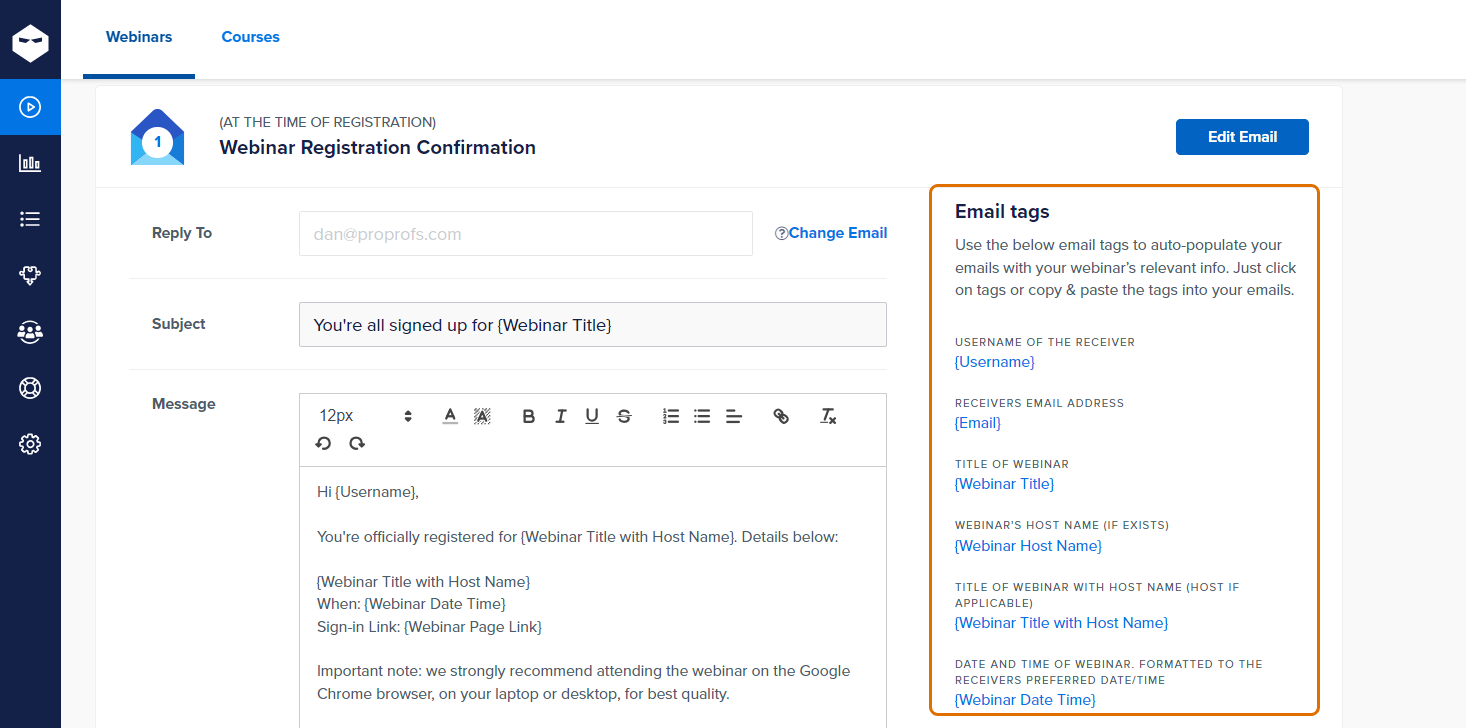
Reminder Email Template 1:
Subject: Don’t Forget – [Webinar Title] Starts Tomorrow!
Hi [Recipient Name],
Just a quick reminder that our [Webinar Title] is happening tomorrow at [Time]! If you haven’t already, be sure to [register/link] and mark your calendar.
We’ll be covering [mention key points or value], and you’ll get the chance to ask questions live during the session.
We’re excited to have you join us!
Join here: [Link to webinar]
Best regards,
[Your Name]
[Your Company]
Reminder Email Template 2:
Subject: Only 1 Day Left – Join Us for [Webinar Title]!
Hi [Recipient Name],
A quick reminder that there’s only 1 day left until [Webinar Title] goes live! We’re all set to deliver [mention valuable insights, strategies, etc.] on [specific topic], and we’d love for you to be part of it.
If you haven’t registered yet, here’s your chance: [Registration Link]
Looking forward to seeing you tomorrow at [Time]!
Best,
[Your Name]
[Your Company]
Post-Webinar Follow-up Email Templates
Follow-up Email Template 1:
Subject: Thank You for Attending! [Webinar Title] Replay & Resources Inside
Hi [Recipient Name],
Thank you for attending our [Webinar Title]! We hope you found it insightful and helpful in understanding [topic/subject matter]. If you missed any part or want to revisit the discussion, here’s the replay link: [Webinar replay link].
Additionally, here are some resources we mentioned during the webinar:
- [Resource 1]
- [Resource 2]
Feel free to reach out if you have any questions!
Best regards,
[Your Name]
[Your Company]
Follow-up Email Template 2:
Subject: We Missed You! Watch the Replay of [Webinar Title]
Hi [Recipient Name],
Sorry we missed you at our recent [Webinar Title]. But don’t worry, you can still catch the full webinar on-demand! Here’s the replay link: [Webinar replay link].
During the session, we discussed [brief recap of key topics] and shared strategies on [key takeaways].
We hope you enjoy the replay, and we’re here to answer any questions you may have.
Best,
[Your Name]
[Your Company]
Takeaway These Templates
Template 1: Initial Invitation
Hi [First Name],
I would like to invite you to a free live webinar:
[Webinar Title] [Day], [Date] | [Start Time] [Timezone] | 60 minutes
In this session, you will learn:
* [Key outcome #1]
* [Key outcome #2]
* [Key outcome #3]
[Speaker Name] is [one-line credential]. In this session, [he/she/they] will share [what makes this specific and different].
[REGISTER FREE — link]
Seats are limited to [X] attendees. If you cannot make it live, register anyway and I will send you the replay.
See you there,
[Your Name]
P.S. Not sure if this is for you? Here is what one past attendee said: “[one-line result or testimonial].”
Template 2: 7-Day Reminder (Non-Registrants)
Hi [First Name],
[Webinar Title] is happening [Day] at [Time]. If you missed my earlier invite, here is the short version of why this matters:
[One sentence: the specific outcome attendees will walk away with.]
[X] people have already registered. The session is capped at [limit].
[SAVE MY SPOT — link]
If you register but cannot attend live, you will automatically receive the replay.
[Your Name]
Template 3: Day-Before Reminder (Registered Attendees)
Hi [First Name],
[Webinar Name] is tomorrow — [Day] at [Time] [Timezone]. You are confirmed.
Here is what to expect:
* Duration: [X] minutes
* Format: [Live / Live with Q&A]
* What to have ready: [e.g., a notepad, your biggest question]
* Join link: [URL]
Tomorrow I will be covering [the single most useful thing they will walk away with].
If something comes up and you cannot make it, reply to this email and I will send you the recording directly.
See you tomorrow,
[Your Name]
Template 4: Day-Of Alert
Hi [First Name],
We go live today at [Time] [Timezone].
Your join link: [URL]
We start on time. See you in [X] hours.
[Your Name]
Template 5: Post-Webinar Follow-Up (Attendees)
Hi [First Name],
Thank you for attending [Webinar Name]. The recording is ready:
[WATCH THE REPLAY — link]
As promised, here are the resources from today’s session:
* [Resource #1]
* [Resource #2]
The three things I want you to take away:
1. [Key takeaway #1]
2. [Key takeaway #2]
3. [Key takeaway #3]
Ready for the next step? [Describe your offer or next action]
[CTA BUTTON — link]
Reply to this email if you have questions. I read every response.
[Your Name]
Template 6: Post-Webinar Follow-Up (No-Shows)
Hi [First Name],
Life happens. You registered for [Webinar Name] but could not make it — no problem.
The full recording is available right now:
[WATCH THE REPLAY — link]
The session covers [one-sentence summary]. It is [X] minutes.
I will also be hosting [next webinar topic] on [date] if you want to join live next time:
[REGISTER FOR NEXT WEBINAR — link]
[Your Name]
Maximize Success With Smart Webinar Email Strategies
A well-run webinar email marketing strategy is not complicated; it is consistent. Send the invite early, load your reminders into the final week, segment by engagement level, and follow up within 24 hours of the event. Those four habits alone will put your attendance rates above what most webinar hosts ever achieve.
The part most people get wrong is the post-event window. The webinar is not the finish line; it is the start of the conversion window. The replay email, the resources email, and the offer email are where a substantial share of webinar revenue actually comes from.
If you want to run all of this without manually scheduling a single send, WebinarNinja handles your entire sequence automatically. Confirmation emails fire the moment someone registers. Reminders go out on the schedule you set. Post-event follow-ups for both attendees and no-shows are triggered the second your webinar ends. It requires no download for attendees, includes built-in landing pages and registration forms, and has a free plan so you can start today.
Sounds like a perfect win-win!
Frequently Asked Questions
What is a webinar email marketing strategy?
A webinar email marketing strategy is a structured sequence of emails sent before, during, and after a webinar to maximize registrations, attendance, and post-event conversions. An effective strategy covers three phases: pre-event emails that drive sign-ups and reduce no-shows, a day-of alert sent 2–3 hours before start, and post-event follow-ups sent within 24–48 hours to attendees and no-shows separately.
How many emails should I send before a webinar?
Send a minimum of 3 pre-webinar emails: an invitation 2 weeks out, a 7-day reminder, and a day-of alert. For maximum attendance, extend to 5 — save the date (3–4 weeks out), invitation (2 weeks out), 7-day reminder, day-before confirmation, and a day-of alert 2–3 hours before start. The reason: 59% of registrations happen in the 7 days before the event (Zippia). The emails you send in that final week do more work than everything before them combined.
What is the best day to send a webinar invitation email?
Tuesday, Wednesday, and Thursday consistently outperform Monday and Friday. Tuesday generates the highest registration volume, while Wednesday and Thursday see the highest live attendance rates (Contrast, 2025). For send time, aim for 11 AM in the recipient's local time zone.
What is a good open rate for webinar invitation emails?
A healthy open rate for a warm, segmented webinar invite list is 25–45%. If you are consistently below 20%, prioritize subject line A/B testing and check your deliverability — your emails may be landing in spam before anyone sees them. Note that Apple Mail Privacy Protection inflates open rates for Apple Mail users, so if your platform shows 60%+, focus on click-through rate as your real engagement metric.
Should I email people who did not attend my webinar?
Yes — and send them a completely different email than your attendees. No-shows registered and expressed interest. They are warm leads who had a scheduling conflict. Send them the replay within 48 hours. Their click-through rates on replay emails are typically higher than cold outreach because they already know who you are and what the session was about.
How do I increase my webinar show-up rate with email?
The four most effective tactics: send a day-before reminder with the join link and what to expect; send a day-of alert 2–3 hours before start; add a calendar invite link in your confirmation email; and use personalized subject lines; they increase open rates by up to 26% (Campaign Monitor), which means more registrants actually see your reminders.
What should a webinar confirmation email include?
The webinar title and date/time in the registrant's timezone, a one-click join link, a calendar add link for Google Calendar and Outlook, a brief bullet list of what the registrant will learn, and the presenter's name with a one-line credential. Keep it short — its only job is to make the event feel real and easy to attend.
How soon after the webinar should I send the follow-up email?
Send the replay to attendees within 24 hours, ideally within 6 hours while the session is still fresh. For no-shows, within 24–48 hours. Each day of delay costs you open rate and click-through rate. If you use WebinarNinja, post-event follow-ups trigger automatically the moment your webinar ends.
What email metrics should I track for webinar campaigns?
Track open rate (directional — treat with caution given Apple MPP inflation), click-through rate (your most reliable engagement metric), registration conversion rate from email, show-up rate, replay view rate, and post-webinar offer conversion rate. The goal is not to optimize each metric separately but to improve the full funnel from first email send to post-event conversion.
Want to host a webinar for free?
Use WebinarNinja to teach, improve marketing, and grow your sales.