
I’ve spent years inside the webinar industry, and the single question I hear more than almost any other is this: “Should I be doing a webinar or a podcast?” It sounds simple. It isn’t. And every time someone picks the wrong format, they either end up with a beautifully produced episode that generates zero leads, or a webinar that could’ve just been a podcast nobody registered for.
Here’s the thing about the webinar vs. podcast debate that most guides won’t tell you: it’s not actually a comparison of formats. It’s a comparison of business outcomes. One format puts names and emails in your pipeline today. The other builds the audience that will fill your pipeline six months from now.
In this guide, I’ll walk you through exactly how these two formats work, where they genuinely differ, and, more importantly, how to know which one your business needs right now. Let’s get started!
What Is the Difference Between a Webinar and a Podcast?
A webinar is a live or pre-recorded online event that combines video, audio, and interactive features, such as polls, Q&A, and registration-based attendance tracking to engage an audience in real time or on demand. A podcast is a pre-recorded audio (or video) series distributed on streaming platforms for passive, asynchronous consumption.
The core difference comes down to intent: webinars are built to convert. Podcasts are built to reach. If you confuse the two and use a podcast where a webinar belongs or vice versa, you lose either the lead data you need or the audience you were trying to build.
WebinarNinja by ProProfs is an all-in-one webinar platform used by over 30,000 businesses for live, automated, hybrid, and series webinars with built-in landing pages, email automation, and analytics, all in one place.
What Are the Key Features and Benefits of Webinars?
A webinar is an interactive online event, live or pre-recorded, that includes video presentations, real-time audience engagement tools, and registration-based attendance tracking, making it one of the most effective formats to host a webinar that both educates and converts. Webinars are purpose-built for lead generation, product education, training, and direct conversion.
Key Features of Webinars
- Registration and Lead Capture: Attendees sign up before joining, creating a lead database automatically.
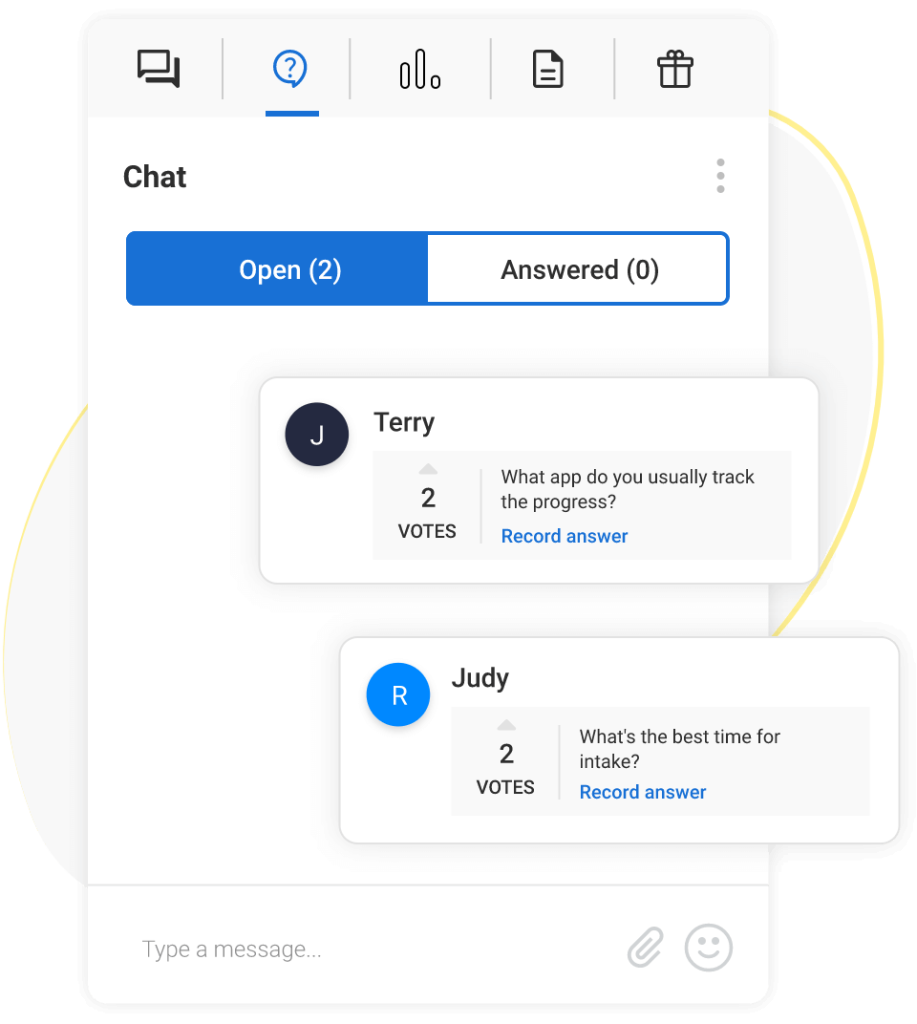
- Live Q&A: Hosts and attendees interact in real time, enabling direct question-and-answer sessions.
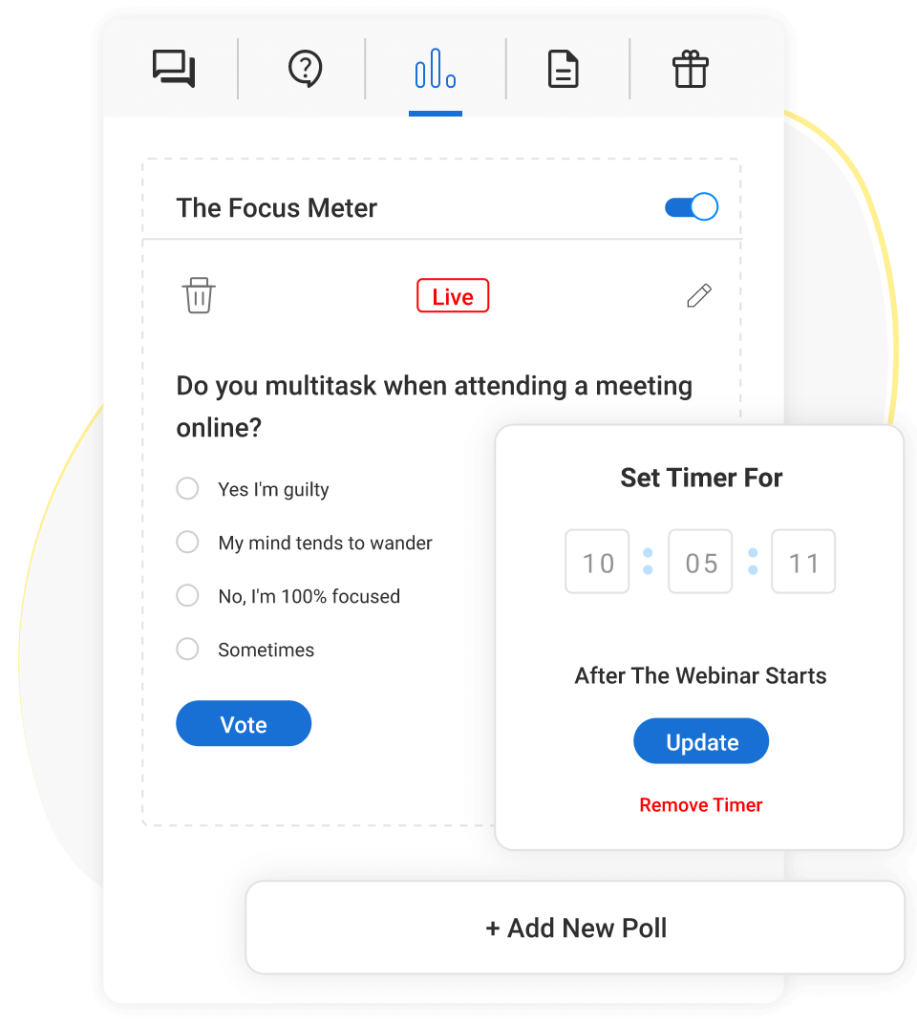
- Polls and Surveys: Real-time polls collect audience input during the session.
- Chat Functions: Attendees communicate with hosts and each other via live chat.
- Screen Sharing and Slide Upload: Presenters share visual content directly in the webinar room.
- HD Video and Audio Streaming: High-quality live and pre-recorded video delivery.
- Automated and Live Options: Webinars can run live or on a pre-recorded, scheduled automation.
- Built-In Email Automation: Registration confirmations, reminders, and follow-up sequences are sent automatically.
- Attendance Analytics: Post-session attendance analytics cover attendance rates, engagement duration, poll responses, and more.
- Custom Branding: Registration pages, email templates, and webinar rooms reflect the host’s brand identity.
- Record and Replay: Every session is recorded and available for on-demand viewing after the event.
- No-Download Access: Modern platforms like WebinarNinja allow attendees to join via browser, eliminating technical friction.
Benefits of Webinars
- Lead Generation With Data: Registration captures name, email, and custom qualifying fields before a single word is spoken.
- Real-Time Feedback Loop: Polls and Q&A tell you exactly what your audience thinks, immediately.
- Direct Conversion Path: Timed call-to-action buttons during a session drive sign-ups, purchases, or demo bookings in the moment.
- Measurable Engagement: Attendance reports, watch duration, and interaction rates let you iterate with data, not guesswork.
- Global Reach With No Travel Cost: Anyone with an internet connection can attend.
- Content Longevity: One live session becomes an automated evergreen webinar, a lead magnet, a social clip, or an email nurture asset.
What Are the Similarities Between Webinars and Podcasts?
Webinars and podcasts are both digital content formats that educate, inform, or entertain an online audience, and both can be produced without a physical venue or large production team. Despite their differences in interactivity and distribution, they share several structural similarities.
- Both Reach Audiences Online: Neither requires physical attendance, removing geography as a barrier.
- Both Use Audio As A Core Medium: Even in webinars, the spoken word carries the majority of the message.
- Both Can Be Consumed On Demand: Recorded webinars and podcast episodes are available after the live moment passes.
- Both Support Episodic Series: Recurring formats, weekly webinars, biweekly podcast episodes — build habitual audience engagement.
- Both Educate And Build Authority: Consistent, valuable content in either format positions the creator as a subject matter expert.
- Both Can Be Produced With Accessible Equipment: A good microphone, stable internet, and the right platform is enough for either format.
What Are the Key Differences Between a Webinar and a Podcast?
The core difference between a webinar and a podcast is interactivity and intent. Webinars are interactive, registration-gated events designed for real-time engagement and direct conversion. Podcasts are passive, open-access audio series designed for long-term audience building.
| Aspect | Webinar | Podcast |
|---|---|---|
| Definition | Live or pre-recorded interactive online event with video, slides, and audience engagement tools | Pre-recorded audio (or video) series available on streaming platforms on demand |
| Format | Video, slides, screen share, live host and/or panel | Audio-first; may include video; typically solo host or interview |
| Interactivity | High — live polls, Q&A, chat, call-to-action buttons | None — one-way broadcast; feedback comes separately via social or reviews |
| Lead capture | Yes — registration collects name, email, and custom qualifying data | No — no built-in registration or lead capture mechanism |
| Real-time availability | Live at a scheduled time; on-demand replay after | Fully asynchronous; no scheduled attendance required |
| Audience engagement | Active — polls, Q&A, and chat during the session | Passive — consumption only; engagement happens outside the episode |
| Primary purpose | Lead generation, conversion, training, product demos | Brand authority, thought leadership, audience loyalty |
| Duration | 30 minutes to 2 hours | 10 to 60 minutes |
| Technology required | Webinar platform (e.g., WebinarNinja), camera, microphone | Recording software (e.g., Audacity), podcast host (e.g., Spotify for Podcasters, Buzzsprout) |
| Monetization | Direct — paid registrations, product sales during session | Indirect — sponsorships, ads, listener memberships over time |
| Analytics | Attendance rates, watch duration, poll responses, engagement score | Download counts, listener location, drop-off point |
| Marketing funnel stage | MOFU to BOFU — converts warm leads | TOFU — builds awareness and brand familiarity |
| Attendee friction | Requires registration; scheduled time or replay link | Zero friction — available instantly on any streaming app |
When Should You Choose a Webinar?
Webinars are the right choice when your goal is lead generation, direct conversion, or real-time education that requires audience interaction. If you need attendee data, a conversion event, or a structured session people register for, use a webinar.
1. When You Need Real-Time Interaction and Q&A
Webinars allow hosts to answer questions on the spot, run live polls, and adapt the session based on audience input. No other digital format offers this in a one-to-many environment.
Example: A B2B SaaS company (like several WebinarNinja customers in the CRM sector) hosts weekly product demo webinars. Prospects ask live questions about integrations and pricing. The sales team converts 30–40% of attendees into demo calls the same week.
2. When Your Topic Requires Visual Aids or Demonstrations
Technical walkthroughs, product demos, and training sessions require screen sharing, slides, and live annotation. Audio alone cannot carry this type of content.
Example: A medical education company hosting CME credit sessions for physicians needs to display clinical slides, collect attendance records for credit verification, and field questions from practitioners in real time, none of which a podcast supports.
3. When You Need to Generate and Qualify Leads Directly
Every webinar registration is a lead. With custom registration fields, you can collect company name, job title, industry, and more, qualifying prospects before they ever attend.
Example: A financial advisor hosting quarterly investment update webinars captures 150–300 registrants per session. Post-webinar email sequences follow up automatically, converting 15–20% into booked consultations. A podcast episode reaches the same audience with zero lead data.
4. When You Have a Time-Sensitive Announcement or Offer
Webinars create urgency. A live session with a visible countdown, a timed offer button, or a limited-attendance registration page drives action that passive podcast content cannot.
Example: A SaaS company launching a new feature hosts a live webinar for existing customers. The session includes a timed upgrade offer that appears at minute 40. Conversion on the offer: 12% of attendees.
5. When You Want Evergreen Lead Generation Without Live Work
Automated webinars run on a pre-set schedule or instantly on demand without the host needing to be present. WebinarNinja’s automated webinar format plays a pre-recorded session at scheduled times, captures registrant data, sends follow-up emails, and fires timed call-to-action buttons, all without live hosting.
Example: A real estate agent records one 45-minute first-time homebuyer education session. It runs every Tuesday and Thursday at 7 PM automatically, generating registrations, nurturing leads, and booking calls, while the agent sleeps.
When Should You Choose a Podcast?
Podcasts are the right choice when your goal is long-term audience building, brand awareness, or thought leadership, and when your audience is not yet warm enough to register for a live event.
1. When Your Audience Consumes Content Passively and On the Go
Podcasts are ideal for audiences with busy schedules who listen during commutes, exercise, or downtime. There is no scheduling requirement and no registration friction.
Example: A financial education brand publishes a biweekly podcast discussing investment trends. Their 10,000 monthly listeners include many who are not yet ready to register for a webinar, but when they eventually are, they already trust the host.
2. When You Are Building Brand Authority Before the Conversion Moment
Podcasts are a top-of-funnel tool. They build the familiarity and trust that makes a future webinar registration feel low-risk.
Example: A cybersecurity company publishes a weekly podcast for IT decision-makers. After 6 months, they run a live webinar on their new platform. Their podcast audience has a 3x higher registration-to-attendance rate than cold traffic because they already know and trust the host.
3. When Your Content Is Narrative or Story-Driven
Some topics like case studies, interviews, thought leadership discussions are better experienced as an intimate conversation than a structured slide presentation. Podcasts handle narrative content more naturally.
How Do You Build a Dual-Format Content Strategy?
Most businesses that generate strong ROI from content marketing do not choose between webinars and podcasts. They use both: sequenced deliberately across the marketing funnel.
Here is a practical framework:
Step 1: Build Awareness With A Podcast (Tofu): Publish a weekly or biweekly podcast targeting your audience’s interests, pain points, and industry news. Distribute on Spotify, Apple Podcasts, and Google Podcasts. Goal: reach and trust.
Step 2: Warm The Audience With Free Webinars (Mofu): Invite your podcast listeners to a free live or automated webinar that goes deeper on a topic covered in an episode. Registration captures the lead. Goal: lead capture and qualification.
Step 3: Convert With Paid Or Gated Webinars (Bofu): Run a webinar series, masterclass, or product demo for registered leads. Use timed CTAs, live Q&A, and post-webinar email sequences. Goal: conversion.
Step 4: Repurpose Across Both Formats: Record your live webinar. Extract the audio for a podcast episode. Clip key moments for social media. Publish the recording as an automated on-demand webinar. One session becomes four assets.
A HubSpot study in 2023 found that companies using three or more content formats, including video and audio, generate 3x more leads than those using a single format.
Which Format Drives Better Lead Quality: Webinar or Podcast?
Lead quality depends on intent, not format. But the mechanics of each format create very different lead profiles.
Webinar Leads Are Higher-Intent By Design: A person who registers for a webinar has taken a deliberate action, they provided their name, email, and often additional qualifying information. They chose a specific date and topic.
Podcast Listeners Are Pre-Qualified By Interest: A listener who has followed your podcast for 20 episodes is highly brand-aware, but you have no contact information for them, no ability to follow up, and no measurable engagement data beyond download counts.
The Practical Verdict: For lead quality that your sales team can act on today, webinars win. For audience quality that builds your brand over 6–18 months, podcasts win. The highest-performing go-to-market strategies sequence both.
How Does WebinarNinja Solve the Key Pain Points of Each Format?
WebinarNinja by ProProfs is built to remove the common objections to running webinars, and to make the transition from podcast-only to a dual-format strategy as friction-free as possible.
| Common Pain Point | How WebinarNinja Addresses It |
|---|---|
| "Webinars are too complex to set up" | Drag-and-drop registration pages; go live in under 10 minutes; no coding required |
| "Attendees hate downloading software" | Browser-based — attendees join with one click, no app download required |
| "I can't be live for every session" | Automated webinar format runs pre-recorded sessions on a set schedule, 24/7 |
| "I don't know who attended or engaged" | Post-webinar reports include attendance rate, watch duration, poll responses, Q&A activity |
| "I need to follow up after the webinar" | Built-in email automation sends follow-up sequences automatically after the session |
| "I want to hide low attendee counts when starting out" | WebinarNinja hides attendee numbers from participants by default |
| "I need webinars for a series or course" | Series webinar format supports multi-session programs with a single registration |
| "I want the recording to keep generating leads" | Every live webinar can be converted to an automated evergreen webinar in one click |
What Are the Technical Requirements for Webinars vs. Podcasts?
Minimum Setup for a Webinar
- A webinar platform with browser-based access (e.g., WebinarNinja)
- A computer with a stable internet connection (minimum 10 Mbps upload)
- A USB microphone or headset with microphone
- A webcam (built-in laptop camera is sufficient for most use cases)
- Presentation slides (uploaded directly or shared via screen)
Minimum Setup for a Podcast
- A recording application (Audacity — free, or Adobe Audition — paid)
- A USB condenser microphone (entry level: $50–$100)
- A podcast hosting platform (Buzzsprout, Anchor, Spotify for Podcasters)
- A quiet recording environment
- Basic audio editing skills or a freelance editor
Cost Comparison At Entry Level:
- Webinar platform: $29–$49/month (WebinarNinja starts at $29/month)
- Podcast hosting: $0–$20/month (many platforms offer free tiers)
- Shared equipment cost (microphone, internet): equivalent
The production cost gap is smaller than most people expect. The meaningful difference is not cost — it is the presence or absence of a conversion mechanism.
Choose the Right Browser-Based Webinar Software and Start Converting Leads Today
The webinar vs. podcast debate is only confusing when the business outcome is left undefined. Once you know what you are trying to accomplish, leads today or an audience over time, the answer is usually clear.
If your goal is a measurable pipeline result this quarter, a webinar with proper registration, follow-up automation, and analytics gives you something a podcast never can: a list of people who raised their hand, a record of how engaged they were, and a direct path to a conversion event. That is not a minor advantage. For the B2B companies, coaches, consultants, healthcare professionals, and real estate professionals who make up the core of WebinarNinja’s user base, webinars are the format that moves the business forward.
If your goal is brand authority and a loyal audience you can activate for future campaigns, podcasts are a legitimate and powerful investment, provided you are patient enough to let the audience compound over 6–18 months.
The best-performing content strategies do not choose. They sequence: podcast for reach, webinar for conversion. If you are only doing one, start with whichever matches your most urgent business need. And when you are ready to run webinars that do not require you to be live for every session, WebinarNinja‘s automated and hybrid formats make the operational side as simple as publishing a podcast episode.
Frequently Asked Questions
Which is better for lead generation, a webinar or a podcast?
Webinars are significantly better for direct lead generation. Every webinar registration captures attendee contact information and qualifying data. Podcasts build audience trust over time but do not provide listener contact details or conversion mechanisms. For near-term pipeline results, webinars are the clear choice.
Can I use both a webinar and a podcast in the same content strategy?
Yes, and the most effective content marketers do exactly this. The recommended sequence is: use a podcast to build top-of-funnel awareness and brand authority, then convert that warm audience into registered webinar attendees for lead capture and direct conversion. One format builds reach; the other closes it.
How much does it cost to start a webinar vs. a podcast?
A podcast can be started for as little as $0–$20 per month using free hosting platforms and a basic USB microphone. A webinar platform like WebinarNinja starts at $29 per month and includes registration pages, email automation, analytics, and recording, making it a more complete marketing tool at a slightly higher price point.
Do attendees need to download software to join a webinar?
Not with browser-based platforms. WebinarNinja allows attendees to join any live, automated, or hybrid webinar directly from their browser, no app download, no plugin, no technical setup. This is one of the most common reasons webinar attendance rates drop, and browser-based access directly resolves it.
What types of businesses benefit most from webinars?
Webinars are most effective for B2B SaaS companies running product demos, coaches and consultants generating leads, healthcare and legal professionals delivering credentialed education (CME, CLE), financial advisors hosting client education sessions, and real estate professionals educating first-time buyers. Any business that needs to capture leads, qualify prospects, or deliver structured training benefits from webinars.
What is an automated or evergreen webinar?
An automated webinar is a pre-recorded session that runs on a set schedule — or instantly on demand — without the host needing to be present live. Registrants sign up, watch the session, receive follow-up emails, and see timed call-to-action buttons, all automatically. WebinarNinja supports automated webinars with built-in scheduling, email sequences, and analytics.
How long should a webinar be compared to a podcast episode?
Webinars typically run 30 minutes to 90 minutes, depending on the topic and level of interaction. Podcast episodes typically run 20 to 60 minutes. For lead-generation webinars, 45–60 minutes with a clear CTA at the end is the format most commonly used by WebinarNinja customers to maximize both engagement and conversion.
Want to host a webinar for free?
Use WebinarNinja to teach, improve marketing, and grow your sales.