


I know many entrepreneurs and leaders who still think reaching thousands of people is a “big business” thing.
But not anymore!
Thanks to webinar software for small businesses, you can reach your target audience and boost engagement without breaking the bank.
They let a small team host reliable live or automated webinars while handling registration, reminders, attendee engagement, and follow-up in one workflow. The best choice depends on your audience size, budget, and whether you need built-in marketing tools, integrations, or advanced engagement features.
Allow me to share some affordable yet feature-rich options with you for enhanced communication and brand visibility.
Here’s a sneak peek at these tools:
| Webinar Software | Best For | Pricing |
|---|---|---|
| WebinarNinja | Best Webinar Software to Generate Leads, Grow Sales, and Teach Better | A FREE 14-day trial is available. Paid starts at $0.30/attendee/month (includes CourseNinja worth $1200) |
| Livestorm | Automated Webinars | Starts at $49/month |
| Webex Webinars | Reaching a Global Audience | Starts at $68.75/license/month |
| GoTo Webinar | Pre-Recorded Webinars | Starts at $49/organizer/month |
| BigMarker | Participant Engagement | Custom pricing |
| ClickMeeting | Branding & Customization | Starts at $26/month |
6 Small Business Webinar Software That Deserve Your Attention
Over the last ten years, I have had opportunities to host hundreds of successful webinars using different webinar tools.
When I got to know that many startup founders and small business owners are looking for the right solution, I felt the need to create this list of the best webinar platforms for small businesses. While I have used most of these tools at some point in my career, a few were recommended to me by peers.
Let’s take a deep dive into each tool’s unique features and pricing details.
1. WebinarNinja
Best Webinar Software to Generate Leads, Grow Sales, and Teach Better
If you are a small business owner looking for affordable yet feature-rich webinar software, I suggest you try WebinarNinja.
I use the tool frequently to host a webinar, present live courses, or conduct live coaching sessions for my audience. I love how the platform allows my attendees to present their screens, chat with other members, and participate in polls for a collaborative learning experience.
But that’s not all.
Beyond the engagement tools, it gives small teams a full marketing engine in one affordable platform. Ready-made templates for registration pages and email sequences mean I can go from zero to a live or automated webinar in minutes.
CRM integrations with HubSpot, Mailchimp, Stripe, and Zapier ensure every lead flows into my existing tools automatically, with no manual exporting needed.
The best part is that no matter which plan you choose for your business, you can create unlimited webinars and send unlimited emails. Sounds like a great deal to me!
Pros:
- Get live or automated webinars running in minutes with ready-made templates and no technical setup.
- Grow your pipeline with branded registration pages and custom forms built to capture and qualify leads.
- Automate email reminders, follow-ups, and replay delivery so no lead is lost after each session.
- Integrate with HubSpot, Mailchimp, Stripe, and 1,000+ tools via Zapier to automate your full funnel.
Cons:
- There is no dark user interface.
- No on-premise or downloadable version.
Pricing: A FREE 14-day trial is available. Paid starts at $0.30/attendee/month (includes CourseNinja worth $1200).
2. Livestorm
Best for Automated Webinars
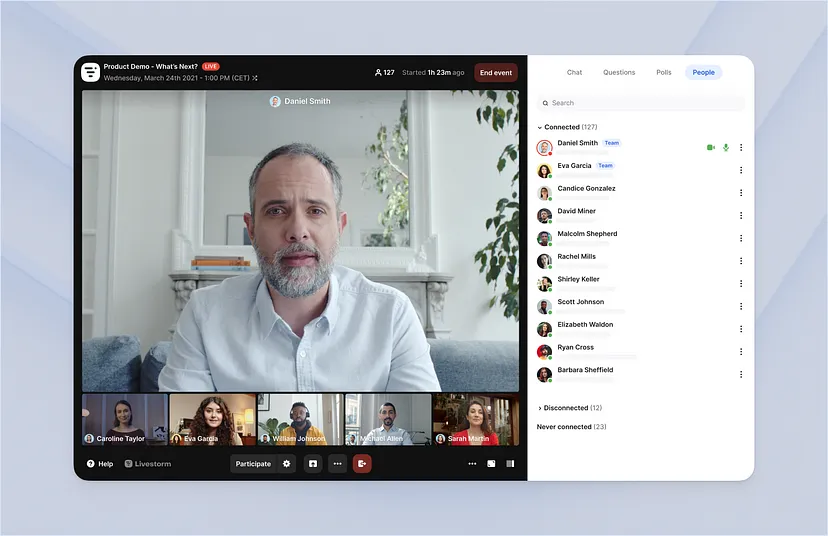
With the AI fever around the block, automation is on everyone’s mind. No wonder Livestorm has been quick to embrace this trend with the help of automated webinars.
So, how exactly does this work? Let me explain.
With Livestorm, I can schedule webinars and online events at a predefined time. I can automate processes like sending email invites, starting the webinar, as well as video sharing.
I’m sure you will find it easy to customize the registration pages of your webinars. You can effortlessly add branding elements like your company logo and optimize the page for conversion.
Pros:
- Real-time polls to engage your webinar participants
- Custom fields to capture additional information in registration forms
- Participation reports to monitor attendance and engagement
- Integrate with HubSpot, Marketo, and multiple other tools
Cons:
- The Pro plan is limited to just four hours per session
- Some users have complained that polls do not always go away even after dismissing them
Pricing: Starts at $79/month
3. Webex Webinars
Best for Reaching a Global Audience
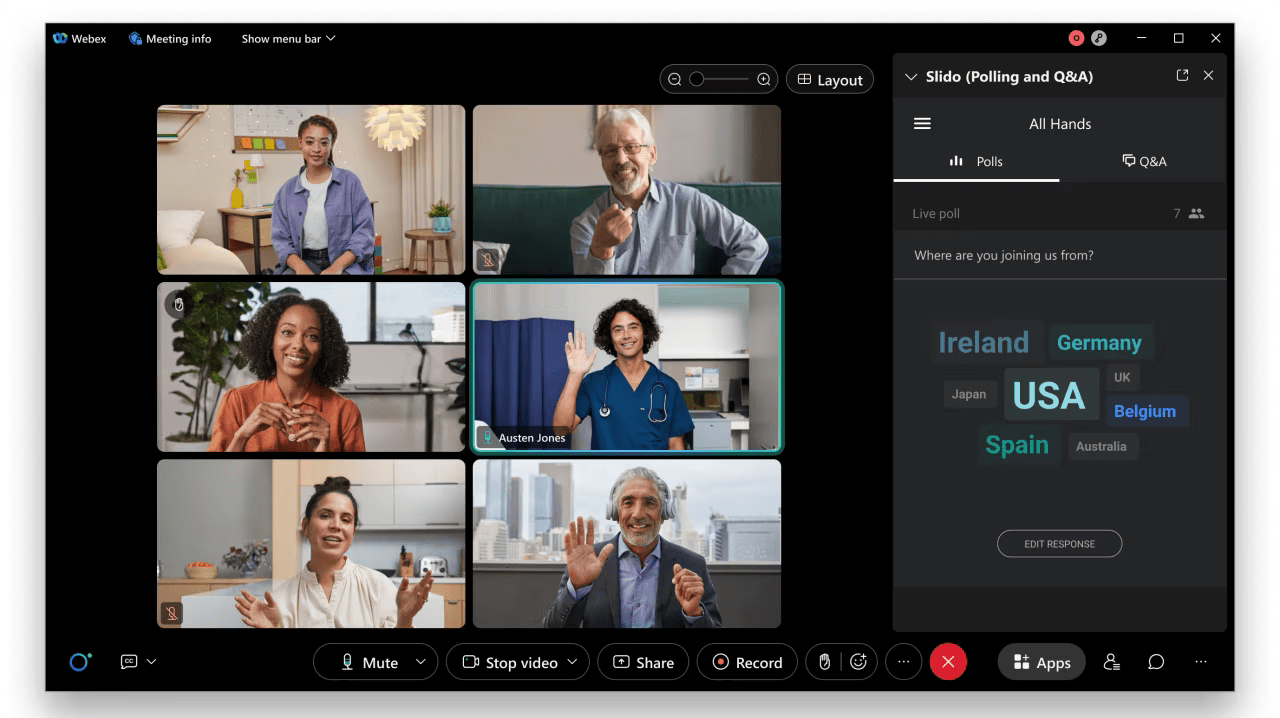
Webex Webinars, designed by CISCO, helps businesses reach and engage global audiences of any size.
The platform helped me reach up to 100,000 attendees, making my webinars an instant hit. While presenting my screen, I can easily place my virtual self directly on the content I share to offer a more immersive experience.
Another noteworthy aspect is the real-time translation feature, which can help attendees translate webinar text in more than a hundred languages. Besides this, I was quite delighted with its support team as it offered me step-by-step guidance right from the start.
Webex’s limited branding and customization options can be a worry for those businesses and entrepreneurs who wish to customize every minute detail of their webinars.
Pros:
- Banner advertisements and announcements can be added to webinars
- Push notifications to keep team members and participants updated
- Integrations with leading CRM tools like Salesforce and Eloqua
- O&A and live polling sessions can be used to engage attendees
Cons:
- When the number of webinar attendees is quite high, the audio and video quality can suffer
- A limited number of branding and customization features
Pricing: Starts at $68.75/license/month
4. GoTo Webinar
Best for Pre-Recorded Webinars
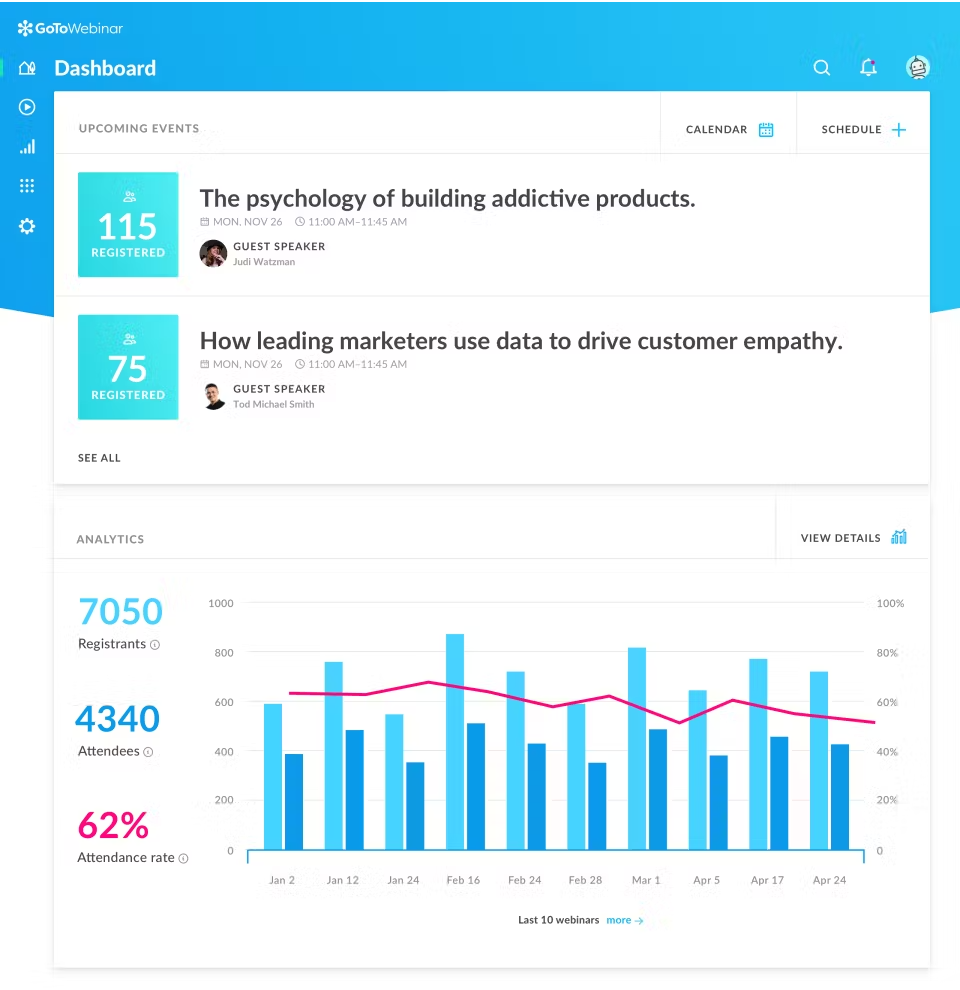
While live webinars are great, pre-recorded webinars help you reach your audience with more confidence. This is where GoTo Webinar can be a game changer for your small business.
I have the option to schedule a webinar at a specific time or allow attendees to watch it as per their own convenience.
Also, pre-recorded doesn’t mean zero interaction. You can still engage your audience with the help of interesting polls, surveys, and handouts.
On the downside, GoTo Webinar needs to improve its mobile experience. Many participants who joined using their smartphones had difficulty in streaming the webinar.
Pros:
- Custom registration forms or quizzes to capture relevant information
- Stripe integration helps you accept payments securely
- Training videos and guides will help you make the most of the platform
- Allow attendees to grab your attention by virtually raising their hands
Cons:
- The recorded webinars feature is only available in the top-tier plans
- The mobile experience needs to be improved
Pricing: Starts at $49/organizer/month
5. BigMarker
Best for Participant Engagement
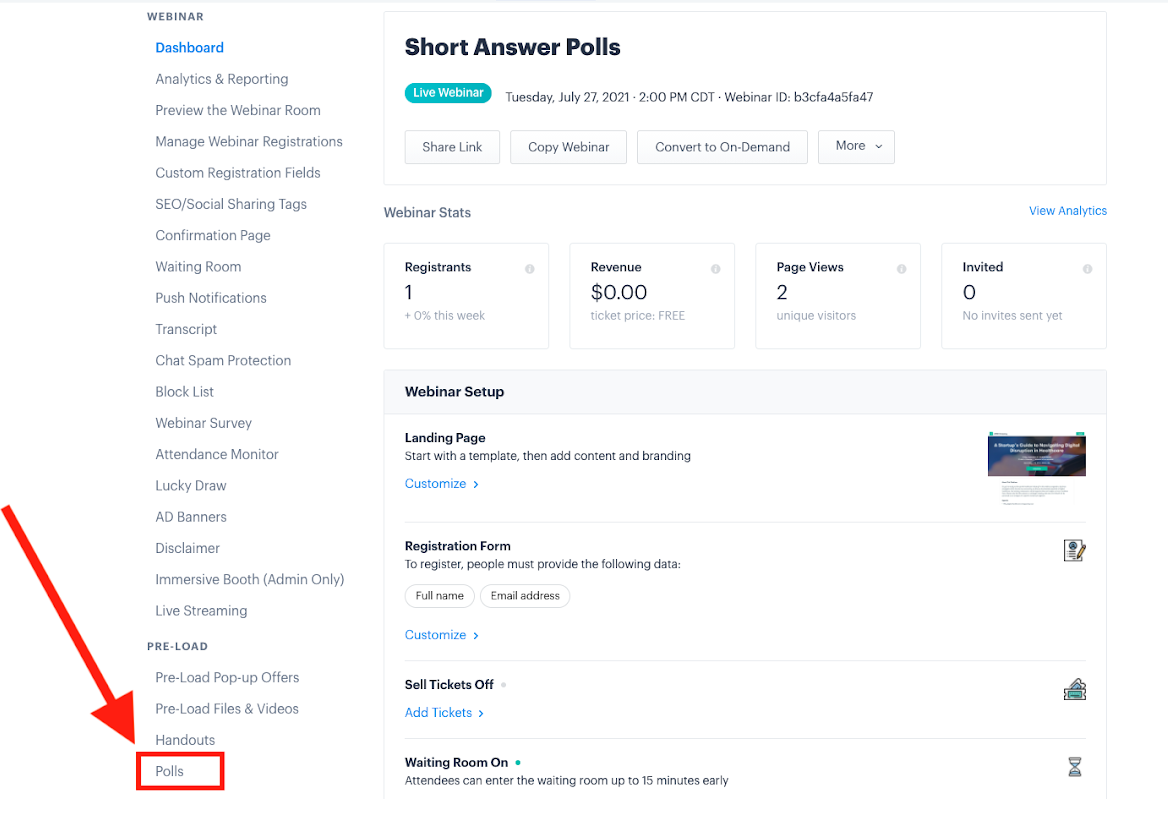
I think BigMarker is meticulously crafted, keeping the needs of marketers in mind.
If you lead the marketing team of your small business, the tool will help you conduct interactive Q&A sessions and collect important information through polls.
You can also guide webinar attendees to the next phase with enticing offers, and extend invitations for individuals to participate on-screen and pose questions directly.
What’s more? You can use BigMarker to create branded landing pages for your business. The tool offers more than 15+ ready-to-use templates so you can simplify the participant registration process.
Pros:
- 24/7 webinar rooms can be created that are always-on for your audience
- CRM integrations to store all your leads in one place
- You can track show-up rates, traffic sources, and multiple other metrics
- YouTube and MP4 videos can be played and paused during live webinars
Cons:
- At times, it can be difficult to integrate the tool with third-party apps
- There is no provision to stream your webinars on social media platforms
Pricing: Custom pricing
6. ClickMeeting
Best for Branding & Customization
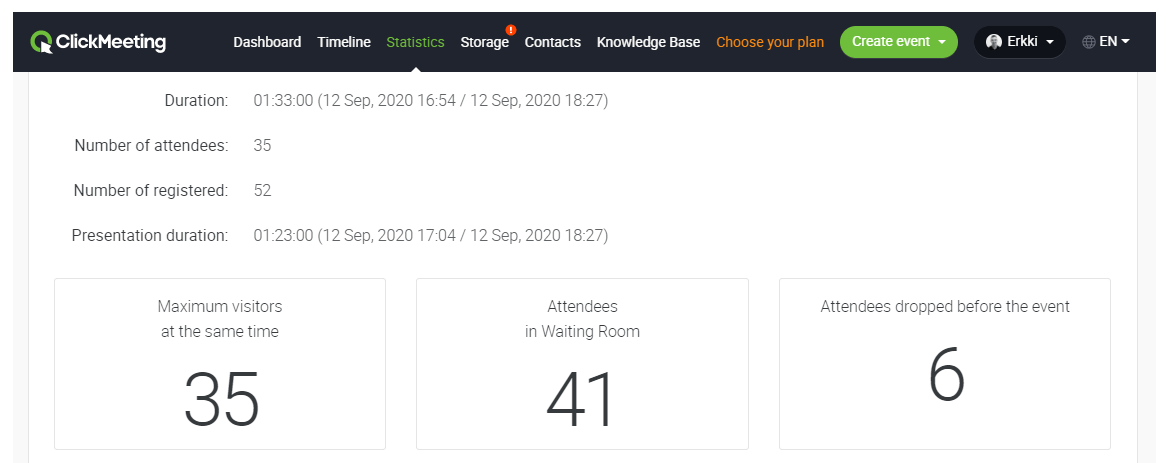
Who doesn’t want to host a well-branded webinar? We all do, right?
This is where ClickMeeting helped me host professional webinars with the help of its customization options. Right from the registration form to numerous email communications, I can brand them easily with our company logo and a custom CTA.
Besides this, I also like how easy it is to set up custom reminders for live webinars. This feature really helped me boost my attendance rate.
On the flip side, many attendees said they didn’t receive the email invitation or reminders. If you face a similar issue, you must ask them to check their spam folders.
Pros:
- Follow-up emails can be automated for improved efficiency
- Q&A sessions can help you collect instant feedback from your attendees
- Live file and video sharing to attract people to your presentation
- Comments and discussions for higher engagement
Cons:
- ClickMeeting’s customer support isn’t up to the mark
- At times, emails will land in a person’s spam folder instead of the main inbox
Pricing: Starts at $26/month
How I Chose the Best Webinar Software for Small Businesses
If you’re trying to pick the best webinar software for a small business without overthinking it, this section will do the heavy lifting. I’m going to make the selection process explainable by showing
(1) the scoring criteria I used,
(2) a side-by-side feature matrix, and
(3) quick guidance based on your business model, audience size, and technical maturity.
I’ll also map the most common small business pain points to the platform(s) that solve them best.
My Scoring Criteria (Clear, Comparable, Small-Business Focused)
I evaluate each platform using the same criteria so the comparison stays fair and consistent.
| Scoring Category | What I Look For | Why It Matters for Small Businesses |
|---|---|---|
| User Reviews and Reliability Signals | Consistent feedback patterns, stability, and common complaints | Small teams cannot afford “surprise” glitches on live days |
| Core Webinar Workflow | Registration, reminders, live delivery, engagement, replays, reporting | You need the full webinar loop, not just a virtual room |
| Ease of Use | Time to set up, UI clarity, templates, learning curve | Most small businesses do not have dedicated webinar ops |
| Automation and Follow-Up | Reminder sequences, replay workflows, automated sessions | Improves show-up rates and turns one webinar into a repeatable asset |
| Integrations | CRM, email marketing, analytics, payment tools | Keeps leads and attendee data from getting trapped in silos |
| Branding and Conversion Assets | Custom registration pages, CTAs, emails, landing pages | Your webinar funnel should look and convert like your brand |
| Support and Onboarding | Responsiveness, docs, live support options | Support becomes your “extra teammate” during launch and troubleshooting |
| Value for Money | What’s included in the plan you’d realistically buy | Small businesses need predictable costs without add-on surprises |
How to use this: If two tools look similar, let your constraints decide. For example, if your team is non-technical, ease of use should outweigh edge-case features you will not use.
My Top 3 Webinar Software for Small Businesses
If you’re busy, let me make your job easier. Here are the three tools I’d shortlist first based on what small teams typically need: fast setup, reliable delivery, and enough marketing support to actually fill the room.
1) WebinarNinja
When I want one platform that covers registration, reminders, live delivery, engagement tools, and follow-up without duct-taping five apps together, this is the one I reach for. It’s especially strong for small businesses that need to move fast but still want a polished, conversion-friendly webinar funnel.
2) Livestorm
If your priority is running more webinars with less manual work, Livestorm stands out. I like it for teams that want scheduling + automated workflows baked into the experience, plus solid integrations so webinar data can move into your CRM and marketing stack cleanly.
3) ClickMeeting
When brand consistency matters a lot (logos, CTAs, reminder emails, the whole look-and-feel), ClickMeeting is a practical choice. It’s a good fit for service businesses and agencies that want webinars to feel like an extension of their website and campaigns.
Choosing a Tool by Business Model, Audience Size, and Technical Maturity
Most “best webinar platform” lists miss this part, but this is where the right choice becomes obvious.
Choose by Business Model
If you sell services (coaching, consulting, agency, professional services):
You’ll win with tools that make your registration pages, reminder emails, and webinar experience look polished.
If you run SaaS or B2B lead gen:
You’ll care about integrations, attendee activity data, and repeatable webinar workflows that connect to your CRM.
If you deliver training, workshops, or internal enablement:
You’ll want smooth delivery, moderation controls, engagement features, and reliable replays.
Choose by Audience Size
Under 100 attendees:
Keep it simple and cost-effective. You want fast setup and templates more than enterprise controls.
100 to 500 attendees:
Reliability and reporting start to matter more, especially if webinars are monthly or weekly.
500+ attendees or global reach:
Prioritize stability at scale, admin controls, and advanced infrastructure features.
Choose by Technical Maturity
Non-technical team (or “I’m doing this myself”):
You want templates, minimal setup, and fewer moving parts.
Lean but capable (you can handle integrations and workflows):
You can benefit from automation and CRM-connected reporting.
Ops-heavy or IT-supported team:
You can use advanced controls and enterprise-grade features effectively.
What Pain Points Do Small Business Webinar Users Face
This is the practical part. If you recognize your situation below, you can skip straight to the best matches.
| Pain Point | What Usually Fixes It | Best Match Platforms in This List |
|---|---|---|
| Low show-up rates | Automated reminders, calendar holds, replay workflows, easy join links | WebinarNinja, Livestorm, ClickMeeting |
| Limited tech skills | Templates, simple UI, fewer integrations required, “all-in-one” workflows | WebinarNinja, ClickMeeting |
| Tight budgets | Predictable pricing, strong core features without pricey add-ons | WebinarNinja, ClickMeeting, GoTo Webinar |
| Content creation overwhelm | Pre-recorded options, replays, automated webinars, reusable formats | GoTo Webinar, Livestorm, WebinarNinja |
| Need strong lead tracking | CRM integrations, attendee activity reporting, source tracking | Livestorm, BigMarker, Webex Webinars |
| Need maximum engagement | Interactive Q&A, polls, on-screen participation, CTAs/offers | BigMarker, WebinarNinja, Livestorm |
| Need strong branding | Custom pages, branded emails, flexible CTAs and layouts | ClickMeeting, BigMarker |
Which Is the Best Webinar Platform for Small Businesses?
So, this brings us to the ultimate question – which is the best webinar software out of all the options shared above?
The best option would depend on factors such as your budget, expected attendance, live webinar features you need, and many others. If you still ask me for my recommendation, I would suggest you go with WebinarNinja.
You can get started with your first webinar in no time with ready-to-use templates for emails, landing pages, and registration forms. It’s also super easy to engage your audience with hangouts, offers, and group chats.
Frequently Asked Questions

What are the leading webinar platforms for startups?
Startups typically do best with tools that are quick to set up, affordable at lower attendee counts, and integrate with common CRMs. Prioritize automation and ease of use so webinars stay consistent even with a small team.
Which webinar tools offer the most affordable plans for small businesses?
The most affordable choice depends on your attendee size and which features are included in the base plan. Compare what’s included for registration, reminders, replays, and analytics before deciding purely on price.
What are the top-rated webinar platforms with easy user interfaces for small businesses?
Look for tools known for simple workflows: creating a webinar, building a registration page, sending reminders, and launching the room should feel straightforward. I like WebinarNinja the best in this aspect. If you need training just to host your first session, it’s probably not the best fit.
Which webinar software has the best audience engagement features for small teams?
You can pick platforms like WebinarNinja that support polls, Q&A, chat, and interactive elements without complicated moderation. Engagement features matter because they keep people present and participating, not multitasking.
Where can I find reviews comparing webinar solutions for small business owners?
Start with reputable software review sites, then cross-check with independent comparisons from trusted business publications. You’re looking for consistent patterns, not one-off opinions.
How do I choose webinar software that integrates well with popular CRM systems?
First, list your CRM and email marketing tools. Then confirm native integrations (or reliable connectors) and check whether key data syncs, including registrants, attendees, and engagement actions.
What pricing plans should I expect for professional webinar hosting services?
Most platforms are priced by attendee limits, host seats, or feature tiers. Expect to pay more as you scale audience size, add automation, or need advanced analytics and integrations.
Want to host a webinar for free?
Use WebinarNinja to teach, improve marketing, and grow your sales.


![10 Free Webinar Software in 2026 [A Detailed Comparison]](https://webinarninja.com/blog/wp-content/uploads/2024/06/Feature_WN_10-Free-Webinar-Software-in-2024-a-Detailed-Comparison.png)