
You can have a great speaker, a strong topic, and a polished landing page, yet still watch signups crawl in far too slowly.
Frustrating? Absolutely.
Common? Also yes.
In most cases, the problem is not your webinar. It is that too few qualified people ever see it.
That is why webinar content syndication matters. Instead of relying on the same tired mix of social posts, cold outreach, and ad spend, you can distribute useful webinar-related content through publishers, partners, and niche platforms that already have your audience. More visibility, more trust, and a much better shot at turning readers into registrants.
- Learn what content syndication for webinars actually means
- See how webinar content syndication helps drive better signups
- Discover the strategies, channels, and assets that make it work
Let’s start with what it actually is:
What Is Webinar Content Syndication?
Content syndication for webinars means publishing or distributing webinar-related content outside your owned channels so third-party audiences can discover your topic, brand, and registration offer. The content may be republished, co-created, gated, promoted through partners, or distributed through paid networks that match your audience.
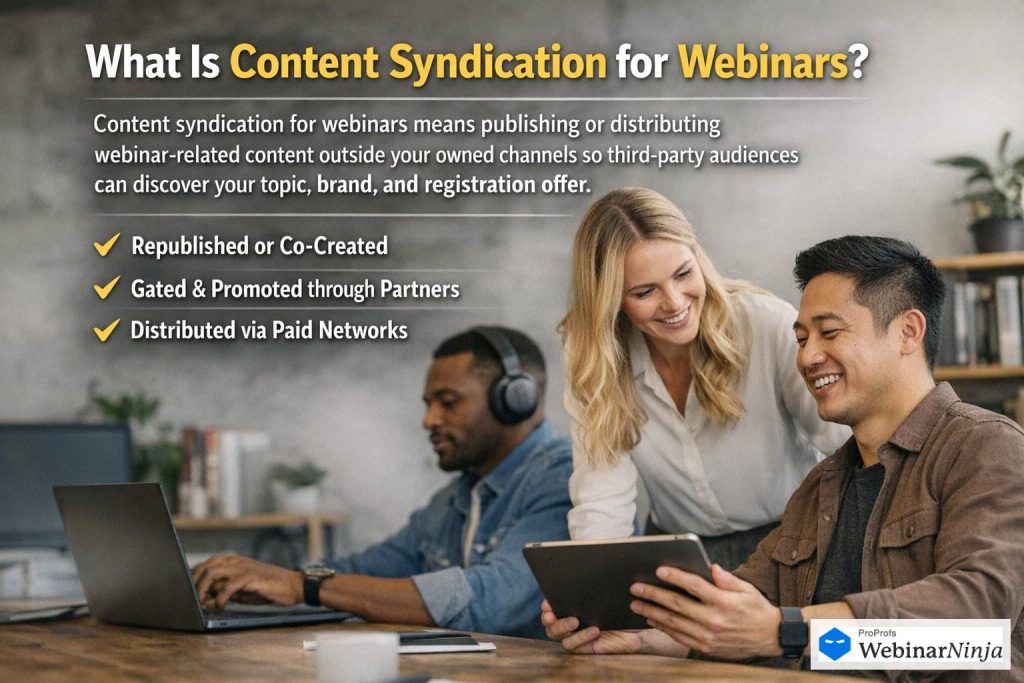
At a practical level, webinar content syndication means you create one useful content asset tied to your webinar topic, then distribute that asset through a third-party channel that already reaches your ideal attendee.
That asset could be:
- A guest article tied to your webinar topic
- A short industry guide or checklist
- A data-led report or benchmark summary
- A co-branded article with a partner
- A community post with a strong takeaway and registration link
- A gated resource that leads to a webinar invitation
The key idea is simple: do not lead with “Join my webinar.” Lead with something your audience actually wants to consume first.
In my experience, this is where most webinar promotion gets stronger. People rarely wake up wanting to register for an unfamiliar webinar. They do, however, click on a useful article, a practical checklist, or a sharp point of view that solves a problem they already care about.
Now that the definition is grounded, the natural next question is performance.
Let’s check how this technique works.
How Content Syndication for Webinars Works
Content syndication for webinars increases registrations by distributing useful webinar-related content through niche publishers, partner brands, communities, and paid syndication channels. The best campaigns lead with educational value, target a clearly defined audience, send traffic to a message-matched registration page, and follow up with reminders and nurture.
- Best for B2B webinars, training webinars, and thought leadership campaigns
- Works best with guides, reports, checklists, case studies, and expert-led articles
- Improves webinar promotion when your owned audience is too small or too saturated
- Performs best when you track source-level signups, attendance, and downstream conversions
Webinars are still worth promoting aggressively. Content Marketing Institute’s 2025 B2B research found that 32% of B2B marketers expect their organizations to increase investment in webinars, which is a strong signal that webinar-led programs still matter in modern B2B marketing
With that snapshot in place, we can define the term more precisely.
Once the definition is clear, the rest of the strategy gets much easier to apply.
Why Does Webinar Content Syndication Increase Registrations?
Webinar content syndication increases registrations by expanding discovery beyond your house list, improving targeting through relevant channels, and building more trust than a cold, standalone invite.
Readers first engage with useful content, then move to the webinar when the topic, timing, and value feel aligned. Besides, here are some other ways in which it helps in increasing your webinar registrations:
Third-Party Audiences Expand Your Reach Faster.
The biggest win is scale with relevance.
Instead of waiting for your own social posts, email list, or retargeting ads to do all the work, syndication places your topic in front of audiences that are already gathered around a publisher, partner, or niche community. You are not building demand from zero. You are stepping into an existing stream of attention.
Tight Targeting Improves Lead Quality.
More reach is only helpful when the audience fits.
A broad placement may send traffic, but a niche placement sends the right traffic. That difference matters. A smaller audience of relevant buyers will usually outperform a larger audience that has no reason to care about your webinar topic, speakers, or offer.
This is especially true for B2B webinars. The right audience often means the right role, industry, company size, maturity level, or buying stage.
Third-Party Context Builds Trust Faster.
Trust is one of the most underrated parts of webinar conversion.
When your audience first encounters your message on a site, newsletter, or partner brand they already respect, your webinar inherits some of that credibility. The registration feels less like a cold interruption and more like a logical next step.
That is why syndication works best when the asset teaches first and invites second.
Content-Primed Registrants Show Up at Higher Rates.
Audiences who register after reading a related educational asset tend to attend at higher rates than those who respond to a cold invite. They already understand the topic and have formed a reason to show up before they ever reach the registration page.
Their intent was built during the content experience, not the signup moment. This is one of the most underrated benefits of leading with content rather than a direct event promotion.
So the benefits are clear.
The next move is to identify the exact business problems this strategy solves.
What Problems Does Webinar Content Syndication Solve?
A good syndication strategy is not just about “more traffic.” It solves specific webinar growth problems that show up again and again.
| Problem | What Usually Happens | How Syndication Helps |
|---|---|---|
| Low registrations | Your webinar only reaches your existing list or followers | Puts the topic in front of new audiences |
| Poor-fit leads | Broad promotion brings low-intent signups | Lets you target niche audiences more precisely |
| Weak trust | Cold audiences hesitate to register | Adds third-party credibility and context |
| Short campaign life | Registrations slow down after the first push | Creates multiple distribution touchpoints over time |
| Weak evergreen performance | The replay gets little traction after the live event | Gives you new channels to promote the recording or replay |
| Limited internal resources | Your team cannot constantly create new promo angles | Lets one core asset work across multiple channels |
I like this section because it keeps the strategy honest. Content syndication is not magic. It is simply a better-fit answer to a specific set of distribution problems.
Now let’s turn that into execution.
The most important choice is not the channel first. It is the asset and the match between the asset and the channel.
Which Assets and Channels Work Best for Webinar Content Syndication?
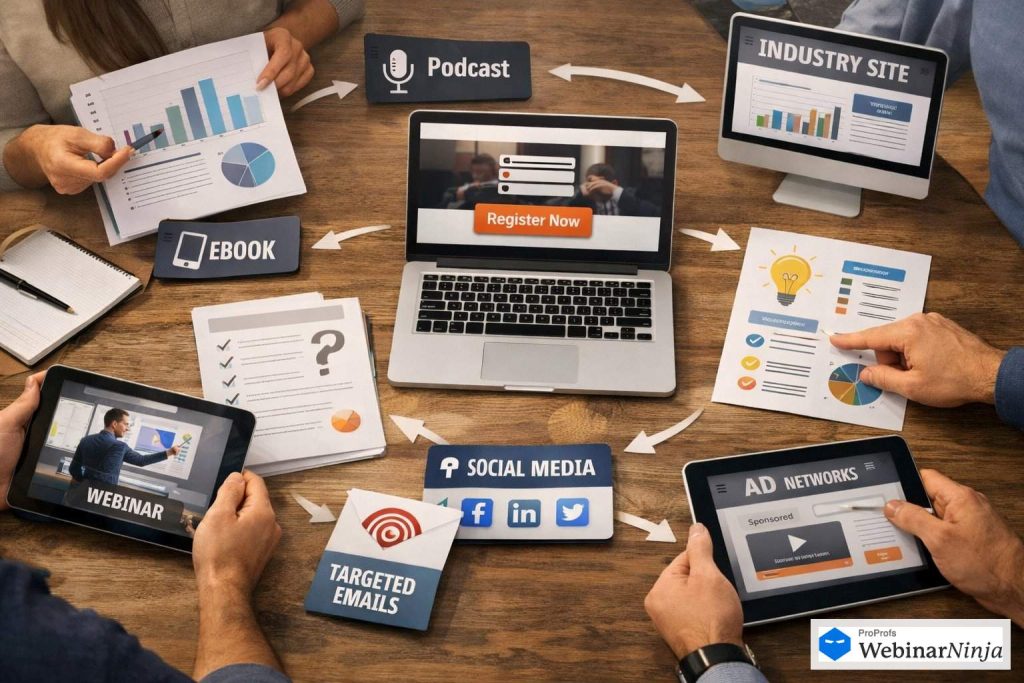
The best webinar syndication campaigns start with one educational asset and one clearly matched distribution channel. The asset should solve a narrow problem, and the channel should already attract the audience most likely to register. Strong fit beats broad reach almost every time.
Choose Assets That Teach Before They Sell.
The strongest syndication assets usually do one of three things:
- They clarify a problem.
- They surface new data.
- They promise a practical outcome.
That means these formats usually work well:
- A benchmark summary
- A case-study article
- A tactical checklist
- A short guide
- A contrarian point-of-view piece
- A co-created expert article
A thin event promo rarely performs well on its own. A useful article that naturally leads into the webinar usually does.
Match Each Asset to One Channel With a Clear Audience Fit.
Your distribution channel should reflect your actual attendee goal.
| Channel Type | Best For | Typical Asset | Main Advantage | Main Limitation |
|---|---|---|---|---|
| Niche publisher | Highly relevant professional audiences | Thought leadership article | Strong audience fit | Lower scale |
| Paid syndication partner | Fast lead generation | Guide, checklist, report | Scalable reach | Can raise CPL |
| Strategic partner | Shared audiences and warm trust | Co-branded webinar or article | Higher credibility | Requires relationships |
| Subject-matter expert or creator | Authority and engagement | Interview, Q&A, expert-led webinar | Strong trust transfer | Harder to standardize |
| Industry community or association | Member-led relevance | Educational post or event listing | High intent | More limited volume |
If I were choosing from scratch, I would start with the narrowest credible audience first. A focused audience of 1,000 right-fit readers often beats a broad audience of 100,000 casual impressions.
The asset-channel fit matters.
Now let’s turn that into concrete tactics you can actually use.
Which Content Syndication Strategies Work Best for Webinars?
Not every syndication tactic will help your webinar the same way. Some channels are great for reach, some are better for lead quality, and some work best when you want to build trust before asking for the signup.
The smartest approach is to choose strategies that match your audience, your webinar topic, and the kind of registrants you actually want.
1. Lead With the Topic, Not the Invitation
Start with the pain point, the question, or the opportunity.
A title like “How SaaS Teams Reduce Trial Drop-Off With Better Onboarding” will usually pull more relevant interest than a generic line about attending a webinar.

The webinar invitation should feel like the logical continuation of the content, not the entire content.
It also helps to match your distribution channel to your audience’s intent stage. An awareness-stage reader on an industry blog needs an educational hook with no selling.
A consideration-stage reader inside a vendor newsletter or partner email list is ready for a more direct value comparison or case study angle. Getting the intent match right is often the difference between a click and a scroll-past.
2. Build One Syndication Asset for One Audience Segment
Do not try to make one article serve everyone.
Create one version for one audience segment, such as:
- Marketing leaders at mid-market SaaS companies
- HR teams evaluating training programs
- Agency founders looking for a scalable lead-generation channel
The narrower the message, the easier it is to convert readers into registrants.
3. Create a Source-Specific Registration Page
This is one of the biggest upgrades you can make.
If three different partners distribute the same asset, send their traffic to three slightly different registration pages. Keep the webinar itself the same, but align the headline, proof points, and CTA language with the source that referred the visitor.
That gives you cleaner tracking and a more message-matched conversion path.
4. Add Partners and Experts to the Distribution Mix
Some of the best syndication does not come from platforms. It comes from people.
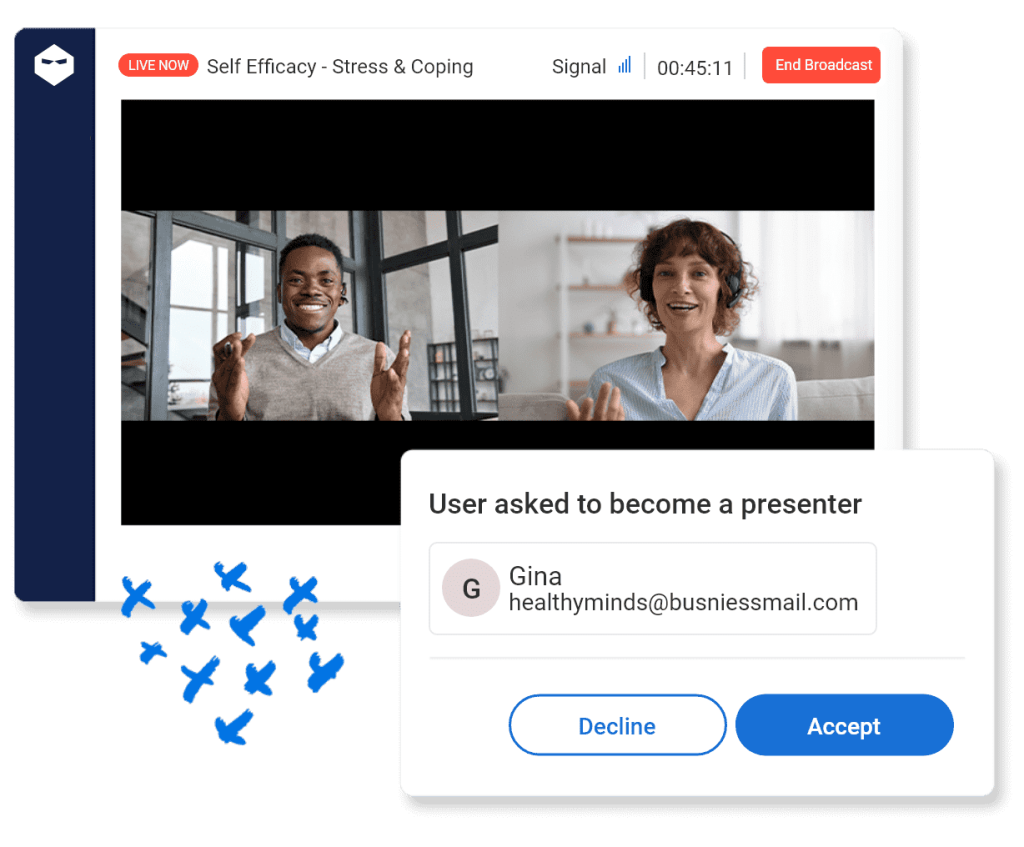
A trusted webinar guest speaker, subject expert, or niche creator can distribute your message with far more credibility than a standalone brand post. This works especially well when the partner also appears in the webinar itself, because the distribution and the content reinforce each other.
5. Use Paid Distribution Only After You Test the Message
Paid syndication can work beautifully, but only after you know the message converts.
I would test the topic, the angle, and the asset organically or through lower-cost channels first. Once you know what gets clicks and registrations, then you can scale with more confidence.
6. Nurture Registrants and Non-Registrants Differently
Do not treat every click the same way.
If someone consumed the asset but did not register, retarget them with a sharper webinar promise. If someone registered, shift the sequence toward reminders, speaker credibility, calendar intent, and attendance motivation.
That one split can improve both registration efficiency and show-up rate.
7. Repurpose the Replay Into an Evergreen Syndication Asset
This is where the strategy compounds.
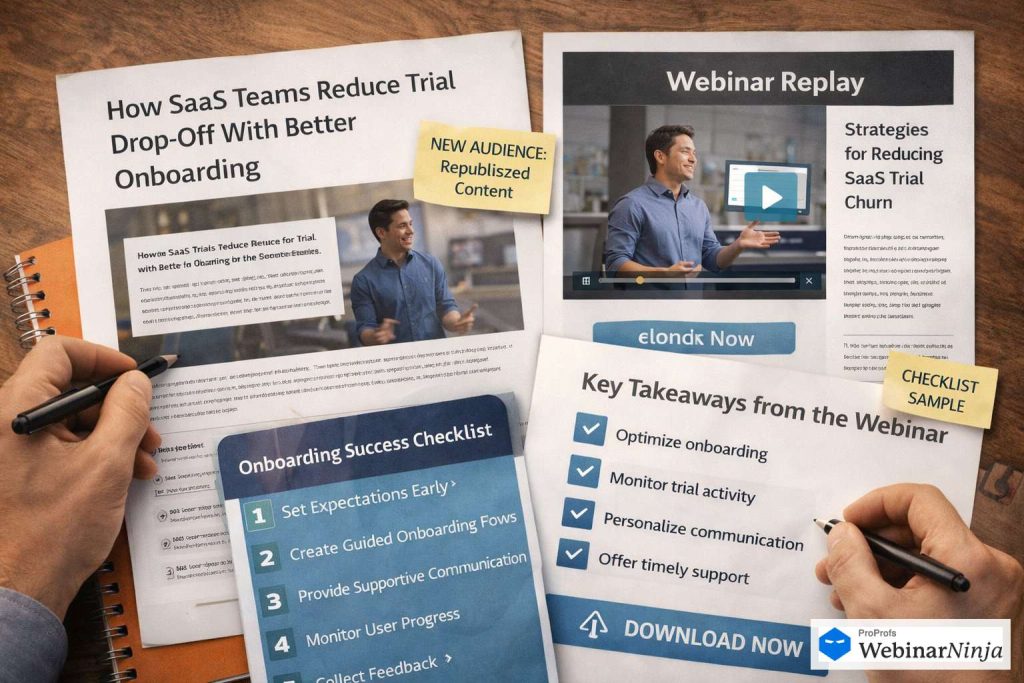
After the live event, repurpose the webinar into:
- A replay page
- A summary article
- A checklist pulled from the talk
- A key-takeaways post
- A short gated recap
This gives you another round of syndication opportunities without creating an entirely new campaign from scratch.
At this point, the strategy is mapped.
The next question is how to turn it into a repeatable workflow instead of a one-time burst.
How Do You Build a Webinar Content Syndication Workflow?
The easiest way to make webinar content syndication work is to treat it like a full campaign, not a one-off promotion. That means you need a clear topic, a useful content asset, the right distribution channel, a strong registration path, and a follow-up plan that keeps working even after the live event ends.
Here is a practical 6-step workflow you can use from start to finish.
1. Pick a Webinar Topic That Already Has Clear Audience Demand
The first step is to choose a topic people already care about. This sounds obvious, but it is where many webinar campaigns go wrong. Teams often pick a topic based on what they want to say rather than what their audience is actively trying to solve.
Start by identifying one urgent problem your target audience is already thinking about. Look at your sales call notes, customer support questions, newsletter replies, LinkedIn comments, blog traffic, and search queries. If the same pain point keeps showing up in multiple places, that is usually a strong webinar topic.
Your topic should be narrow enough to feel useful and specific. A broad title like “How to Improve Marketing” is too vague. A topic like “How B2B SaaS Teams Can Use Content Syndication to Increase Webinar Registrations” is much stronger because it speaks to a defined audience with a clear outcome.
For example, let’s say you sell software to HR teams. Instead of running a webinar called “Employee Training Trends,” you could choose a topic like:
How HR Teams Can Increase Training Attendance Without Sending More Reminder Emails
That topic works better because it focuses on a practical pain point and promises a result.
A good way to test your topic before building the whole campaign is to ask:
Would someone click on an article about this event if there were no webinar attached?
If the answer is yes, you are on the right track.
Outcome: You anchor the campaign around a problem people already want solved, which makes the syndication content much easier to distribute and much more likely to convert.
Here’s a quick video that will help you choose a good webinar topic:
2. Create One Educational Asset That Leads Naturally Into the Webinar
Once you have the topic, do not promote the webinar first. Create a useful piece of content that introduces the topic and gives readers a reason to care.
This asset is what you will actually syndicate. It should stand on its own as something valuable, while also creating curiosity for the webinar.
The best formats for this are:
- A blog post
- A checklist
- A short guide
- A benchmark summary
- A case study
- A practical article with examples
- A co-branded thought leadership piece
The key is to make the content educational, not overly promotional. Give people something useful upfront, then position the webinar as the place where they can go deeper.
For example, if your webinar is called:
How to Use Content Syndication to Increase Webinar Signups
Your syndication asset could be:
7 Distribution Mistakes That Keep Webinars From Filling Up
That article could explain common problems like weak targeting, generic landing pages, poor partner selection, and no retargeting. Then, at the end, you invite readers to join the webinar for a deeper walkthrough.
Another example:
If your webinar is about improving demo conversions, your syndication asset could be a checklist called:
5 Landing Page Elements That Influence B2B Demo Bookings
At the end of that checklist, you can add a CTA like:
Want to see how top-performing teams apply these conversion principles in real campaigns? Join our upcoming webinar.
This works because the webinar feels like the next logical step, not a random ask.
If you are running a small team, keep the workflow simple: write the asset three weeks before the webinar, publish it through one trusted partner two weeks out, send the replay through the same channel the week after.
One asset, one partner, one reusable landing page template. A consistent rhythm like this repeated across every webinar will outperform a scattered multi-channel push every single time.
Outcome: You create something publishers, partners, and communities can share because it gives value first and sells second.
3. Choose One Primary Distribution Channel and Tailor the Asset to It
This is where focus matters. A lot of teams make the mistake of pushing the same generic content everywhere at once. That usually leads to weak performance because every platform has different audience expectations.
Instead, choose one primary distribution channel first and tailor your content to fit it.
Your main options might include:
- A niche industry publisher
- A paid content syndication network
- A strategic partner’s blog or email list
- An industry newsletter
- A professional community
- A trusted influencer or subject matter expert in your space
The right channel depends on who your ideal webinar attendee is.
For example:
- If you are targeting SaaS marketers, a niche MarTech publication or B2B demand-gen newsletter may work better than a broad business site.
- If you are targeting healthcare professionals, a healthcare-focused media outlet or association newsletter will usually be stronger than a general marketing platform.
- If you want senior decision-makers at specific accounts, an ABM-focused syndication partner may make more sense than a public blog placement.
Once you choose the channel, adapt the asset for that audience.
For example, imagine your webinar is for cybersecurity leaders. If you publish through a technical publication, your intro might focus on technical risk, implementation gaps, or operational complexity. But if the same webinar is promoted through a leadership newsletter, you may want to frame it around compliance, business risk, or team efficiency.
You are not changing the webinar itself. You are changing the way you introduce it based on who is reading.
A simple example:
Same webinar:
How to Reduce Security Response Delays With Better Automation
Version for a technical audience:
Learn where manual triage slows down incident response and how security teams can automate first-level investigation workflows.
Version for an executive audience:
See how faster response workflows reduce operational risk, improve team efficiency, and support more resilient security operations.
That small shift can dramatically improve click-through and registration quality.
Outcome: You avoid weak, scattered distribution and put your asset in front of the audience most likely to convert.
4. Build a Registration Page That Matches the Promise of the Syndicated Content
Once someone clicks from your syndicated article, guide, or partner promotion, the registration page should feel like a natural continuation of what they just read.
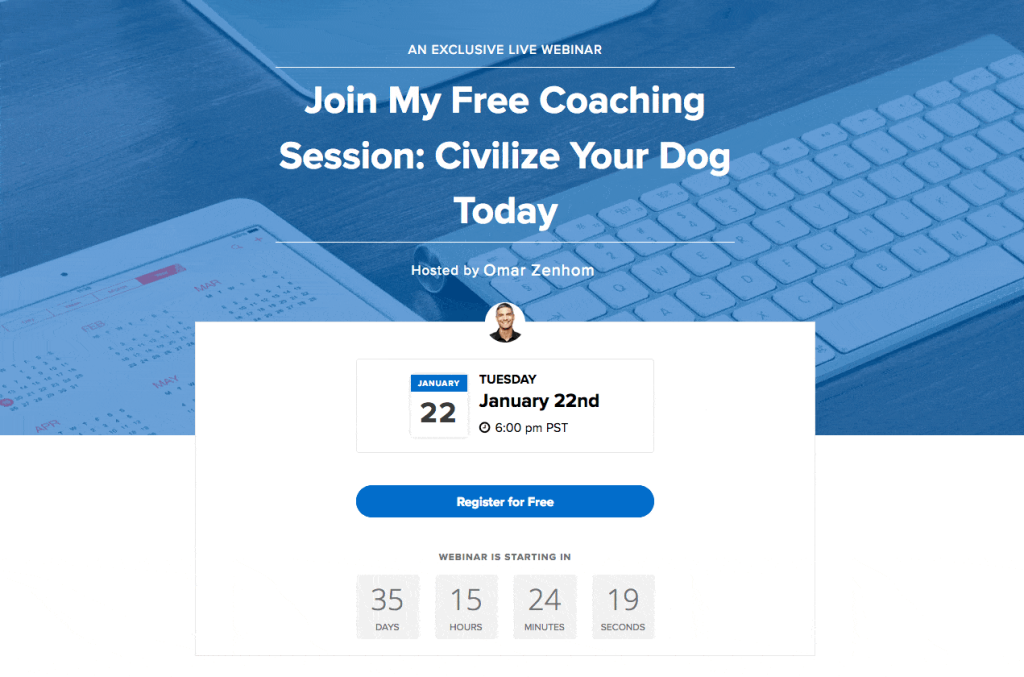
This is one of the most important parts of the workflow. If the article promises one thing and the webinar page says something else, conversions drop fast.
Your webinar landing page should match the content in three ways:
1. Match the topic language
If your article is about “increasing webinar signups through niche content distribution,” your registration page should not suddenly switch to a vague headline like “Join Our Marketing Webinar.” Keep the wording aligned.
2. Match the audience angle
If the syndicated content was written for B2B SaaS marketers, the page should speak directly to them. Mention their use case, their funnel challenges, and the outcomes they care about.
3. Match the promise
If your article promised tactical steps, your webinar page should make it clear that attendees will get tactical steps. If it promised case studies, examples, or templates, say that clearly.
For instance, if the syndicated article is titled:
How B2B Brands Can Use Content Syndication to Fill Webinar Funnels
Then your landing page headline could be:
Learn How to Use Content Syndication to Drive More Qualified Webinar Registrations
And your bullet points could say:
- How to choose syndication channels that fit your audience
- How to turn educational content into webinar signups
- How to track which sources drive the best attendees
That is much stronger than a generic page that only says:
Join our upcoming webinar on webinar marketing.
Also, create separate versions of the landing page when needed. If you are using multiple sources, a page tailored to each source can improve both relevance and attribution.
For example:
- A partner newsletter audience may respond better to a “co-hosted insights” angle
- A paid syndication audience may respond better to a “practical framework” angle
- A community audience may respond better to a “learn from real examples” angle
Outcome: Readers move from content to signup without friction, confusion, or a drop in trust.
Here’s a quick video that will help you get a better idea:
5. Track Every Source Properly and Follow Up Based on Behavior
If you do not track where registrations come from, you will never know which syndication efforts are actually working.
At the very least, every distribution source should have:
- A unique UTM-tagged link
- A source label in your CRM or webinar platform
- A way to measure the signup rate and attendance rate by source
This lets you answer the questions that matter:
- Which article or partner drove the most registrations?
- Which source sent the most qualified attendees?
- Which source brought in people who stayed until the end?
- Which channel influenced demos, meetings, or sales?
Beyond conversion counts, analyze referral traffic quality in GA4 or your analytics platform. Compare engagement rate and average session duration across UTM sources.
A syndication partner that sends 200 visitors with a three-minute average session is more valuable than one sending 500 visitors who leave in ten seconds. Low engagement from a source usually means the audience fit was weak, not that the content was bad.
For example, if you syndicate the same webinar through three places:
- a niche publisher
- a partner newsletter
- a paid syndication platform
You want separate URLs like:
- ?utm_source=nichepublisher&utm_medium=content_syndication&utm_campaign=webinar_signup
- ?utm_source=partnernewsletter&utm_medium=email&utm_campaign=webinar_signup
- ?utm_source=paidsyndication&utm_medium=distribution&utm_campaign=webinar_signup
Then you can compare performance accurately.
But tracking alone is not enough. You also need to follow up based on what people did.
For example:
If someone clicked the syndicated article but did not register:
Retarget them with an ad or email highlighting the main benefit of attending live.
If someone registered but has not opened reminder emails:
Send a shorter reminder with one strong reason to attend, such as a key takeaway, a speaker highlight, or a live Q&A promise.
If someone attended but did not convert after the webinar:
Send a webinar replay, summary, or related resource to keep the topic alive.
This behavior-based follow-up makes the workflow much smarter than a simple traffic push.
Outcome: You can see exactly which channel performs best and improve conversions at every stage of the funnel.
6. Extend the Campaign After the Webinar With Retargeting, Nurture, and Replay Distribution
A webinar campaign should not end when the live session ends. In fact, some of the best syndication value shows up after the event, when you turn the webinar into an evergreen asset.
Start by segmenting your audience into three groups:
- People who saw the content but never registered
- People who registered but did not attend
- People who attended and engaged
Each group should get a different follow-up.
Group 1: Saw the content but never registered
Retarget them with a sharper CTA.
Example:
Missed the live session? Watch the replay to learn the 5 content syndication tactics that helped brands increase webinar signups.
Group 2: Registered but did not attend
Send them the replay with a clear benefit-driven subject line.
Example:
You signed up for our webinar. Here is the replay and the key framework we covered.
Group 3: Attended the webinar
Follow up with the next logical action, such as a template, a demo, a checklist, or a related guide.
Example:
Thanks for joining us. Here is the webinar recap and a checklist you can use to build your own syndication campaign.
Then turn the webinar itself into more content. You can create:
- A replay landing page
- A blog post summarizing the biggest takeaways
- Short social clips
- A checklist based on the webinar
- A follow-up guest article using the strongest insight from the session
- A nurture sequence for future leads
For example, if your live webinar was about webinar content syndication, you could repurpose it into:
- A blog post: “What We Learned About Content Syndication for Webinars.”
- A checklist: “6 Things to Set Up Before Syndicating a Webinar Campaign”
- A replay page: “Watch the Webinar: How to Increase Webinar Registrations Through Content Distribution.”
This gives your campaign a much longer shelf life and helps you get more returns from the original effort.
Outcome: The webinar continues generating leads, traffic, and conversion opportunities long after the live event is over.
Case Study
Before we move forward, check out this quick case study on how Sales Market Fit generates 20,000+ leads every webinar, using WebinarNinja as their webinar platform:
Execution is one thing, though.
Measurement is what tells you whether the system is actually working.
Which Metrics Show Whether Webinar Content Syndication Is Working?
The goal is not just more registrations. The real goal is more qualified registrations at a better acquisition cost, with stronger attendance and downstream conversion.
| Metric | What It Tells You | Why It Matters |
|---|---|---|
| Cost per lead | How efficiently a source generates signups | Helps you compare paid and unpaid channels |
| Registration rate | How well the landing page converts traffic | Shows whether the message match is strong |
| Attendance rate | Whether registrants actually show up | Indicates audience quality and reminder strength |
| Engagement rate | Whether attendees stay and interact | Shows topic fit and webinar quality |
| Conversion to demo, call, or sale | Whether the webinar produces business value | Connects syndication to pipeline, not vanity |
| Replay consumption | Whether post-event content still performs | Helps evaluate evergreen value |
If performance is weak, I would check these in order:
- Is the audience fit wrong?
- Is the asset too promotional?
- Does the landing page match the article’s promise?
- Are reminder emails too weak or too sparse?
- Is the webinar topic interesting, but not urgent?
That order matters. Teams often blame the channel first, when the real issue is the message or the conversion path.
Now let’s look at a pattern that larger brands use well.
You do not need their budget to learn from the structure.
Real Webinar Content Syndication Example
A useful enterprise pattern is this: publish flagship research, let that research power articles and partner pickup, then invite that warmed audience into a webinar that expands on the findings.
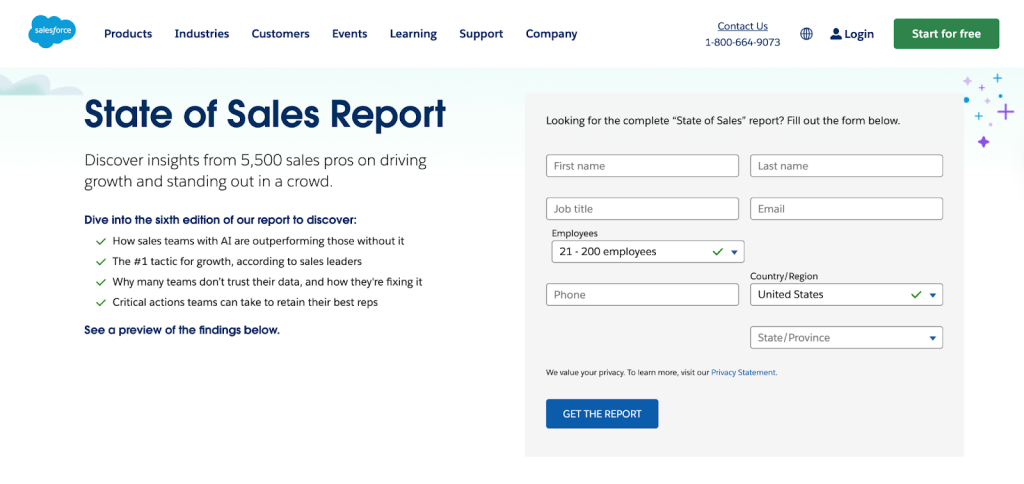
Salesforce is a good example of the research-first model. Its sixth State of Sales report is based on responses from more than 5,500 sellers, which makes it a strong example of how proprietary research can become the seed for multiple content formats and webinar angles.
Here is the playbook behind that model:
Publish a Flagship Asset That Earns Attention.
Original data, benchmark research, and annual reports travel further than generic event promos. They give publishers and partners something worth referencing.
Turn the Research Into Multiple Distribution Formats.
One report can become:
- A guest article
- A stats-led post
- A co-branded discussion
- A webinar topic
- A replay asset
- A follow-up nurture sequence
Use the Webinar as the “Go Deeper” Offer.
This is the part most brands miss.
The webinar should not repeat the article. It should advance the conversation. A reader should feel, “I got the overview here, and now I want the deeper walkthrough live.”
Keep the Asset Working After the Event.
Once the webinar ends, the replay becomes another distribution asset. That extends the campaign life and improves the total return on the original content investment.
You do not need a giant research team to use this model. A small business can do a lighter version with a customer case study, a survey of its own audience, or a sharp expert guide.
That brings us to the final piece.
A strong strategy still needs the right system behind it.
Use Content Syndication for Webinars to Drive Better Signups
Content syndication for webinars works best when you stop treating webinar promotion like a one-channel announcement and start treating it like a distribution system.
The formula is straightforward: create a useful asset, match it to a relevant third-party audience, move readers to a message-matched registration page, and follow up with reminders and post-event content. When that system is in place, registrations tend to feel less forced and much more natural.
In my experience, the strategy gets even stronger when the webinar platform already supports the operational side of the campaign. For instance, tools like WebinarNinja include built-in registration pages, email reminders and follow-ups, and support for live and automated webinars, which make it easier to connect syndication traffic to actual attendance and replay workflows.
If your current challenge is low visibility, not low webinar quality, syndication is one of the smartest places to focus next.
Frequently Asked Questions

How Is Webinar Content Syndication Different From Webinar Promotion?
Webinar promotion is broader and includes email, social media, paid ads, and outreach. Webinar content syndication specifically focuses on third-party distribution.
Does Content Syndication Help Live Webinars Only?
No. It can also drive registrations for on-demand, replay-based, and evergreen webinars.
Which Assets Work Best for Webinar Content Syndication?
Short guides, thought leadership articles, benchmark summaries, checklists, case studies, and expert co-created content usually perform best.
Which Channels Are Best for Content Syndication for Webinars?
The best channels are niche publishers, trusted partners, subject-matter experts, industry communities, and carefully tested paid distribution partners.
How Do I Measure Webinar Content Syndication Performance?
Track cost per lead, registration rate, attendance rate, engagement, and post-webinar conversion to demos, meetings, or sales.
Is Paid Syndication Required to Increase Webinar Signups?
No. Paid syndication can scale faster, but partner distribution, guest content, and niche placements can work very well too.
Can Small Businesses Use Webinar Content Syndication?
Yes. Start with one asset, one narrow audience, one trusted distribution channel, and one message-matched webinar page.
What Is the Difference Between Content Syndication and Content Repurposing?
Syndication means distributing the same content, or a close version of it, to a third-party audience through an external channel. Repurposing means transforming content into a new format for reuse on any channel. Turning your webinar into a blog post is repurposing. Publishing that blog post on an industry newsletter is syndication. The two are not the same, but they work well together.
Want to host a webinar for free?
Use WebinarNinja to teach, improve marketing, and grow your sales.